FAA AC 150/5380-6: Maintenance of Airport Pavements
What FAA AC 150/5380-6C says on airport pavement maintenance: inspection and records, distress types, repair depths and limits, and where drone imagery fits.
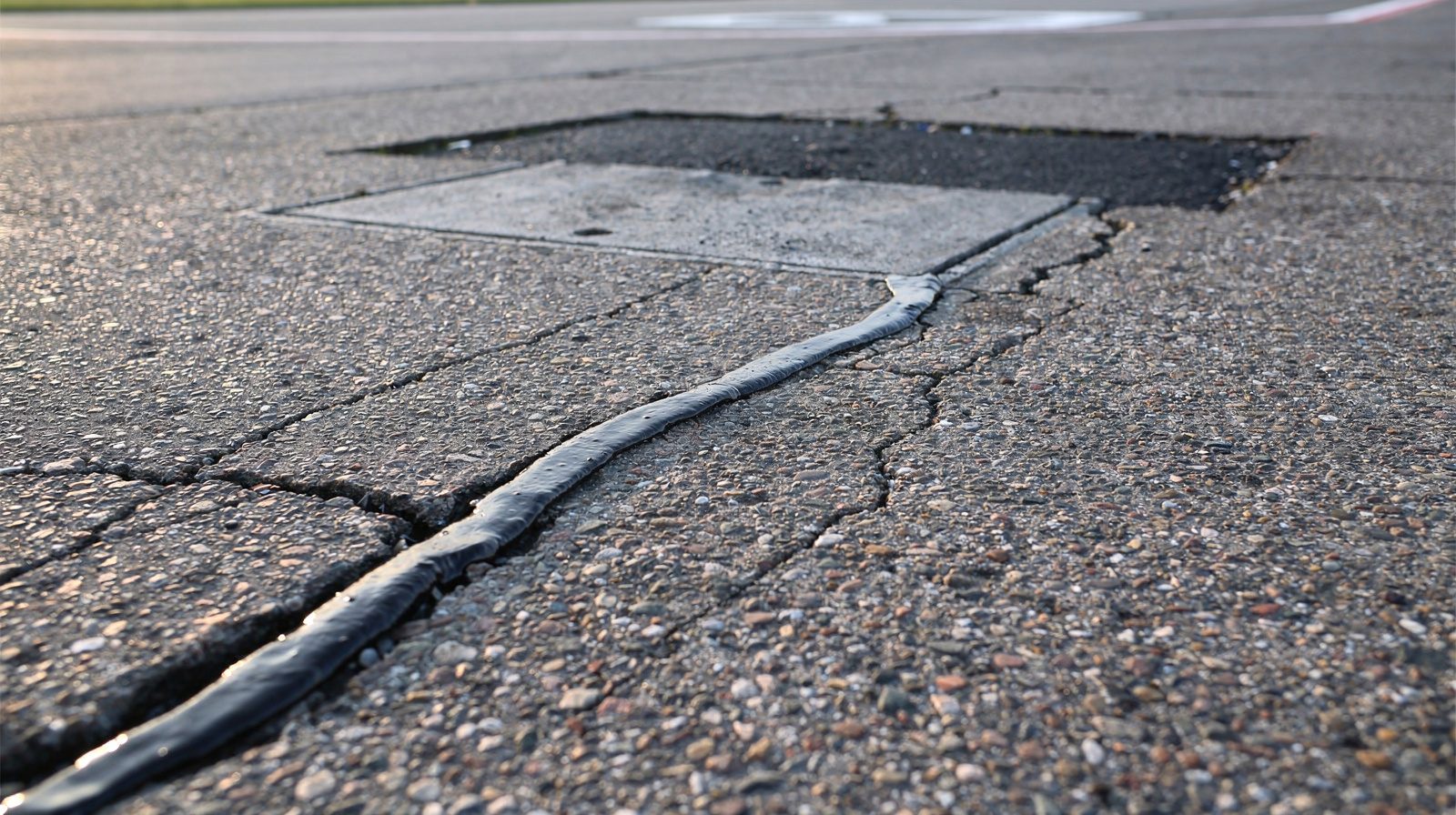
- 01 The Application paragraph calls the circular general guidance, neither binding nor regulatory. The mandatory link runs to AC 150/5370-10, which AIP-funded and PFC-funded maintenance and repair projects must follow for materials and methods.
- 02 Chapter 4 sets no inspection interval. The airport sets its own schedule, adds inspections after severe weather and runs daily drive-by inspections. The yearly detailed inspection comes from AC 150/5380-7B.
- 03 Chapter 3 names the distresses of flexible and rigid pavement and their usual causes. The rating of a distress by type, severity and quantity belongs to ASTM D5340.
- 04 Appendix A gives the repair procedures with their limits, such as a pavement temperature of 50 °F (10 °C) and rising for crack sealing and an ambient 40 °F (4 °C) and rising for concrete repairs.
- 05 The circular never mentions drones. Imagery can locate and size visible surface distress, but friction, load-carrying capacity and the repair itself stay on the ground.
On this page · 10 sections
Pavement design life is the structural life a pavement is designed for. FAA design assumes at least 20 years, provided routine maintenance is done. Preventive maintenance keeps a good pavement good, and rehabilitation restores a declining one. Both delay rapid deterioration and extend useful life, and AC 150/5380-6C covers the maintenance side.
AC 150/5380-6C is the FAA advisory circular on maintaining airport pavement. It is dated 10 October 2014, initiated by AAS-100 and signed by the FAA Director of Airport Safety and Standards. It cancels the 2007 edition, 6B. It names the distresses that occur on flexible and rigid pavement, describes how an airport should inspect and record them, and gives typical repairs for the work a maintenance crew does. It is a maintenance document and not a survey method. The condition rating sits in ASTM D5340 and the programme around it in AC 150/5380-7B.
What the circular is, and who it binds
The Application paragraph, numbered 3 on page i, says the guidelines and procedures “are recommended by the Federal Aviation Administration (FAA) for the maintenance and minor repairs of airport pavements.” It calls the circular general guidance that is “neither binding nor regulatory” and states that “Use of this AC is not mandatory.” For major maintenance projects the airport should use plans and specifications developed under the direction of a pavement design engineer.
One obligation sits beside that. For all maintenance and repair projects funded with federal grant money through the Airport Improvement Program (AIP) and with revenue from the Passenger Facility Charge (PFC) Program, the airport must use the guidelines and specifications for materials and methods in AC 150/5370-10, Standards for Specifying Construction of Airports. So the circular is not what binds. The document it points to is. The introduction to Appendix A repeats the design-engineer and AC 150/5370-10 statements. The FAA lighting circulars phrase their status differently, and the FAA AC 150/5340-26 page shows that case.
The scope is airfield pavement. The Application paragraph adds that maintenance of airport access roads and other non-aeronautical pavements may typically use state highway standards. The circular never mentions 14 CFR Part 139 or drones. It sends the reader to AC 150/5200-18, Airport Safety Self-Inspection, for the operational items of a self-inspection, pavement areas among them (paragraph 4.1).
AC 150/5380-6C at a glance
- Issuer
- Federal Aviation Administration, initiated by AAS-100. Dated 10 October 2014. Cancels AC 150/5380-6B of 28 September 2007.
- Status
- Recommended guidance, neither binding nor regulatory. AC 150/5370-10 materials and methods are required on AIP-funded and PFC-funded maintenance and repair projects (Application paragraph 3, repeated in the introduction to Appendix A).
- Scope
- Maintenance and minor repair of airfield pavements. Larger projects use plans from a pavement design engineer. Access roads and other non-aeronautical pavements may use state highway standards.
- Inspection
- A schedule set by the airport, extra inspections after severe weather, daily drive-by inspections, reports from airport users, and records of distresses, locations, causes and actions (paragraphs 4.2.1 and 4.2.2).
- Distress types
- Flexible: cracking, disintegration, distortion, loss of skid resistance. Rigid: cracking, joint seal damage, disintegration, distortion, loss of skid resistance (paragraph 3.2).
- Repairs
- Quick guides in Tables 6-1 and 6-2 and Appendix A, which holds seven repair procedures (A1 to A3 and A5 to A8) with weather limits and one plan-view figure (A4).
- Linked documents
- ASTM D5340 for the PCI (paragraph 2.4), AC 150/5380-7 for pavement management, AC 150/5320-12 for friction surveys, AC 150/5370-11 for nondestructive testing.
Design life, preventive maintenance and rehabilitation
Paragraph 1.1 says FAA airport pavement design is based on a minimum 20-year structural life, “with the understanding that regular, routine maintenance is performed.” Without that maintenance the pavement may not reach the intended life. AC 150/5320-6G defines the terms more narrowly (paragraph 3.10). Design life is structural life, the total load cycles a pavement structure carries before it fails structurally. Useful life is the time the pavement gives acceptable service, judged by FOD, skid resistance or roughness, and it can outlast structural failure. New pavement on federally funded projects is designed for at least 20 years and rehabilitation projects for at least 10 (paragraphs 3.11.3.2 and 3.11.3.3).
Preventive maintenance. The circular counts preventive and regular or recurring work as maintenance. Paragraph 1.1 lists routine cleaning, filling and sealing of cracks, patching, seal coating, grading pavement edges, maintaining drainage and restoring markings. AC 150/5380-7B says routine maintenance is required to preserve the pavement so that it reaches its design life, and gives yearly crack sealing and daily inspections as examples (paragraph 2.0).
Rehabilitation. AC 150/5380-7B (paragraph 2.0, Figure 1) describes a pavement that performs well for most of its life, reaches a critical condition and then deteriorates rapidly. The ideal time for major rehabilitation is just as the rate of deterioration begins to increase. The years a pavement stays in good condition depend on construction type and quality, use, climate and maintenance. Preserving a pavement in good condition costs four to five times less than rehabilitating one in fair to poor condition, and it increases useful life. A series of preservation treatments postpones rehabilitation and reconstruction, and it closes the pavement for less time than a reconstruction does. The circular asks the airport to compare rehabilitation alternatives over a life cycle, with their future economic consequences as well as the first cost (Chapter 1). The pavement design life and preventive maintenance glossary pages define the terms.
What it says about inspection
Chapter 4 opens with a firm claim. “Adequate and timely maintenance is the greatest single means of controlling pavement deterioration,” paragraph 4.1 says, and it adds that failures of airport pavements can be directly attributed to inadequate maintenance, marked by the absence of a vigorously followed inspection program. Paragraph 1.1 calls early detection and repair of defects “the most important preventive maintenance procedure.” Maintenance cannot overcome a major design or construction inadequacy, but it can prevent total failure.
The chapter then gives few numbers. Paragraph 4.2 asks for scheduled, periodic inspections by experienced engineers, technicians or maintenance personnel, controlled so that each element or feature is thoroughly inspected, with follow-up to be sure the corrective work is done and recorded. Paragraph 4.2.1 makes the airport responsible for the schedule. Conditions such as severe weather may call for extra inspections, and airport personnel should solicit reports from airport users and conduct daily drive-by-type inspections.
All pavement inspections should address foreign object debris (FOD), says paragraph 4.1, because pavement distress can generate loose material that strikes propellers or is ingested into jet engines. AC 150/5210-24 covers FOD management.
Paragraph 4.2.2 sets what the record holds. The airport should keep records of all inspections and maintenance, documenting the existing distresses, their locations, probable causes, remedial actions required and any follow-up. Records of the materials and equipment used go on file too. Drainage has its own rhythm in paragraph 2.3.2. Runway and taxiway edge drains and catch basins should be inspected at intervals, for example in spring, summer, fall and winter, and after unusually heavy rainfall, looking for ponding, eroded ditches, blocked outlets and discoloration of pavement at joints or cracks.
The fixed intervals are elsewhere. AC 150/5380-7B says the pavement management programme should have annual detailed inspections and provisions for less comprehensive daily, weekly and monthly inspections. Federally obligated airports must perform a detailed inspection of airfield pavements at least once a year for the programme. If a PCI survey is performed as set out in ASTM D5340, the interval between detailed inspections may be extended to three years. These programme inspections are in addition to the routine maintenance inspections for operations (paragraphs 1 and 2.4.2, Appendix A-1.2). The ASTM D5340 page covers what that survey is.
The distress types it uses
Chapter 3 sorts distress by surface type and links each to likely causes. Paragraph 3.1 sends the reader to AC 150/5380-7, ASTM D5340 and ASTM D6433 for more on distresses. The groups are these.
Flexible pavement (paragraph 3.2.1). Cracking covers longitudinal and transverse cracks, block cracking, reflection cracking, alligator cracking and slippage cracks. Block cracks divide the pavement into pieces from about 1 ft by 1 ft (0.3 m by 0.3 m) to 10 ft by 10 ft (3 m by 3 m), and alligator pieces are less than 2 ft (0.6 m) on the longest side. Disintegration covers raveling , weathering, potholes, asphalt stripping, jet blast erosion and patching. Distortion covers rutting , corrugation, shoving, depressions and swelling. Loss of skid resistance covers polished aggregate, contaminants, bleeding and fuel or oil spillage.
Rigid pavement (paragraph 3.2.2). Cracking covers longitudinal, transverse and diagonal cracks, corner breaks, durability “D” cracking, shrinkage cracking and shattered slabs. Joint seal damage has its own entry. Disintegration covers scaling, map cracking and crazing, alkali-silica reactivity, joint and corner spalling , blowups, popouts and patching. A small patch is under 5 ft² (0.5 m²) and a large patch over it. Distortion covers pumping and settlement or faulting. Loss of skid resistance covers polished aggregates and contaminants.
Two details matter for anyone who looks at a surface rather than walks it. Paragraph 3.2.1(c) says ruts often become noticeable only after rain, when the wheel paths fill with water, and light depressions are typically noticeable only after a rain. And a corner break differs from a corner spall by depth. The break extends vertically through the whole slab thickness, and the spall intersects the joint at an angle.
The chapter describes. It does not rate. Paragraph 2.4 names ASTM D5340 as the procedure for the Pavement Condition Index , so the rating of a distress by type, severity and quantity is that standard’s job.
How repairs are chosen and carried out
Chapter 6 starts with cause. Paragraph 6.1 says the first step in rehabilitating or preparing a pavement for repair is to identify the causes of distress, so the repair corrects the damage and also prevents or retards its return. Repairs should be made as quickly as possible and at early stages, even when the distress is minor, because delay may let minor distresses progress into major failures. Table 6-1 for flexible pavement and Table 6-2 for rigid pavement then give a quick guide per problem, its repair and its probable cause.
A few lines from the tables show the logic. Cracks in flexible pavement call for removing old sealer, cleaning and preparing the cracks and sealing or resealing them. Alligator cracking calls for removing and replacing the damaged pavement, with the base or subbase if required, and the tables list base or subgrade failure, overload and an under-designed surface course as its probable causes. Bleeding is blotted with sand, and the sand removed before aircraft operations resume. On rigid pavement, a corner break is sealed and maintained until a full depth patch. Cracks are cleaned and sealed, and the table adds evaluating the adequacy of the pavement structure, which may call for strengthening. Popouts call for removing FOD.
Paragraph 6.3.1.1 says shrinkage cracks are non-structural and non-propagating, cosmetic, and typically do not require repair. Paragraph 6.4 allows a broken rigid area to be patched with flexible pavement as an interim measure, but such full-depth HMA repairs are temporary and corrective long-term repairs must be scheduled. The minimum depth of a portland cement concrete repair should be 2 in (5 cm), because thinner repairs usually deteriorate quickly on an airfield pavement.
Appendix A holds the procedures. The seven procedures (A4 is a plan view) each open with the same step: review the construction safety and phasing plan (CSPP) and make sure the closures are in place and all NOTAMs have been issued for the affected areas. Each also has a step to clean the work area before the pavement opens to aircraft, which ties back to FOD.
Appendix A procedures and the limits each one sets
| Procedure | Used for | Temperature and weather limits | Dimensions |
|---|---|---|---|
| A1, crack repair, flexible | Cracks less than 1 in (2.5 cm) wide | Not in inclement weather. Pavement 50 °F (10 °C) and rising, or the manufacturer's limit. No sealant if moisture is seen in the crack | Sealant surface ¼ to ⅜ in (6 to 9 mm) below the pavement surface |
| A2, partial depth, flexible | HMA 5 in (13 cm) or thicker with cracks wider than 1 in (2.5 cm) | HMA not placed on a wet surface or when the underlying course is below 45 °F (7 °C) | Saw cut or mill 24 in (0.6 m) wide and 2 to 3 in (5 to 8 cm) deep, extended at least 12 in (30 cm) beyond the distress |
| A3, full depth, flexible | Full depth repairs and cracks wider than 1 in (2.5 cm) in HMA 5 in (13 cm) or thinner | HMA not placed on a wet surface or when the underlying course is below 45 °F (7 °C) | 24 in (0.6 m) wide to the full HMA depth, extended at least 12 in (30 cm) beyond the distress |
| A5 to A7, full depth, rigid | Corner break, partial slab replacement, full slab replacement | Ambient at least 40 °F (4 °C) and rising, concrete at least 50 °F (10 °C), never above 90 °F (32 °C). Sprinkle adjacent concrete and base above 85 °F (29 °C) | Full-depth saw cuts at least 2 ft (0.6 m) beyond the damage. Dowel holes at least 3 in (8 cm) from the old dowels |
| A8, joint spall, rigid | Joint spalls | Same concrete limits as A5 to A7 | Vertical saw cuts at least 2 in (5 cm) deep and about 3 in (8 cm) beyond the spall. Spall repairs closer than 1½ ft (45 cm) are combined |
Weather also changes which repair works. Paragraph 6.1 says crack filling is more effective in cool, dry conditions, while pothole patches, seal coats and other surface treatments need warm, dry weather. It does not forbid the opposite. It says those repairs need much greater care. An emergency repair made outside the limits is temporary and replaced when conditions allow. Paragraph 5.1 describes normal maintenance as work for a crew of two to six trained people, and work needing more staff is typically beyond its scope.
What a condition survey feeds
The circular treats inspection and the condition survey as two layers of one system. Paragraph 1.1 asks for a maintenance programme that is coordinated, budgeted and systematic, updated every year, with a schedule of inspections and a list of required equipment and products. It notes that AIP grants require many airports to develop and maintain a pavement maintenance-management programme and that the FAA encourages the others to do so.
Paragraph 2.4 describes the pavement management programme (PMP) as a systematic procedure for scheduling maintenance and rehabilitation. It can evaluate present condition, forecast future condition and support a life-cycle cost analysis. Its primary component is the ability to track deterioration and find its cause, using an evaluation that is objective, systematic and repeatable. One such procedure is the PCI. The circular calls the PCI a rating of surface condition that indicates functional performance and says it “may also provide an indication of the pavement’s structural performance.” Repeated PCI determinations on the same pavement show the change over time, and the rate at which distress intensity grows is a good indicator of performance.
The record keeping of paragraph 4.2.2 feeds the same system. AC 150/5380-7B asks an airport to track the routine maintenance it performs, including the types and severities of distresses repaired, the type of work, quantities and cost, to judge which strategies work (paragraph 2.2.1.3). It also warns that changes seen in routine inspections may call for a more detailed PCI survey, because the structural condition of a pavement cannot be determined from a visual inspection alone (paragraph 2.2.1.4). Load-carrying capacity has its own route. Paragraph 2.6 says airports should consider nondestructive testing data and sends the reader to AC 150/5370-11.
Friction is a third route. Paragraph 2.5 sends the reader to AC 150/5320-12 for frequency and procedures of friction surveys, and states that “Visual observations made during a pavement inspection are an inadequate predictor of skid resistance.”
Where a drone survey fits
Chapters 3 and 4 are about what can be seen on the surface and where it is. That part suits aerial imagery. The structural, frictional and repair parts do not. The table sets each task in the circular against both.
What AC 150/5380-6C asks for, and what drone imagery can and cannot supply
| Task | What the circular asks for | What drone imagery can supply | What stays a ground task |
|---|---|---|---|
| Scheduled inspection and records (4.2, 4.2.2) | A schedule set by the airport, with records of distresses, locations, probable causes and actions | Dated images with positions, from which the extent and location of visible distress can be read | The daily drive-by inspections and the judgement of causes, which the circular leaves to experienced personnel |
| Cracking, patching, joint seal and raveling (3.2) | Identify the distress and where it is | Visible cracks, sealant condition, patches, loose aggregate and joint staining, as an input to a walked survey | Probable causes, and any rating that must be signed by an inspector. The PCI procedure belongs to ASTM D5340 |
| Rutting, depressions and faulting (3.2) | Describes ruts, depressions and faulting. Ruts and light depressions are often noticeable only after rain | Ponding and staining seen in the image on a wet day | Depth and elevation difference, which need a measurement |
| FOD from pavement distress (4.1) | Address FOD in every pavement inspection | Loose pieces and broken edges seen on the surface | Sweeping and FOD removal, and the clean-up after repairs |
| Drainage (2.3.2) | Inspect each season and after heavy rain for ponding, erosion, blocked outlets and discoloured joints | Ponding, edge erosion and vegetation at outlets after rain | Subsurface drains, pipes, catch basins and anything underground |
| Friction (2.5) | Friction surveys to AC 150/5320-12. Visual observation is an inadequate predictor | Nothing that replaces a friction measurement | The friction survey itself |
| Load-carrying capacity (2.6) | Consider nondestructive testing data (AC 150/5370-11) | Nothing. Imagery does not see structure | All of it, by nondestructive testing |
| Repair (Chapter 6, Appendix A) | Procedures A1 to A8 with weather limits, quality control and FOD clean-up | A before-and-after image set of the repair area | Cutting, sealing, filling, compaction, curing, temperature checks and the CSPP |
That is the division of labour behind TarmacView’s pavement condition assessment , which is in development and offered as early access. The platform plans the survey flights and captures the imagery, and the software computes a PCI per sample unit following the ASTM D5340 definitions. It is not a certified inspector’s survey and does not replace the inspections of the circular. The runway pavement check page covers the recurring surface check between condition assessments, and the FOD risk from pavement distress page covers the link the circular draws in paragraphs 4.1 and 6.1.
How it compares with the EASA and ICAO texts
The European framework puts pavement maintenance in Regulation (EU) No 139/2014, under ADR.OPS.C.010, Maintenance of pavements, other ground surfaces and drainage. Paragraph (a) says the aerodrome operator shall inspect the surfaces of all movement areas, including pavements (runways, taxiways and aprons), adjacent areas and drainage, to regularly assess their condition as part of an aerodrome preventive and corrective maintenance programme. Paragraph (b) adds duties to avoid and eliminate FOD, prevent harmful irregularities, keep runway friction at or above the minimum standards, inspect and document friction at a frequency that shows the trend, and take corrective action. The AMC and GM add removal of pollutants, drainage checks, surface evenness limits and friction maintenance planning levels. These are requirements, with acceptable means of compliance beneath them.
ICAO Annex 14, Volume I, 9th edition, has the same structure in section 10.2. Paragraph 10.2.1 is a Standard on inspecting the surfaces and monitoring their condition regularly within a preventive and corrective maintenance programme, with the objective of avoiding FOD. Paragraphs 10.2.2 to 10.2.7 are Standards on irregularities and friction. Paragraphs 10.2.8 on visual assessment of ponding and 10.2.9 on taxiway shoulders are Recommendations. Amendment 18, applicable from 27 November 2025, does not list pavement maintenance among its subjects.
The FAA circular differs in kind. It is guidance, not a requirement, and it works at the level of the repair crew. In the texts read for this page, neither ADR.OPS.C.010 nor Annex 14 section 10.2 contains a distress catalogue, a Pavement Condition Index or repair procedures. A US operator finds them in this circular, AC 150/5380-7B and ASTM D5340. The EASA CS-ADR-DSN page and the ICAO Annex 14 page set out the design and operations frameworks in their own terms.
Frequently Asked Questions
- Is AC 150/5380-6C mandatory?
- No. The Application paragraph says the guidelines and procedures are recommended by the FAA, that the circular is neither binding nor regulatory, and that its use is not mandatory. One obligation sits next to it. For all maintenance and repair projects funded through the Airport Improvement Program or the Passenger Facility Charge Program, the airport must use the materials and methods guidelines and specifications in AC 150/5370-10.
- How often must an airport inspect its pavements?
- AC 150/5380-6C gives no interval. Paragraph 4.2.1 makes the airport responsible for a schedule of regular and routine inspections, adds inspections after conditions such as severe weather, and asks for daily drive-by inspections and reports from airport users. The yearly figure is in AC 150/5380-7B. Federally obligated airports must perform a detailed inspection at least once a year, and a PCI survey to ASTM D5340 may extend that to three years.
- Does the circular require a PCI survey?
- No. Paragraph 2.4 describes the Pavement Condition Index as one procedure for tracking deterioration within a pavement management programme and says it is determined under ASTM D5340. The circular itself only recommends maintenance. Whether a survey is needed, and how often, is a matter for AC 150/5380-7B and the airport's own programme, and the PCI does not replace the routine inspections of Chapter 4.
- What are the temperature limits for crack sealing and concrete repair?
- Appendix A sets them per procedure. For crack sealing in flexible pavement, procedure A1 asks for a pavement temperature of 50 °F (10 °C) and rising, or the manufacturer's limit. HMA is not placed when the underlying course is below 45 °F (7 °C). Concrete is not placed unless the ambient temperature is at least 40 °F (4 °C) and rising and the concrete is at least 50 °F (10 °C), and its temperature never exceeds 90 °F (32 °C).
- Does AC 150/5380-6C allow drones for pavement inspection?
- The circular is silent on drones. It asks for scheduled inspections by experienced engineers, technicians or maintenance personnel, with records of distresses, locations, probable causes and remedial actions. Whether imagery from a drone supports that record is for the airport's own programme and its FAA contacts to decide. The circular does not settle it, and it says visual observation is an inadequate predictor of skid resistance.
- How does it compare with ICAO Annex 14 and the EASA rules?
- The EU and ICAO texts are shorter and set outcomes. ADR.OPS.C.010 of Regulation (EU) No 139/2014 and Annex 14 Volume I paragraph 10.2.1 require regular inspection of movement area surfaces as part of a preventive and corrective maintenance programme, and both tie surface maintenance to avoiding FOD. They also cover irregularities and runway friction. Neither text, as read, has a distress catalogue, a PCI or repair procedures. The FAA circular supplies those as guidance.
- What is pavement design life, and how do preventive maintenance and rehabilitation extend it?
- Design life is the period a pavement structure is designed to carry traffic before it fails structurally, and FAA design assumes a minimum of 20 years with regular, routine maintenance (AC 150/5380-6C paragraph 1.1). Preventive maintenance such as crack sealing keeps a pavement in good condition so it can reach that life. Rehabilitation restores a pavement that has declined, and AC 150/5380-7B puts the ideal time for it just as the rate of deterioration begins to increase. Preserving a good pavement costs four to five times less than rehabilitating a fair or poor one.
- How often should runway pavement condition be surveyed?
- At least once a year for a detailed inspection at federally obligated US airports, under AC 150/5380-7B paragraph 2.4.2. A PCI survey to ASTM D5340 may extend the detailed inspection to three years. The programme should also include less comprehensive daily, weekly and monthly inspections, and these sit on top of the routine maintenance inspections for operations. AC 150/5380-6C sets no interval itself.
References
- faa-ac-150-5380-6c
- AC 150/5380-6C, Guidelines and Procedures for Maintenance of Airport Pavements Federal Aviation Administration
- faa-ac-150-5380-7b
- AC 150/5380-7B, Airport Pavement Management Program (PMP) Federal Aviation Administration
- easa-ear-aerodromes
- Easy Access Rules for Aerodromes (Regulation (EU) No 139/2014) European Union Aviation Safety Agency
- icao-annex-14-vol-1
- Annex 14 to the Convention on International Civil Aviation, Volume I, Aerodrome Design and Operations International Civil Aviation Organization
- faa-ac-150-5320-6g
- AC 150/5320-6G, Airport Pavement Design and Evaluation Federal Aviation Administration