What is Bandwidth in Electronics?
Bandwidth – Range of Frequencies (Electronics)
Definition
Bandwidth in electronics quantifies the range of frequencies an electronic system, component, or channel can transmit, amplify, or process while maintaining reliable performance. Expressed in hertz (Hz), bandwidth is the difference between the upper and lower cut-off frequencies, often the -3 dB points, where the output amplitude or power falls to a specified threshold (typically 70.7% of the maximum for amplitude, or half-power for power). This definition is standardized by international bodies such as the IEC and ITU.
Mathematically:
[ \text{Bandwidth (BW)} = f_2 - f_1 ]
where:
- ( f_1 ) = lower cut-off frequency
- ( f_2 ) = upper cut-off frequency
Bandwidth is pivotal in analog and digital electronics, RF engineering, and telecommunications. It dictates how much information a system can handle and how faithfully signals are reproduced.
Key Concepts and Standards
- 3 dB Bandwidth: The internationally accepted standard for defining bandwidth, representing the range where system response is within -3 dB of its maximum.
- Frequency Range vs. Bandwidth: Frequency range is the absolute span (from lowest to highest frequency), bandwidth is always the difference between two cut-off points.
- Physical & Technical Limits: Parasitic capacitance/inductance, material losses, and impedance mismatches all reduce practical bandwidth.
- Applications: From audio amplifiers (20 Hz–20 kHz) to high-speed digital data (hundreds of MHz or GHz), each application’s requirements and limitations differ.
Practical Analogies
- Radio Tuning: A radio’s selectivity (ability to isolate a station) depends on the bandwidth of its filter circuit, narrow bandwidth isolates signals, wide bandwidth admits more.
- Highway Analogy: Bandwidth is like the width of a highway, wider highways (more bandwidth) allow more traffic (signals/data) to pass simultaneously.
Frequency Response and Bandwidth Visualization
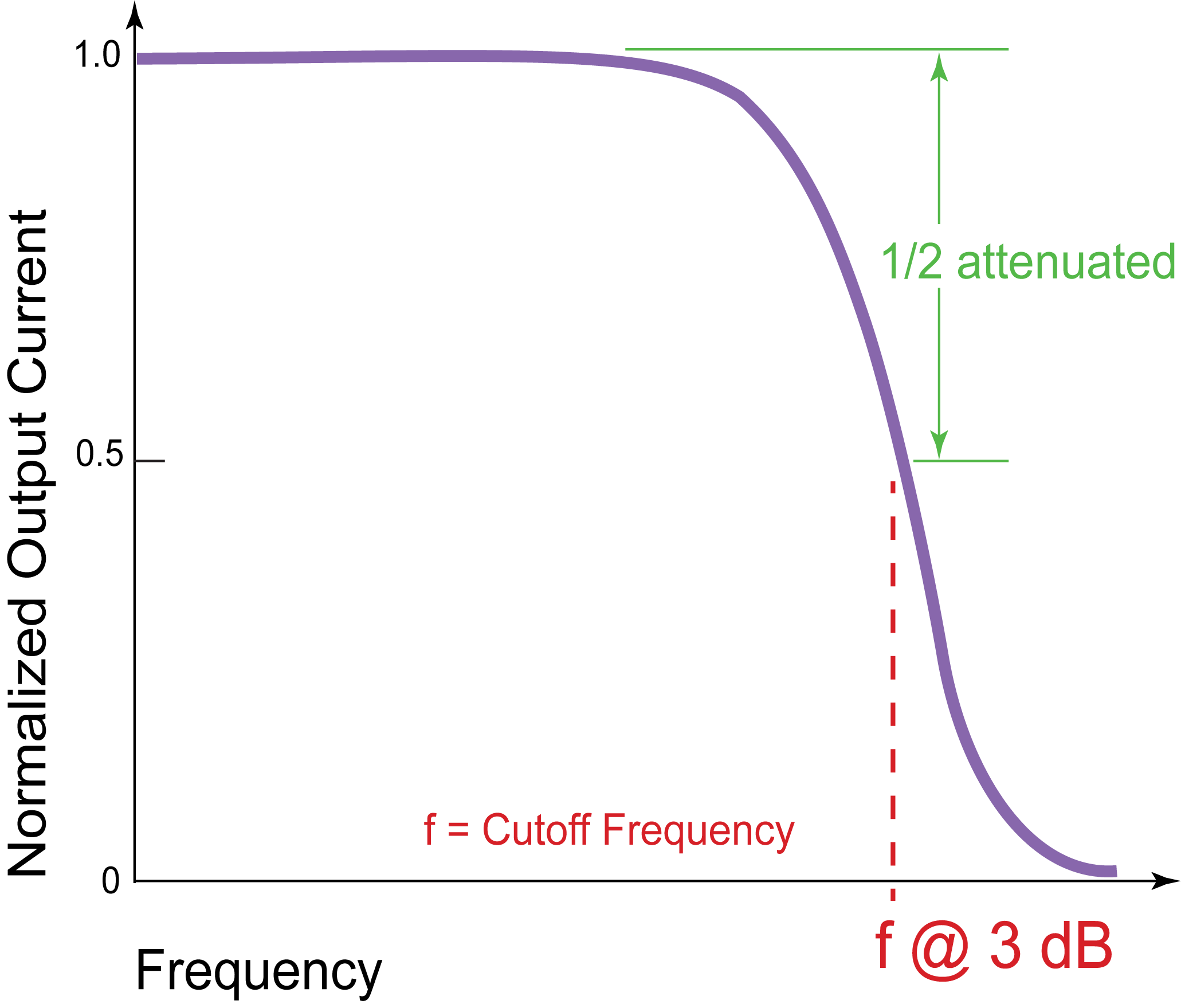
Frequency response curve showing the -3 dB bandwidth region between cut-off frequencies.
The bandwidth is visually the width of this curve at the -3 dB level.
Measurement and Formulas
Basic Measurement Steps
- Apply a sinusoidal signal across the frequency range.
- Measure output amplitude/gain at each frequency.
- Find frequencies where output drops to 70.7% of peak (-3 dB).
- Subtract to find bandwidth: ( BW = f_2 - f_1 ).
Common Formulas
- Amplifiers/Filters:
( BW = f_2 - f_1 ) - Resonant Circuits (RLC):
( Q = \frac{f_r}{BW} ), ( BW = \frac{f_r}{Q} ) - Digital Systems (Rise Time): ( BW \approx \frac{0.35}{t_r} )
Applications
Amplifiers
- Audio: Must cover 20 Hz–20 kHz for hi-fi, limited bandwidth dulls sound.
- Op-Amps: Gain-bandwidth product (GBW) defines frequency for unity gain.
Filters
- Low-pass, High-pass, Band-pass: Bandwidth defines the passband or stopband width.
Resonant Circuits
- Radio Tuners: Selectivity depends on bandwidth.
- Impedance Matching: Wide bandwidth ensures efficient power transfer in RF/microwave.
High-Speed Digital
- Data Transmission: Higher bandwidth = higher possible data rates.
- PCB Design: As data rates rise, traces become bandwidth-limited transmission lines.
Example:
A digital signal with 1 ns rise time needs ≈350 MHz bandwidth for clean edges.
Graphical Representations
- Bode Plot: Gain vs. frequency (log scale), with -3 dB points marking bandwidth.
- Impedance vs. Frequency: Resonant circuits show bandwidth as width at -3 dB around the resonance.
- Square Wave Harmonics: Limited bandwidth rounds edges, losing higher harmonics.
Common Misconceptions
- Bandwidth ≠ Frequency Range: It’s the difference between cut-off frequencies.
- BW ≈ 0.35/tr Only for Simple Cases: This applies mainly to single-pole RC-limited systems.
- Digital ≠ Infinite Bandwidth: Practical systems only transmit as many harmonics as the channel supports.
- Channel vs. Signal Bandwidth: Often, the channel limits system performance, not the signal.
Practical Trade-Offs
- Gain vs. Bandwidth: Increasing amplifier gain reduces bandwidth.
- Limiting Factors: Parasitics, material losses, impedance mismatches, physical length, etc.
- Measurement Tools: Oscilloscope and signal generator for analog, network analyzer for RF/microwave.
| Application | Typical Bandwidth Requirement |
|---|---|
| Audio | 20 Hz – 20 kHz |
| Video | Several MHz |
| RF/Microwave | 100s MHz – GHz |
| Digital | Determined by rise time/data rate |
Example Calculations
- Amplifier: ( f_1 = 200,Hz, f_2 = 20,000,Hz ) ⇒ BW = 19,800 Hz
- Resonant Circuit: ( f_r = 28,MHz, Q = 80 ) ⇒ BW = 350 kHz
- Digital Rise Time: ( t_r = 1,ns ) ⇒ BW ≈ 350 MHz
International Standards and Aviation
Bandwidth is regulated to ensure interference-free operation in aviation and telecom. The International Civil Aviation Organization (ICAO) and ITU allocate and govern channel bandwidths for safety and spectrum management.
Cross-References
| Term | Definition |
|---|---|
| Gain | Ratio of output to input amplitude, measured in voltage, current, or power. |
| Cut-off Frequency | Frequency where system response drops to -3 dB of maximum. |
| Frequency Response | Variation of output amplitude or phase as a function of input frequency. |
| Signal-to-Noise Ratio | Measure of desired signal strength relative to noise. |
| Data Rate | Amount of data transmitted per unit time, limited by bandwidth. |
| Q Factor | Ratio of resonant frequency to bandwidth in a resonant circuit. |
| Passband | The range of frequencies a system allows to pass with minimal attenuation. |
| Channel Capacity | Maximum information rate a channel can support, governed by bandwidth and noise. |
Further Reading
- IEC 60050-702: International Electrotechnical Vocabulary
- ITU-T G.1010: Quality of Service Requirements
- Shannon–Hartley Theorem
- ICAO Annex 10, Volume I: Aeronautical Telecommunications
Bandwidth is a foundational concept in electronics, underlying the design, operation, and regulation of systems from audio amplifiers to global telecommunication networks. Whether you’re designing a high-fidelity sound system, a radio receiver, or a high-speed digital interface, understanding bandwidth is essential for achieving optimal system performance.
Frequently Asked Questions
- What is bandwidth in electronics?
- Bandwidth in electronics is the numerical range between the lower and upper frequencies (cut-off points) where a system’s output remains within a specified performance threshold, typically measured at the -3 dB points. It determines how much of the frequency spectrum a system can transmit or process accurately and is expressed in hertz (Hz).
- Why is -3 dB used to define bandwidth?
- The -3 dB point corresponds to a 50% reduction in output power (or approximately 70.7% of the maximum amplitude), providing a consistent and internationally recognized threshold for measuring the effective operating range of electronic systems. This standardization enables reliable comparison across different devices and applications.
- How do you measure bandwidth?
- To measure bandwidth, apply a variable-frequency signal to the system, record the output amplitude across frequencies, and identify the frequencies where the response drops to 70.7% (or -3 dB) of its maximum. The bandwidth is the difference between these two frequencies. Specialized tools like network analyzers are often used in high-frequency or complex systems.
- What is the relationship between bandwidth and data rate?
- A greater bandwidth allows for higher data rates because it enables a system or channel to transmit more information per unit time. In digital communications, the channel bandwidth and signal-to-noise ratio together determine the theoretical maximum data rate, as described by the Shannon–Hartley theorem.
- How does bandwidth affect audio quality?
- In audio electronics, sufficient bandwidth (typically 20 Hz–20 kHz for human hearing) ensures accurate reproduction of all audible frequencies. Insufficient bandwidth leads to loss of low or high frequencies, resulting in dull or tinny sound.
This is a reference entry. TarmacView provides drone inspection services and doesn't sell the equipment or materials described in this glossary.