What is gain (amplification factor) in electronics?
Definition and Core Concept
Gain (amplification factor) is a fundamental parameter in electronics that quantifies how much an amplifier increases the strength of an input signal. It is defined as the ratio of an output signal (voltage, current, or power) to its corresponding input signal:
[ \text{Gain} = \frac{\text{Output Quantity}}{\text{Input Quantity}} ]
Gain is dimensionless and can refer to voltage, current, or power, depending on the application. For example, a voltage gain of 10 means the output voltage is 10 times the input voltage.
Amplifiers, such as those in audio equipment, radio receivers, and measurement systems, rely on gain to boost weak signals into usable ranges. The actual value of gain is influenced by circuit topology, component values, feedback, and the properties of active devices (like transistors or operational amplifiers).
In practice, gain is not just about raw amplification, it also affects signal fidelity, noise, and stability. Excessive gain can introduce distortion or instability, while insufficient gain may leave signals too weak for further processing.
In summary: Gain is the numerical factor by which an amplifier increases the amplitude of an input signal, forming the foundation of signal processing in electronic systems.
How Gain Is Used in Electronics
Gain is central to the functionality of a vast array of electronic systems. It ensures that signals from sources like sensors, microphones, or antennas are strong enough for processing, measurement, or driving actuators.
Audio Systems:
Microphone preamplifiers and instrument amplifiers use gain to boost low-level signals (often microvolts or millivolts) to line-level (about 1 volt), making them suitable for recording or playback.
Sensor Interfaces:
Sensors like thermocouples, strain gauges, or photodiodes generate minute signals that must be amplified. Signal conditioning amplifiers with carefully controlled gain bring these signals into a measurable range.
Communication Systems:
Low-noise amplifiers (LNAs) at the receiver front-end increase weak radio signals before further processing. Power amplifiers at the transmitter end ensure signals are strong enough to be transmitted over long distances.
Test and Measurement Equipment:
Oscilloscopes, spectrum analyzers, and data acquisition systems use adjustable gain stages to handle signals of varying amplitudes, ensuring accuracy and visibility.
Feedback Control Systems:
Amplifiers provide the necessary gain for control signals to drive actuators (motors, valves, etc.) in automation and robotics.
Gain is also key in filtering, mixing, and modulation circuits, affecting everything from audio mixing consoles to RF transmitters.
Types of Gain
Gain is classified based on the signal parameter being amplified:
| Type of Gain | Definition | Formula | Units |
|---|---|---|---|
| Voltage Gain ((G_v)) | Output voltage / Input voltage | ( G_v = \frac{V_{out}}{V_{in}} ) | None |
| Current Gain ((G_i)) | Output current / Input current | ( G_i = \frac{I_{out}}{I_{in}} ) | None |
| Power Gain ((G_p)) | Output power / Input power | ( G_p = \frac{P_{out}}{P_{in}} ) | None |
- Voltage Gain: Most common, vital in audio, instrumentation, and signal processing.
- Current Gain: Important in transistor amplifiers (e.g., BJT’s β or h_FE).
- Power Gain: Critical in RF and communications systems.
Other related measures include transresistance ((R_m = V_{out}/I_{in})) and transconductance ((G_m = I_{out}/V_{in})), often used in operational and integrated circuits.
Formulas and Units
Basic Gain Formulas
- Voltage Gain:
[ G_v = \frac{V_{out}}{V_{in}} ] - Current Gain:
[ G_i = \frac{I_{out}}{I_{in}} ] - Power Gain:
[ G_p = \frac{P_{out}}{P_{in}} ]
Op-Amp Gain Examples
- Non-Inverting Amplifier:
[ G = 1 + \frac{R_2}{R_1} ] - Inverting Amplifier:
[ G = -\frac{R_2}{R_1} ] (negative sign indicates 180° phase inversion)
Decibel (dB) Representation
- Voltage Gain (dB):
[ 20\log_{10}\left(\frac{V_{out}}{V_{in}}\right) ] - Power Gain (dB):
[ 10\log_{10}\left(\frac{P_{out}}{P_{in}}\right) ]
This logarithmic scale simplifies calculations for cascaded stages and is standard in audio and RF design.
Amplifier Circuits and Practical Examples
Amplifiers are practical realizations of gain. The most basic form is a single-stage transistor or op-amp circuit. More complex systems cascade multiple stages for higher gain.
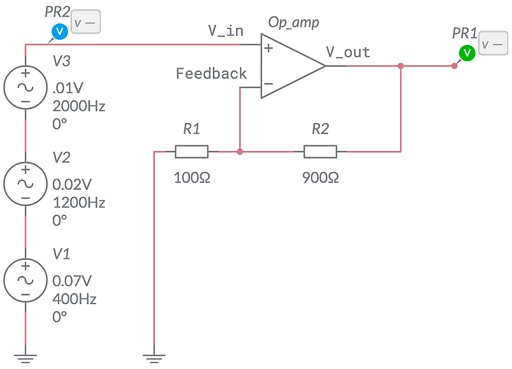
Non-Inverting Op-Amp Amplifier
A popular configuration for its high input impedance and precise, feedback-controlled gain.
[ G = 1 + \frac{R_2}{R_1} ]
Example:
If (R_1 = 100,\Omega) and (R_2 = 900,\Omega), gain (G = 10). An input of 0.1 V yields an output of 1 V.
Other Op-Amp Circuits
- Inverting Amplifier:
Provides gain with phase inversion. - Differential Amplifier:
Amplifies the difference between two inputs. - Integrator:
Outputs a signal proportional to the integral of input.
Selecting appropriate resistors tailors the gain for your needs. Always consider input/output impedance, bandwidth, and noise.
Decibel (dB) Representation
The decibel is a logarithmic unit used to express ratios such as gain or attenuation. It compresses a wide range of values and simplifies calculations for cascaded systems.
Key Formulas
- Voltage Gain (dB):
[ 20 \cdot \log_{10}\left(\frac{V_{out}}{V_{in}}\right) ] - Power Gain (dB):
[ 10 \cdot \log_{10}\left(\frac{P_{out}}{P_{in}}\right) ]
Conversion Table
| dB | Voltage Gain Ratio | Approx. Multiple |
|---|---|---|
| 3 | ≈ 1.41 | √2 |
| 6 | ≈ 2.00 | |
| 10 | ≈ 3.16 | |
| 20 | 10.00 | |
| 40 | 100.00 | |
| 60 | 1000.00 |
Special references:
- dBV: 1 V RMS reference
- dBm: 1 mW (typically into 600 Ω)
The dB scale is invaluable for system designers, allowing simple addition/subtraction of gains or losses in cascaded stages.
Feedback Circuits and Gain Control
Feedback is crucial for setting and stabilizing gain in amplifiers, especially op-amps.
Negative Feedback
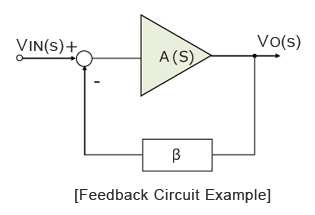
Negative feedback routes a portion of the output back to the input in opposition to the incoming signal.
[ \frac{V_{out}}{V_{in}} = \frac{A_{open}}{1 + \beta A_{open}} ]
- (A_{open}): Open-loop gain
- (\beta): Feedback factor (set by resistor values)
With high (A_{open}), closed-loop gain depends mainly on resistor values, not device characteristics, ensuring stability and predictability.
Benefits of Negative Feedback:
- Stable, predictable gain
- Lower distortion and noise
- Wider bandwidth
- Controlled input/output impedance
Negative feedback is a cornerstone of nearly all modern amplifier and signal processing circuits.
Key Parameters Affecting Gain
Several factors influence practical gain in electronic circuits:
Open-Loop Gain
- The maximum possible gain without feedback
- Op-amps typically have very high open-loop gain (e.g., 100,000×)
- Varies with frequency and device/process variations
Bandwidth
- Frequency range where gain remains within 3 dB of its nominal value
- Gain-bandwidth product (GBWP): Higher gain usually means lower bandwidth
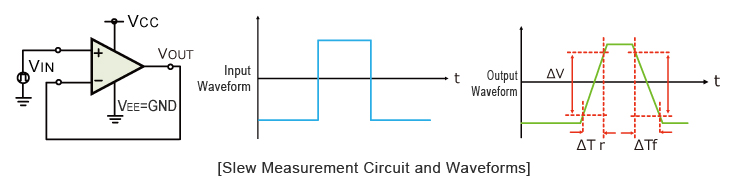
Slew Rate (SR)
- Maximum rate of output voltage change (V/μs)
- Limits accurate reproduction of rapid or high-frequency signals
Input Offset Voltage
- Small voltage required between inputs to produce zero output
- Affects precision, especially in high-gain, low-signal applications
Noise and Distortion
- Higher gain can amplify noise and introduce distortion if not properly managed
- Good design balances gain, bandwidth, and noise performance
Real-World Applications
- Audio Amplifiers: Microphone preamps, instrument amps, mixing consoles
- Instrumentation: Signal conditioning for sensors (thermocouples, strain gauges)
- Communications: RF amplifiers, IF stages, satellite receivers
- Measurement: Oscilloscopes, data acquisition systems, medical devices
- Industrial Control: Actuator drivers, feedback loops, analog computation
In each case, the correct gain setting is essential for reliable, high-quality operation.
Summary
Gain is the amplification factor by which an electronic circuit increases the amplitude of an input signal. It is central to all amplifier designs and is measured as the ratio of output to input for voltage, current, or power. Expressed as a simple ratio or in decibels, gain determines a circuit’s ability to process, transmit, or measure signals effectively.
Understanding and controlling gain is critical for optimizing signal quality, minimizing noise and distortion, and achieving the desired performance in audio, sensor, communications, and measurement systems.
Further Reading
- “The Art of Electronics” by Horowitz & Hill
- IEEE Standard 1057: IEEE Standard for Digitizing Waveform Recorders
- IEC 60268: Sound system equipment, Part 3: Amplifiers
For deeper dives, consult electronics textbooks, amplifier datasheets, and application notes from major semiconductor manufacturers.
Frequently Asked Questions
- What is gain in electronics?
- Gain is a ratio that describes how much an electronic circuit (such as an amplifier) increases the strength of an input signal. It is the output divided by the input, and may refer to voltage, current, or power. Gain enables weak signals from sensors, microphones, or antennas to be amplified for further processing.
- How is gain different from amplification?
- Gain is the numerical value (or ratio) describing the degree of amplification, while amplification refers to the process itself. Gain quantifies how much an amplifier increases a signal’s amplitude.
- What are the main types of gain?
- The three primary types are voltage gain (output voltage/input voltage), current gain (output current/input current), and power gain (output power/input power). Each is suited to different circuit types and applications.
- Why is gain important in audio and sensor systems?
- Audio and sensor signals are often very weak and need to be amplified to line level or a measurable range. Proper gain ensures signals are readable, clear, and strong enough for further processing, recording, or actuation.
- What does gain in decibels (dB) mean?
- Decibels (dB) express gain on a logarithmic scale, making it easier to represent large ratios and sum multiple amplifier stages. For voltage gain: dB = 20 × log10(Vout/Vin). For power gain: dB = 10 × log10(Pout/Pin).
- How is gain set in an op-amp circuit?
- In operational amplifier circuits, gain is set using external resistors. For a non-inverting configuration, gain = 1 + (R2/R1), for an inverting configuration, gain = –(R2/R1).
- What is negative feedback and its effect on gain?
- Negative feedback involves feeding a portion of the output back to the input in opposition to the signal. This stabilizes and precisely sets the gain, reduces distortion, improves bandwidth, and suppresses noise.
- What factors affect the actual gain of an amplifier?
- Key factors include the open-loop gain of the active device, negative feedback, resistor accuracy, bandwidth limitations, slew rate, and temperature drift. Practical circuits use feedback and careful design to achieve stable, predictable gain.
This is a reference entry. TarmacView provides drone inspection services and doesn't sell the equipment or materials described in this glossary.