What is Switching – Opening and Closing of Circuits?
Switching – Opening and Closing of Circuits in Electrical Systems
Switching, the deliberate opening and closing of electrical circuits, is a fundamental principle that underpins the operation, safety, and automation of virtually all electrical and electronic systems. Whether you press a light switch at home, operate complex avionics in an aircraft, or manage power in an industrial plant, you are engaging with the concepts and mechanisms of switching.
What is Switching? Understanding the Basics
At its core, switching is the process of either interrupting or completing an electrical pathway. This is accomplished using devices like mechanical switches, relays, or circuit breakers, which can be operated manually, automatically, or remotely. In critical sectors like aviation and industry, the act of switching is governed by rigorous standards to ensure reliability, safety, and system continuity.
- Opening a circuit (breaking the path) stops the flow of current.
- Closing a circuit (completing the path) enables current to flow and devices to operate.
Switching is not only about turning things on or off, it enables diagnostics, system redundancy, emergency isolation, and safe maintenance.
An open circuit (left) vs a closed circuit (right) in a simple lamp circuit.
Core Circuit States: Open, Closed, and Short Circuits
Understanding how circuits behave in different states is essential for safe and effective system design.
Open Circuit
An open circuit has an intentional or accidental break in the electrical path. No current flows, and all supply voltage appears across the open points.
- Intentional: Using a switch, fuse, or breaker to isolate part of a system.
- Unintentional: Broken wires, loose connections, or failed components.
- In Aviation: Open circuits are quickly detected and isolated by monitoring systems to ensure safety and continuity.
Closed Circuit
A closed circuit provides a continuous path for current to flow from the source through the load and back. This is the normal operating state for most systems.
- Current flows according to Ohm’s Law: I = V/R.
- Design Considerations: Voltage drop, resistance of connections, and compatibility.
- In Avionics: Closed circuits power displays, lighting, and control actuators, with redundancy for critical functions.
Short Circuit
A short circuit is an unintended low-resistance connection that bypasses the intended load, causing excessive current.
- Causes: Damaged insulation, chafed wires, or conductive contamination.
- Hazards: Overheating, component damage, fire.
- Prevention: Protective devices (fuses, breakers) and strict wiring standards.
| Circuit State | Resistance | Current Flow | Voltage Drop | Example Use/Occurrence |
|---|---|---|---|---|
| Open Circuit | Infinite (∞ Ω) | None (0 A) | Full supply voltage | Light switch off, blown fuse |
| Closed Circuit | Finite (R > 0 Ω) | As per Ohm’s Law | Across components | Light switch on, appliances |
| Short Circuit | Near zero (≈ 0 Ω) | Excessive (very high) | Near zero | Wire bridges battery, fault |
Types of Switches: Choosing the Right Control
Switches come in many forms, each suited to particular applications and control logic.
Normally Open (NO) Switch
A normally open (NO) switch is open by default, no current flows until the switch is actuated.
- Use Cases: Start buttons, cockpit momentary switches.
- Operation: Pressing or actuating the switch closes the contacts and starts current flow.
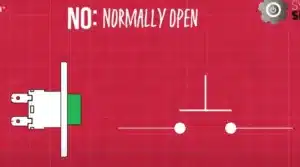
A normally open switch: current only flows when actuated.
Normally Closed (NC) Switch
A normally closed (NC) switch is closed by default, current flows until the switch is actuated, which opens the contacts and stops the current.
- Use Cases: Emergency stop (E-stop), safety interlocks, fail-safe controls.
- Operation: Pressing or actuating the switch opens the circuit, halting operation.
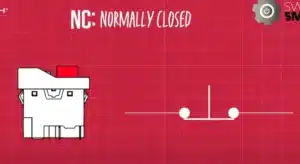
A normally closed switch: current flows until the switch is actuated.
Other Key Types
- Toggle Switches: Latching on/off, used for lighting or master power.
- Pushbutton Switches: Momentary contact, used for resets, tests, or communication.
- Rotary Switches: Selects between multiple circuits or settings, common in avionics.
- Relays: Electrically operated switches for remote or automated control, vital for system automation and isolation.
| Feature | Normally Open (NO) | Normally Closed (NC) |
|---|---|---|
| Default State | Open (no current flows) | Closed (current flows) |
| Actuation Effect | Closes circuit | Opens circuit |
| Typical Use | Start, momentary actions | Safety, emergency shutdown |
The Physics: Current, Resistance, and Voltage
Ohm’s Law governs all circuit behavior:
- Closed circuits: Current flows as I = V/R.
- Open circuits: R → ∞, so I = 0.
- Short circuits: R ≈ 0, so I spikes dangerously high.
Engineers use these principles to design safe, efficient systems, sizing wires, specifying switches, and ensuring compatibility.
Analogy: Water in Pipes
- Closed circuit: A closed loop of pipe, water (current) flows freely.
- Open circuit: A valve is shut, water stops.
- Short circuit: A leak or bypass, water escapes uncontrollably.
Real-World Applications
Household
- Light switches: Open/close circuits to control lighting.
- Circuit breakers: Protect against overloads/shorts, can be reset.
- Appliance interlocks: NC switches prevent operation when doors are open.
An open switch disconnects the bulb from power, creating an open circuit.
Industrial and Safety
- Emergency stops (E-stop): NC switches cut power instantly for safety.
- Control panels: Multiple switches, relays, and indicators manage complex processes.
- Machine interlocks: Prevent operation unless guards are in place.
Aviation
- Cockpit switches: Control navigation, lights, and critical systems.
- Redundant switching: Ensures backup pathways for power and control.
- Protective relays and breakers: Prevent faults from propagating.
Switches and Safety: Standards and Best Practices
Stringent standards from organizations like ICAO, SAE, and IEC define requirements for switch reliability, redundancy, and fail-safe operation, especially in aviation and industrial contexts. Best practices include:
- Redundancy: Multiple switches or pathways for critical systems.
- Status indication: Lights or panels confirm if a circuit is open or closed.
- Regular inspection: Prevents faults from vibration, corrosion, or wear.
- Automated health monitoring: Built-in test equipment (BITE) for rapid fault detection.
Advanced Switching: Automation and Remote Control
Modern systems often use relays or solid-state switches, enabling central or remote control, rapid automation, and integration with software-defined logic. This allows for:
- Centralized monitoring from a control panel or cockpit.
- Automatic isolation of faulty sections.
- Complex sequencing for system startup, operation, and shutdown.
In Summary
Switching, the art and science of opening and closing electrical circuits, is the backbone of control, safety, and automation in all electrical systems. Whether in a jetliner, a factory, or your home, the principles remain the same: reliable switching enables safe, efficient, and flexible operation.
Understanding the types of switches, the behavior of open/closed/short circuits, and the standards for safe operation is essential for engineers, operators, and anyone working with electricity.
Industrial automation relies on robust switching for system safety and control.
Further Reading
- International Civil Aviation Organization (ICAO) Electrical Standards
- SAE Aerospace Standards for Electrical Systems
- IEC 60947 – Low-voltage Switchgear and Controlgear
- Basic Electrical Theory – Electronics Tutorials
Switch confidently, design safely, and keep your systems running with the right switching solutions.
Frequently Asked Questions
- What is meant by switching in electrical circuits?
- Switching refers to the intentional action of opening (interrupting) or closing (completing) an electrical circuit, which either stops or allows the flow of current. This is achieved using devices like switches, relays, and circuit breakers, and is fundamental for controlling, protecting, and automating electrical systems.
- What is the difference between open, closed, and short circuits?
- An open circuit has a break in the path, causing current flow to stop. A closed circuit has a complete path, allowing current to flow as intended. A short circuit is an unintended low-resistance connection, causing excessive current and potential damage.
- Why is switching important in aviation and industrial systems?
- Switching ensures reliable control over critical systems, enables safe isolation of faulty components, supports redundancy, and provides the means for emergency shutdowns or reconfigurations as required by strict safety standards like those from ICAO.
- What are normally open and normally closed switches?
- A normally open (NO) switch is open by default and closes to allow current flow when actuated. A normally closed (NC) switch is closed by default and opens to interrupt current flow when actuated. They serve different control and safety functions in circuits.
- How are short circuits detected and prevented?
- Short circuits are detected by monitoring abnormal current surges using protective devices like fuses and circuit breakers. Prevention involves proper insulation, secure wiring, and regular maintenance according to industry standards.
This is a reference entry. TarmacView provides drone inspection services and doesn't sell the equipment or materials described in this glossary.