What is Correlated Color Temperature (CCT)?
Correlated Color Temperature (CCT) in Aviation and Lighting
Definition and Scientific Foundation
Correlated Color Temperature (CCT) is a standardized metric that describes the appearance of white light, expressed in Kelvin (K). It represents the temperature at which a blackbody radiator emits light of a color most closely matching that of the light source. CCT conveys the “warmth” (yellowish-red, low Kelvin) or “coolness” (bluish, high Kelvin) of white light, which is essential in specifying, comparing, and regulating lighting systems, particularly in safety-critical aviation environments.
While traditional light sources like incandescent lamps emit spectra resembling blackbody radiation, most modern aviation lighting (LEDs, fluorescent, HID) does not. Nonetheless, CCT provides a practical reference by linking their chromaticity to a theoretical blackbody, enabling uniform communication of color appearance across technologies.
Aviation regulations, such as those from the International Civil Aviation Organization (ICAO), define CCT and chromaticity requirements for various lighting systems (runways, taxiways, terminals) to promote visual clarity and operational safety.
Blackbody Radiation, Chromaticity, and the Planckian Locus
Blackbody radiation forms the scientific basis for color temperature. As a blackbody’s temperature rises, its emitted light transitions from red (low K) to white to blue (high K). This progression is mapped on a chromaticity diagram as the Planckian locus, which serves as the reference for specifying CCT.
Light sources not emitting true blackbody spectra (such as LEDs or discharge sources) are assigned a CCT based on the closest visible match, the shortest distance from their chromaticity coordinates to the Planckian locus in CIE color space.
ICAO standards reference specific chromaticity boundaries and tolerances to ensure that airfield and aviation lighting not only falls within prescribed CCT ranges but also does not deviate excessively (measured as duv) from the ideal blackbody appearance. This is vital for ensuring that pilots and ground crews interpret light signals correctly in all conditions.
Measurement Methods, Instruments, and Standards
CCT is measured in Kelvin using precision instruments:
- Spectroradiometers: Analyze the spectral power distribution of a light source, calculate chromaticity coordinates, and determine the CCT by reference to the Planckian locus.
- Colorimeters: Simpler devices used for routine checks, but less precise than spectroradiometers.
Aviation standards (e.g., ICAO Annex 14, Doc 9157) specify measurement protocols, including instrument calibration, ambient condition control, and viewing geometry. Manufacturers “bin” LEDs by CCT and chromaticity to ensure consistency and compliance.
Typical aviation lighting CCT ranges:
- Runway/Taxiway lighting: 4000–6500K (often 6000K ±300K)
- Terminal/interior spaces: 2200–4000K, depending on area function
- Aprons/Hangars: 5000–6500K for maximum visibility
Visual Appearance of CCT: Aviation-Specific Ranges and Examples
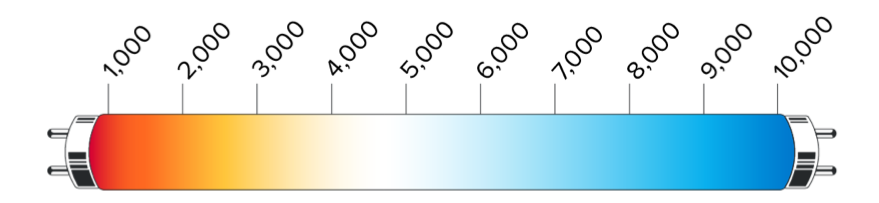
The CCT value strongly affects the visual impression and operational suitability of lighting:
| CCT (Kelvin) | Appearance | Aviation Application | Example Source |
|---|---|---|---|
| 1800–2200K | Ultra-warm, amber | Accent, historic terminals | Incandescent/amber LED |
| 2200–2700K | Warm, yellowish | Lounges, hospitality | Warm white LED |
| 2700–3500K | Soft, inviting | VIP areas, terminals | Halogen, residential LED |
| 3500–4100K | Neutral white | Offices, security, retail | Fluorescent, LED |
| 4100–5000K | Cool white, daylight-like | Hangars, towers, workspaces | Daylight LED, T8/T5 |
| 5000–6500K | Crisp, blue-white, high alert | Aprons, runways, maintenance | Outdoor LED, HID |
| 6500K+ | Very cool, blue-tinted | Specialty, display, airfield lighting | Specialty LED/tube |
Aviation Example:
Apron floodlights at 5500K enhance color discrimination and visual acuity for nighttime ground operations, in compliance with ICAO and local regulations.
CCT Selection Guidelines for Aviation Environments
Lighting designers and aviation engineers must consider both regulatory and human factors:
| Area | Recommended CCT | Mood/Goal | Notes |
|---|---|---|---|
| Passenger terminals/lounges | 2200–3500K | Relaxation, comfort | Warm, welcoming ambience |
| Security/customs | 3500–4100K | Neutral, accurate color | Critical for document/ID checks |
| Aprons/hangars/maintenance | 4000–6500K | High visibility, safety | Task lighting for technical accuracy |
| Towers/operations | 4100–5000K | Alertness, reduced eye strain | Supports vigilance and focus |
| Runway/taxiway lighting | 5000–6500K | High contrast, compliance | ICAO/FAA boundaries apply |
| Retail/food courts | 3000–4000K | Balanced, inviting | Enhances product and food appearance |
| VIP suites | 2700–3500K | Luxury, exclusivity | Premium passenger experience |
Best practices:
- Use tunable or selectable CCT fixtures for flexible areas.
- Test lighting in situ, visual appearance can differ depending on surfaces and daylight.
- Always coordinate CCT with interior design and operational needs.
Effects of CCT on Mood, Health, and Perception
CCT has a measurable impact on mood, alertness, and operational effectiveness:
- Warm light (2200–3000K): Promotes relaxation and comfort, best for lounges and waiting areas.
- Cool light (4000–6500K): Boosts alertness, color recognition, and task performance, critical for operational and technical zones.
Circadian health:
Cool, blue-rich light (high CCT) is energizing during the day but may disrupt sleep if used at night. For 24/7 aviation operations, careful CCT scheduling (warmer at night, cooler by day) helps maintain staff and passenger well-being.
Operational example:
5700K lighting in maintenance hangars allows accurate color identification of wires, fluids, and safety markings, reducing errors. 2700K lighting in lounges soothes passengers and lowers stress.
Specifying and Selecting CCT: Best Practices
- State CCT and tolerance (e.g., 4000K ±100K) in all specifications.
- Include chromaticity coordinates and CRI for critical applications.
- Conduct field mock-ups to assess real-world appearance.
- Use tunable/adaptive lighting for spaces with varying requirements.
- Ensure compliance with ICAO, FAA, and local regulations, especially for runway, taxiway, and emergency lighting.
- Integrate intelligent controls for dimming, scheduling, and energy savings.
Limitations of CCT as a Metric
- Two lights with the same CCT can look different due to spectral differences, this is called metamerism.
- CCT does not describe deviation from the Planckian locus (duv), which can cause white light to appear “greener” or “pinker.”
- CCT is not meaningful for colored or saturated light sources (e.g., blue taxiway lights), for these, chromaticity or dominant wavelength is specified.
- Visual perception of white varies between people and environments, always verify with measurements and field tests.
Recommendation:
Always specify both CCT and chromaticity coordinates. Confirm compliance and visual performance via instrument readings and in-situ assessment.
Real-World Aviation Examples
Airfield Lighting Compliance:
An airport upgrades runway lighting to 6000K LEDs, specifying chromaticity boundaries per ICAO Annex 14. Field checks confirm uniform color appearance and improved pilot recognition in fog and low visibility.
Terminal Renovation:
A terminal switches from 4000K fluorescent to 3000K high-CRI LEDs in lounge areas, improving passenger comfort and satisfaction.
Security Screening:
4100K lighting is installed to achieve accurate color rendering and maintain staff alertness for long shifts.
Hangar Maintenance:
5700K LEDs in hangars boost technical accuracy and safety for maintenance personnel.
Apron Lighting:
5000K floodlights enhance color discrimination and operational safety on the ramp at night.
Glossary of Related Terms
Blackbody Radiation:
Idealized emission dependent solely on temperature, forming the scientific basis for CCT.
Color Rendering Index (CRI):
Measures how faithfully a light source reproduces object colors, compared to a reference of the same CCT.
Chromaticity Coordinates:
Numerical values (x, y or u, v) that precisely describe a light’s hue and saturation in CIE color space.
Planckian Locus:
The trajectory on a chromaticity diagram that shows how a blackbody’s color changes as temperature increases.
duv (Delta uv):
Metric for how far a light’s chromaticity deviates from the Planckian locus, impacting perceived “whiteness.”
Tunable White:
Lighting technology that allows dynamic adjustment of CCT for flexible environments and energy savings.
Spectroradiometer:
Precision device for measuring spectral power distribution and thereby calculating CCT and chromaticity.
Binning:
Grouping LEDs or lights by measured CCT and chromaticity to ensure color consistency.
Key Takeaways for Aviation Professionals
- CCT is central to aviation lighting design, specifying the color appearance of white light for safety, clarity, and comfort.
- Always specify CCT, chromaticity, and CRI for critical applications, verify compliance with ICAO and FAA standards.
- Conduct field testing and use calibrated instruments to confirm real-world visual performance and uniformity.
- Consider human factors and operational needs when selecting CCT for each aviation environment.
Further Reading and ICAO References
- ICAO Annex 14 – Aerodromes: Lighting color and intensity requirements.
- ICAO Doc 9157 – Aerodrome Design Manual, Part 4: Visual Aids
- CIE 1931 and 1960 Color Spaces: Fundamentals of colorimetric measurement.
- IES TM-30: Advanced color rendition evaluation.
- FAA AC 150/5340-30J: U.S. airfield lighting standards.
For best results, always verify product CCT, CRI, and chromaticity with the manufacturer and confirm with on-site testing before deployment.
Frequently Asked Questions
- What does Correlated Color Temperature (CCT) mean in aviation lighting?
- CCT is a standardized measure, in Kelvin, that describes the visual 'warmth' or 'coolness' of white light. In aviation, CCT helps specify and regulate lighting for runways, terminals, hangars, and other environments, ensuring safety and visual clarity by aligning the light’s color with operational and regulatory standards.
- Why is CCT critical for airfield and terminal lighting?
- Proper CCT selection ensures pilots, ground staff, and passengers experience optimal visibility, color discrimination, and comfort. Aviation regulations, such as ICAO Annex 14, specify CCT and chromaticity boundaries for different lighting applications to prevent misinterpretation, reduce fatigue, and promote operational safety.
- How is CCT measured and specified for aviation applications?
- CCT is measured using spectroradiometers or calibrated colorimeters, which analyze a light source’s spectral power distribution and chromaticity. Specifications include a target CCT (e.g., 4000K ±100K), chromaticity coordinates, and color rendering index (CRI) to ensure regulatory compliance and visual uniformity.
- What is the difference between CCT and CRI?
- CCT defines the color appearance of white light (warm to cool), while CRI (Color Rendering Index) measures how accurately a light source renders object colors compared to a reference. Both metrics are important in aviation: CCT for specifying the right 'shade' of white, and CRI for ensuring color-critical tasks are performed accurately.
- Can two lights with the same CCT look different?
- Yes. While CCT provides the closest blackbody equivalent, different lights with identical CCTs can have varying spectral distributions, leading to differences in color rendering and appearance. That's why chromaticity (including duv) and CRI must also be considered in aviation lighting design.
- What CCT ranges are recommended for aviation areas?
- Typical recommendations are: 2200–3500K for passenger lounges (warm, relaxing), 3500–4100K for offices and security (neutral), and 4000–6500K for aprons, hangars, runways, and task lighting (cool, high visibility). ICAO and FAA documents provide specific boundaries for airfield lighting.
This is a reference entry. TarmacView provides drone inspection services and doesn't sell the equipment or materials described in this glossary.