What is an Intersection (Airport Operations)?
Intersection (Airport Operations)
Comprehensive Definition and Application
An intersection in airport operations is the precise point where two or more runways, taxiways, or a runway and a taxiway cross or merge within the movement area of an airport. These intersections are essential to airfield geometry and their proper identification, marking, and procedural management are critical to safe, orderly, and efficient ground movement.
The International Civil Aviation Organization (ICAO) defines an intersection as “a point where two or more runways or taxiways cross or join, requiring specific operational procedures to ensure safety and efficiency.” This includes both the physical layout and the regulatory procedures that govern their use. National authorities such as the FAA further standardize intersection management through regulations, clearances, and airport diagram documentation.
Intersections occur at airports of all sizes, ranging from simple crossings at small airfields to complex, multi-node intersections at major hubs. Their operational significance spans routine taxiing, takeoff, landing, and emergency procedures.

Where and Why Intersections Occur
Intersections are a product of both spatial limitations and operational needs:
- Runway-runway intersections: Used for optimal wind coverage and operational flexibility, e.g., a crosswind runway intersecting a primary runway.
- Taxiway-taxiway and runway-taxiway intersections: Enable access between runways, aprons, and hangars, supporting efficient traffic flow and separation.
- Space utilization: Intersections maximize use of limited land, especially at airports surrounded by urban development or constrained by environmental factors.
- Traffic density and complexity: High-traffic airports may have complex intersections or “nodes,” increasing the risk for confusion and requiring special management as “hot spots.”
The main purpose of intersections is to support flexible, efficient routing while maintaining the highest safety standards. However, their existence introduces operational risks that must be mitigated.
Operational Procedures at Intersections
ATC Clearance Requirements
- No aircraft or vehicle may cross, enter, or use a runway or taxiway intersection at a controlled airport without explicit ATC clearance.
- This applies to all runways, active or inactive.
- ATC uses clear, standardized phraseology, such as:
- “Hold short of Runway 24 at Charlie.”
- “Cross Runway 24 at Alpha.”
- “Taxi via Alpha, cross Runway 24.”
- Pilots must read back all hold short and crossing clearances.
Signage and Markings
- Runway holding position markings: Two solid and two dashed yellow lines across the taxiway/runway.
- Surface-painted holding position signs: Red background with white runway designation.
- Illuminated stop bars: Used at some airports for additional control.
- Taxiway intersection markings: Yellow centerlines and surface-painted direction/location signs.
Communication and Procedural Discipline
- Strict readback protocols ensure mutual understanding.
- Progressive taxi instructions may be issued for complex intersections.
- Failure to follow procedures can result in runway incursions and regulatory action.
Safety Considerations and Human Factors
Runway Incursions at Intersections
Intersections are high-risk areas for runway incursions, unauthorized presence of an aircraft, vehicle, or person on a runway. Contributing factors include:
- Complex airfield layouts
- Inadequate markings or signage
- Miscommunication or misunderstood clearances
- Human factors like fatigue and expectation bias
Regulatory authorities mandate explicit crossing instructions and conduct regular training to reduce risks. ICAO and FAA designate “hot spots”, intersections with heightened risk, on airport diagrams.
Design and Procedural Improvements
- Hot spot designation: Alerts crews to areas requiring extra vigilance.
- Geometry improvements: Designing taxiway-to-runway intersections at 90-degree angles improves visibility and safety.
- Enhanced markings and lighting: Surface-painted signs, stop bars, and improved signage.
ICAO Doc 9870 details risk assessment and mitigation strategies specific to intersections.
Real-World Scenarios
Scenario 1: Taxiing across an intersecting runway
A pilot on Taxiway Alpha receives: “Taxi via Alpha, hold short of Runway 24.” They must stop at the marking and await explicit clearance to cross.
Scenario 2: Landing and rolling through a runway intersection
A landing aircraft may roll through an intersecting runway unless instructed to “land and hold short.” After slowing to taxi speed, new clearances are needed for further crossings.
Scenario 3: Taxiway-to-taxiway intersection
Unless otherwise instructed, aircraft may proceed through taxiway intersections under existing clearance, unless a hold short line is present.
Scenario 4: Complex intersection with hot spot
At a major airport, crews must brief complex intersections, identify hot spots, and request progressive taxi if needed.
Airport Markings and Signage
Runway Holding Position Markings
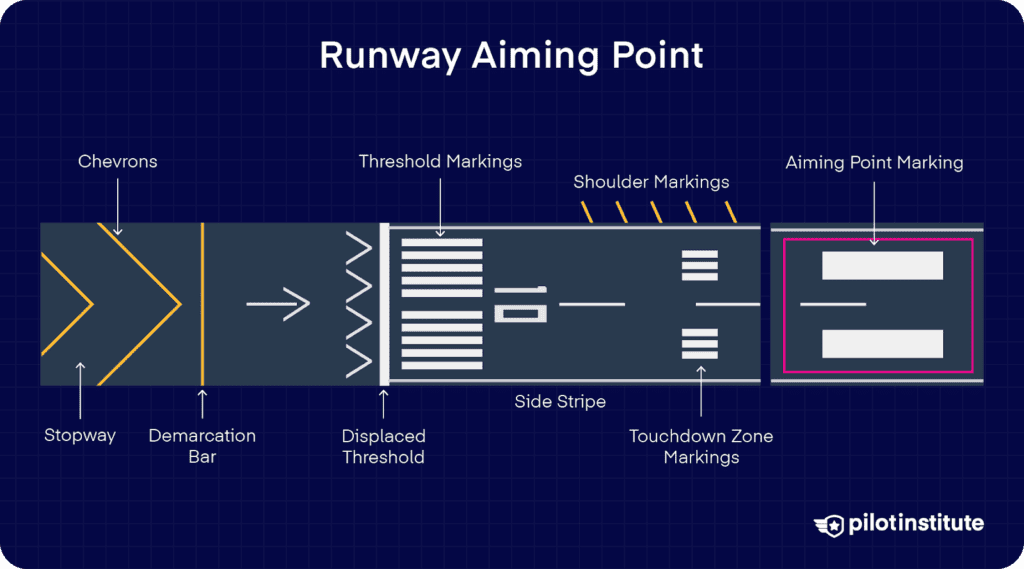
Four yellow lines (two solid, two dashed) indicate mandatory stop points before entering a runway. Solid lines face the approach direction.
Surface-Painted Holding Position Signs
Red background, white runway numbers, placed next to holding position markings.
Directional and Location Signs
- Location signs: Black background, yellow letters (current taxiway/runway)
- Direction signs: Yellow background, black letters and arrows
These help pilots navigate intersections and prevent misidentification.
Intersection Design and Human Factors
Geometry and Visibility
Best practices favor 90-degree taxiway-runway joins for visibility. Acute angles and “aligned taxiway” configurations are discouraged. Where problematic geometry exists, mitigations include better markings, lighting, and crew briefings.
Problematic Taxiway Geometry (PTG)
PTG increases confusion and risk, such as multiple taxiways converging or direct taxiway alignment with runways. Solutions include reconfiguration, enhanced signage, and procedural briefings.
Hot Spots and Safety Management
Identification
Hot spots are areas with a history or potential for collisions or incursions, marked on airport diagrams.
Management
- Design changes, improved markings and signage
- Procedural controls: readbacks, progressive taxi, safety briefings
- Pilot awareness: pre-taxi briefings, review of diagrams, proactive communication with ATC
Ongoing monitoring ensures effectiveness.
International Standards and Regulations
ICAO
- Annex 14: Sets standards for intersection angles, markings, signage, and lighting.
- Doc 9870: Guidance on incursion prevention, risk assessment, and incident investigation.
FAA
- FAR 91.129(i): Explicit ATC clearance for all crossings.
- Order 7110.65: ATC procedures, phraseology, readbacks.
- AC 150/5340-18G: Standards for markings.
Advanced Intersection Technologies
- Runway Status Lights (RWSL): Automated in-pavement lights indicating runway occupancy.
- A-SMGCS: Surface movement tracking and alerting.
- Electronic Flight Bags (EFBs): Real-time maps showing intersections, hot spots, and hold points.
Case Studies and Incident Analysis
- Tenerife (1977): Deadliest runway incursion at an intersection, leading to major procedural reforms.
- Chicago O’Hare (2006): Incursion due to ambiguous instructions, resulting in improved signage and mandatory readbacks.
- Dallas/Fort Worth: Hot spot mitigations (markings, RWSL, training) reduced incident rates by 70%.
Training and Best Practices
Pilot Training
- Markings, signage, ATC communication, readbacks
- Use of airport diagrams and hot spot briefings
- Scenario-based, recurrent training
ATC Training
- Issuing clearances, phraseology, readback confirmation
- Hot spot management, incident simulation
Checklist: Intersection Operations
| Checklist Item | Action/Description |
|---|---|
| Review airport diagram for intersections/hot spots | Pre-taxi, identify high-risk areas and planned route |
| Confirm all holding position markings and signage | Visually verify at each intersection |
| Obtain explicit ATC clearance for all crossings | Never cross without direct instruction |
| Read back all ATC clearances and hold short points | Confirm mutual understanding |
| Brief crew on intersection hot spots and procedures | Enhance situational awareness prior to taxi |
| Use EFB and moving map for real-time position | Monitor progress and verify location |
| Request progressive taxi if uncertain | ATC will guide step by step |
| Report any ambiguity or confusion to ATC | Safety is paramount |
Proper intersection management is foundational to airport safety. Through regulatory compliance, advanced technologies, vigilant communication, and ongoing training, airports and crews can minimize the risks inherent at these critical junctions, ensuring safe and efficient ground operations for all.
For more information on airport safety and intersection best practices, contact us or schedule a demo .
Frequently Asked Questions
- What is an intersection in airport operations?
- An intersection refers to the physical point on an airport where two or more runways, taxiways, or a runway and a taxiway cross or join. These locations are critical for managing safe and efficient movement of aircraft and vehicles and are governed by strict procedures, markings, and ATC clearances.
- Why are intersections important for airport safety?
- Intersections are high-risk areas for potential runway incursions and collisions. Proper identification, clear ATC communication, standardized signage, and procedural discipline at intersections are essential to maintain operational safety and prevent accidents on the ground.
- What markings and signs are used at intersections?
- Runway holding position markings, surface-painted holding position signs, and color-coded location and direction signs are used. These provide clear visual cues for pilots and vehicle operators, indicating where to stop and which direction to proceed at intersections.
- What is a 'hot spot' at an airport intersection?
- A 'hot spot' is an area on the airport movement surface, often an intersection, with a higher risk of collision or runway incursion. These are highlighted on airport diagrams and require extra vigilance from pilots and ground personnel.
- How can technology reduce risks at intersections?
- Technologies such as Runway Status Lights (RWSL), Advanced Surface Movement Guidance and Control Systems (A-SMGCS), and electronic moving maps on EFBs help enhance situational awareness and reduce the risk of errors at complex intersections.
This is a reference entry. TarmacView provides drone inspection services and doesn't sell the equipment or materials described in this glossary.