What is Millicandela (mcd)?
Millicandela (mcd): The Aviation and Photometry Authority
Millicandela (mcd) is a unit of luminous intensity in the International System of Units (SI), equal to one-thousandth (1/1000) of a candela (cd). This fundamental photometric unit is essential for specifying the brightness of low-intensity light sources, such as indicator LEDs, aviation panel lights, and small-scale emitters. The precision offered by the millicandela is indispensable in fields where light levels are critical but relatively low, including aviation, electronics, and safety equipment.
Understanding the Millicandela in the SI System
The candela is the SI base unit for luminous intensity, quantifying the amount of visible light emitted by a source in a specified direction. The millicandela is derived simply:
1 millicandela (mcd) = 0.001 candela (cd)
This straightforward relationship enables clear and accurate communication of light levels, especially for small or low-output sources where the candela would be an inappropriately large unit. The SI’s use of decimal submultiples like the millicandela ensures consistency in engineering, scientific, and regulatory contexts worldwide.
The candela is uniquely defined in reference to human visual perception, specifically, by the intensity of monochromatic light at a wavelength of 555 nm (green, where human vision is most sensitive). This definition, refined and reaffirmed by international standards bodies, ensures that all derived units, including the millicandela, are rooted in universal physical constants and human experience.
Photometry: Measuring Light as Humans See It
Photometry is the science of measuring visible light, accounting for the sensitivity of the human eye across different wavelengths. Unlike radiometry, which measures all electromagnetic energy, photometry applies a weighting function mirroring human vision, ensuring that units like the candela and millicandela correspond to perceived brightness.
The Role of Millicandela in Luminous Intensity
Luminous intensity quantifies the strength of light in a particular direction, measured in candelas or millicandelas. In aviation, this is crucial for applications such as:
- Panel indicators and cockpit LEDs: Specified in millicandelas for visibility without glare.
- Runway and taxiway lights: Compliance demands precise luminous intensity values, often in mcd for individual LEDs.
- Safety and emergency lights: Must be visible under all conditions, but not overpowering.
The use of millicandela allows engineers to fine-tune light output for optimal performance and compliance in low-intensity applications.
Historical Roots and Technical Foundations
The candela traces its origins to the brightness of a standard candle, once a practical but inconsistent reference. Modern definitions anchor the candela (and thus the millicandela) to physical constants and human visual response, as established by the International Bureau of Weights and Measures (BIPM) and the International Commission on Illumination (CIE). The current SI definition ensures global consistency, critical for aviation safety and regulatory alignment.
Regulatory Standards
Agencies such as the International Civil Aviation Organization (ICAO), Federal Aviation Administration (FAA), and European Union Aviation Safety Agency (EASA) enforce rigorous photometric standards. Minimum luminous intensities for lighting applications are often specified in millicandelas, with regular testing required for compliance and safety.
Measuring Luminous Intensity: Laboratory and Field Techniques
Accurately measuring millicandelas requires specialized photometric equipment:
Laboratory measurement:
- Goniophotometers: Measure intensity at various angles, producing isocandela diagrams.
- Integrating spheres: Capture total luminous flux, contributing to intensity calculations.
- Used for design, certification, and regulatory approval.
Field measurement:
- Mobile photometric systems: Mounted on vehicles for in-situ testing of installed fixtures.
- Portable photometers: Allow quick, precise checks during maintenance.
Routine measurement ensures that every light meets regulatory thresholds and maintains operational safety.
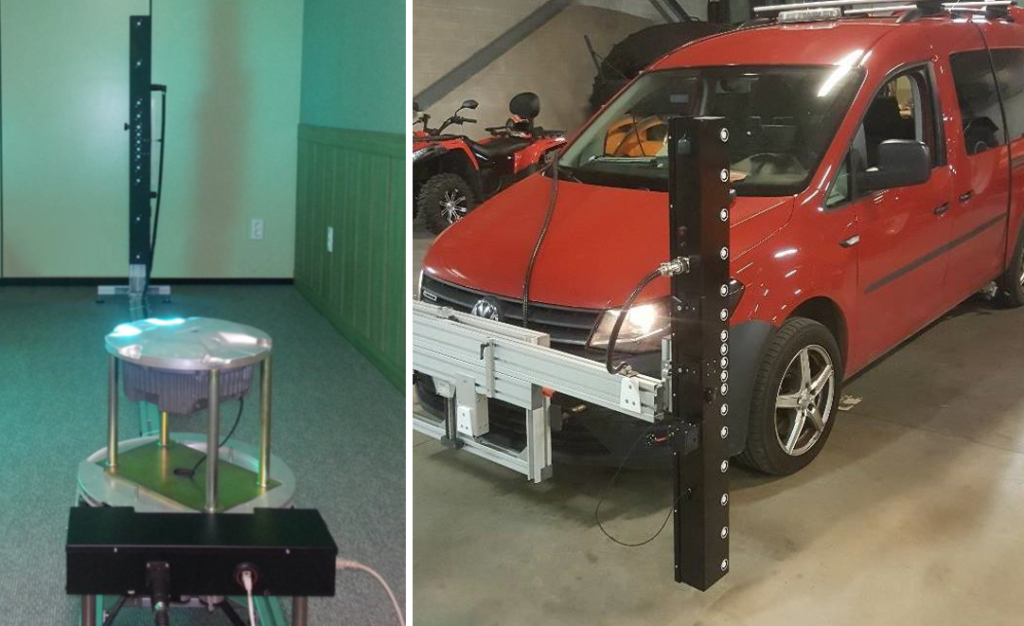
Laboratory (left) and mobile (right) photometric measurement setups used for airfield lighting compliance.
Isocandela Diagrams: Visualizing Intensity Distribution
Isocandela diagrams graphically represent a light source’s intensity distribution in space, measured in candelas or millicandelas. They are vital for:
- Verifying compliance with regulatory requirements.
- Diagnosing installation or alignment issues.
- Optimizing light placement for safety and efficiency.
In aviation, isocandela diagrams confirm that approach, runway, and taxiway lights emit within prescribed patterns and intensities.
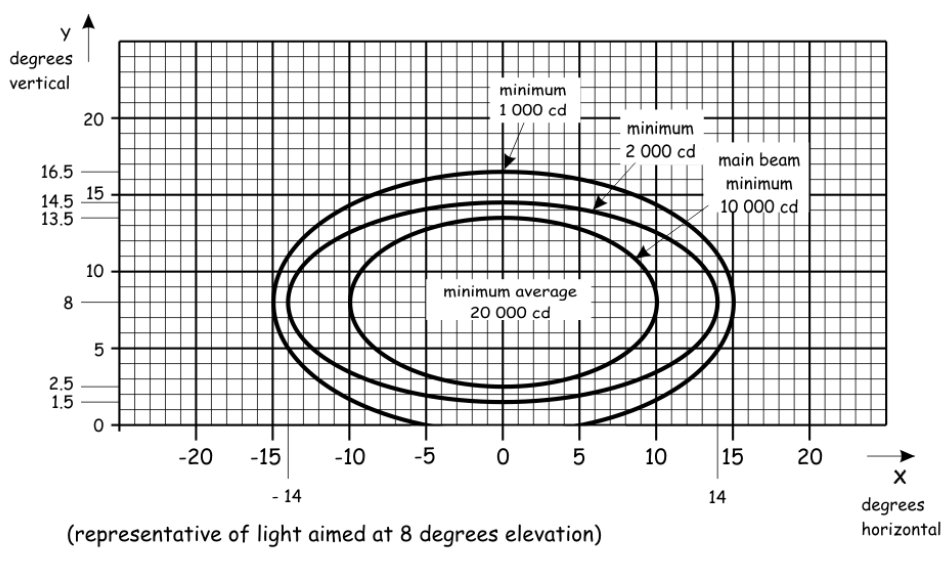
Isocandela diagram for approach lighting systems, showing intensity distribution in candelas and millicandelas.
Mathematical Relationships and Unit Conversions
Millicandela and Candela
| Candelas (cd) | Millicandelas (mcd) |
|---|---|
| 0.001 | 1 |
| 0.01 | 10 |
| 0.1 | 100 |
| 0.5 | 500 |
| 1 | 1,000 |
| 5 | 5,000 |
| 10 | 10,000 |
Example:
A status LED rated at 350 mcd has an intensity of 0.35 cd.
Photometric Unit Relationships
| Quantity | Unit | Symbol | What It Measures | Aviation Example / Notes |
|---|---|---|---|---|
| Luminous Intensity | candela | cd | Light output in a direction per solid angle | Runway edge light, obstruction beacon |
| Luminous Intensity | millicandela | mcd | 1/1000 of a candela | Panel indicators, avionics LEDs |
| Luminous Flux | lumen | lm | Total visible light emitted (all directions) | Interior cabin lighting |
| Illuminance | lux | lx | Light falling on a surface per unit area | Cockpit instrument illumination |
| Luminance | cd/m² | cd/m² | Intensity per area in a given direction | Display screens, sign backlighting |
The Steradian and Directionality
A steradian (sr) is the SI unit of solid angle. Luminous intensity (cd or mcd) is defined as the luminous flux emitted per steradian, making millicandela ideal for specifying tightly focused directional lights.
Aviation Lighting: Practical Examples
Everyday Analogies
- Standard candle: ~1 candela (1,000 mcd)
- Avionics status LED: 1–100 mcd
- Runway/taxiway marker LEDs: 100–5,000 mcd
Application: Selecting an LED Indicator
An avionics engineer must choose a cockpit LED. Testing finds 20 mcd is too dim in daylight, while 200 mcd is too bright at night. A 100 mcd LED, with dimming capability, provides optimal visibility in all conditions.
Regulatory Standards: ICAO, FAA, EASA
ICAO Annex 14 sets minimum and maximum intensities for all airfield lights, often in millicandelas for smaller fixtures.
- Runway centerline lights: minimum 200 mcd
- Taxiway centerline lights: minimum 50 mcd
- Obstruction lighting: minimums of 32,500 mcd (32.5 cd) for some applications, status indicators may use lower mcd values.
FAA and EASA require similar standards and regular photometric testing with equipment capable of resolving millicandela intensities.
Quick Reference: Millicandela in Aviation
| Millicandela (mcd) | Candela (cd) | Typical Aviation Use Case |
|---|---|---|
| 1 | 0.001 | Very dim panel indicator |
| 10 | 0.01 | Nighttime cockpit indicator |
| 100 | 0.1 | Daylight-visible status LED |
| 500 | 0.5 | Taxiway marker LED |
| 1,000 | 1 | High-intensity beacon or edge light |
Key Takeaways
- Millicandela (mcd) is 1/1000 of a candela, ideal for specifying low-intensity, directional lights.
- Used extensively in aviation, electronics, and safety for precise, standards-compliant lighting.
- Measurement and compliance are critical for operational safety and regulatory approval.
- Regular testing and documentation using millicandela values ensure longevity and visibility of vital aviation lighting.
Use millicandela values for precision, safety, and global compatibility in specifying and maintaining aviation and electronic lighting systems.
Frequently Asked Questions
- What is a millicandela (mcd)?
- A millicandela is a unit of luminous intensity in the International System of Units (SI), equal to one-thousandth (1/1000) of a candela (cd). It is commonly used to specify low-output light sources like indicator LEDs, control panel lights, and small aviation lighting fixtures.
- How does millicandela differ from candela and lux?
- Both millicandela (mcd) and candela (cd) measure luminous intensity, the strength of light in a specific direction. Lux (lx), on the other hand, measures illuminance, which is the amount of light falling on a surface. Millicandela is used for lower-intensity sources, while candela is for higher-intensity lights.
- Why is millicandela important in aviation lighting?
- Millicandela enables precise specification and measurement of the luminous intensity of small, directional aviation lights. This ensures lights are visible at the required distances without being excessively bright, which is vital for safety, regulatory compliance, and efficient operations.
- How is luminous intensity in millicandelas measured?
- Photometric equipment such as goniophotometers and portable photometers measure luminous intensity. Measurements are typically taken in a dark environment at a standardized distance, with results expressed in millicandelas for low-output sources, ensuring accuracy and repeatability.
- What are typical millicandela values for aviation lights?
- Typical values range from 1–100 mcd for panel indicators and avionics LEDs, 50–500 mcd for taxiway and runway markers, and thousands of mcd for higher-intensity lights. Regulatory bodies specify minimums for each application to ensure adequate visibility.
This is a reference entry. TarmacView provides drone inspection services and doesn't sell the equipment or materials described in this glossary.