What is a cosine corrector?
Cosine Corrector – Technical Glossary
Introduction and Definition
A cosine corrector is a specialized optical device placed over a photometric or radiometric sensor to modify its angular response, ensuring that sensitivity to light matches the cosine of the angle between the incident ray and the surface normal, according to Lambert’s cosine law. Without this correction, sensors typically overemphasize light from directly overhead and undercount light from oblique angles, resulting in inaccurate measurements, especially in real-world settings with diffuse or multi-directional illumination.
Cosine correctors employ diffusing materials such as PTFE (Teflon), Spectralon, opaline glass, or quartz, which scatter incoming light so the detector’s effective response closely follows the ideal cosine function. This correction makes the measured signal proportional to the perpendicular component of the incident light, enabling accurate calculation of irradiance (W/m²) or illuminance (lux).
These devices are essential in environmental monitoring, lighting engineering, solar energy research, industrial process control, photometric calibration, and more. Their construction, calibration, and performance are governed by international standards (CIE, ISO, NIST), making corrector selection and maintenance crucial for professional-grade measurements.
Principle of Operation
The operation of a cosine corrector is based on Lambert’s cosine law, which states:
The irradiance (E) on a flat surface from a point source is proportional to the cosine of the angle (θ) between the incident ray and the normal to the surface.
Mathematically:
E(θ) = E₀ × cos(θ)
Most bare detectors are not naturally Lambertian, they are much more sensitive to light at normal incidence and lose sensitivity rapidly at higher angles. A cosine corrector overcomes this by using a diffusing element that redistributes the incoming light, so the total response follows the ideal cosine profile.
Key engineering details include:
- Diffuser thickness, microstructure, and refractive index are selected to create an angular response matching the cosine function.
- Optical coupling options (direct sensor mount or fiber optic interface, e.g., SMA905) enable use in a range of systems.
- Internal baffles and anti-reflective coatings improve uniformity and minimize stray light.
- The performance is quantified by cosine error (how closely the actual response matches the ideal), with high-end devices achieving errors below 3% up to 80° incidence.
Applications and Use Cases
Cosine correctors are used wherever true plane irradiance or illuminance measurements are required, including:
Environmental and Solar Monitoring
Used in weather stations and research for measuring solar irradiance (total sunlight on Earth’s surface). Pyranometers and spectroradiometers with cosine correction meet ISO 9060 and WMO standards for accurate energy and climate data.
Architectural and Industrial Lighting
Lux meters and photometers with cosine correctors assess workspace lighting, validate compliance with ISO 8995 and EN 12464, and characterize commercial lighting products.
Photovoltaic Testing
In solar cell testing, cosine-corrected sensors ensure accurate measurements of total incoming power, whether from direct sun or solar simulators.
Spectral and Remote Sensing
Fiber-coupled cosine correctors allow spectrometers to measure spectral irradiance in UV, visible, and NIR bands for environmental monitoring, laboratory studies, and industrial process control.
Consumer Electronics
Miniature cosine correctors in smartphones and smart lighting systems enable accurate ambient light detection for automatic screen brightness and exposure control.
Calibration Standards
Metrology labs use NIST-traceable, cosine-corrected sensors as references for calibrating other instruments, ensuring consistency throughout the measurement chain.
Product Features and Technical Parameters
Construction and Geometry:
- Direct-attach or fiber-coupled (e.g., SMA905) configurations.
- Geometry (diffuser diameter and thickness) sets the field of view (typically 180°) and collection efficiency.
- Anti-reflective coatings and alignment features minimize errors.
Diffuser Materials:
- PTFE (Teflon): UV–NIR, high durability.
- Spectralon: Near-Lambertian, UV–VIS–NIR, reference-grade.
- Opaline Glass: Visible range, cost-effective.
- Quartz: Deep UV and NIR, robust.
- Acrylic: Lower-cost, visible spectrum.
Key Specifications:
- Field of view: 180° (standard)
- Wavelength range: UV to NIR (material dependent)
- Cosine error: <3% up to 80° (best devices)
- Connector: SMA905, direct attach, custom
- Calibration: NIST-traceable certificates
Example Specifications Table:
| Model | Diffuser | Wavelength Range | Active Area | Field of View | Connector | Notes |
|---|---|---|---|---|---|---|
| CC-UV | Spectralon | 200–2500 nm | 4.8 mm | 180° | SMA905 | UV-VIS-NIR, fiber-coupled |
| CC-3 | Opaline Glass | 350–1000 nm | 4.9 mm | 180° | SMA905 | VIS, fiber-coupled |
| CC-VIS/NIR | Quartz | 200–2500 nm | 3.9 mm | 180° | SMA905 | Compact, UV/VIS/NIR |
| 818-RAD | Acrylic/PTFE | 200–850 nm | 8.0 mm | 180° | Direct | Photodiode, NIST-traceable |
Calibration and Traceability:
High-performing devices are supplied with calibration certificates, traceable to NIST or equivalent. Calibration involves both spectral and angular response checks, with recommended recalibration every 1–2 years.
Environmental Considerations:
Field and industrial models may include IP-rated housings, anti-fouling coatings, and ruggedized construction, submersible versions are used in aquatic research.
Technical Considerations
To ensure high-accuracy measurements, consider the following:
Angular Response Deviation:
No physical diffuser is perfectly Lambertian, errors increase at high angles. For reference applications, select devices with cosine error <3% up to 80°.
Spectral Flatness:
Diffuser materials vary in spectral response. PTFE and Spectralon offer broad, flat response, glass and acrylic may be limited to visible wavelengths.
Contamination and Aging:
Dust, moisture, and UV exposure degrade performance. Use protective covers and schedule regular calibration and cleaning.
Mechanical Alignment:
Ensure the corrector is perpendicular to the measurement plane, misalignment introduces systematic errors.
Integration:
Standard connectors (SMA905) and modular design facilitate system integration.
Cosine Response Curve
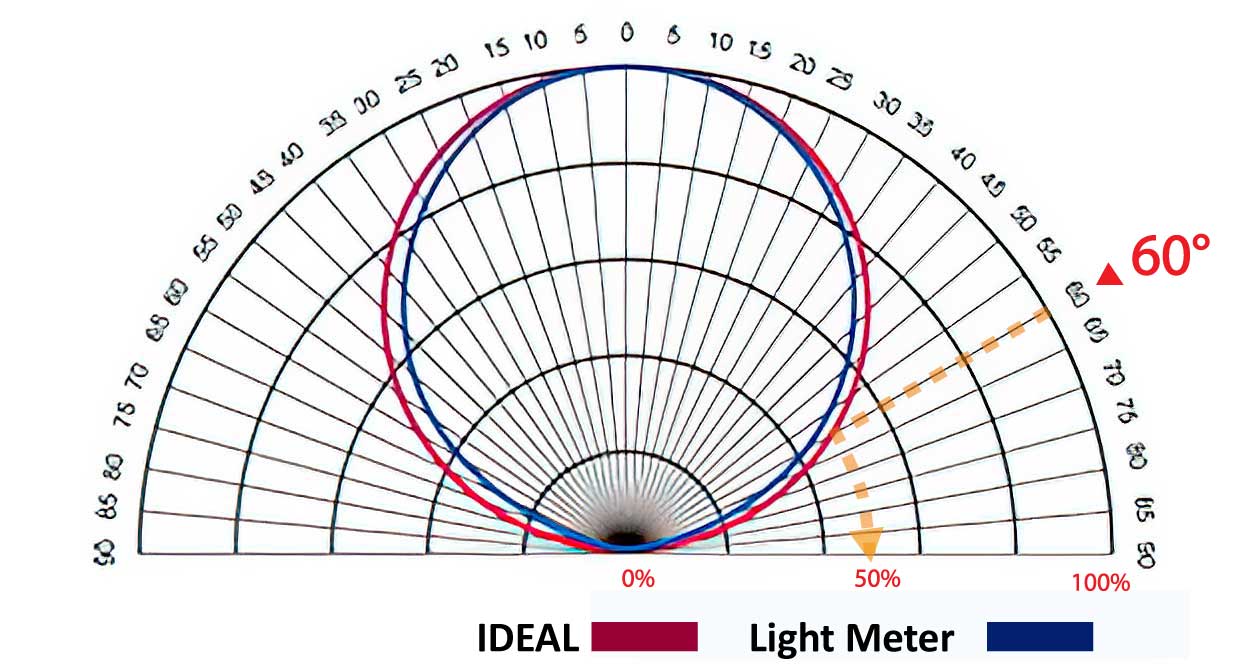
Example: Cosine response curve comparing an ideal (Lambertian) profile to an actual device.
This curve illustrates why cosine correction is essential: uncorrected sensors under-respond to oblique light, while a cosine corrector enables accurate, angle-independent measurements.
Examples and Use Cases
LED Panel Testing
A manufacturer uses a cosine corrector with a fiber-coupled spectrometer to measure the total luminous flux from an LED panel, ensuring reliable, unbiased results for product characterization.
Outdoor Solar Monitoring
Weather stations deploy cosine-corrected sensors for continuous global solar irradiance measurement, capturing both direct and diffuse sunlight for accurate energy resource assessment.
Ambient Light Sensing
Consumer devices (phones, tablets) use miniaturized cosine correctors to ensure ambient light readings reflect true environmental conditions, enabling effective auto-brightness adjustment.
Laboratory Calibration
Calibration labs employ NIST-traceable cosine-corrected sensors to transfer standards and verify the performance of other light meters.
Underwater Light Profiling
Marine researchers use submersible cosine-corrected sensors to profile sunlight penetration in water, essential for aquatic ecosystem studies.
Glossary of Related Terms
- Irradiance (E): Radiant power per unit area (W/m²), integrating light from all directions.
- Illuminance (lux): Luminous flux per unit area (lumens/m²), weighted by human visual response.
- Lambertian Response: An idealized, perfectly diffuse angular response following the cosine law.
- Field of View (FOV): Angular light collection range, 180° is standard for cosine correctors.
- Spectral Response: Variation in sensitivity versus wavelength, determined by sensor and diffuser.
- Cosine Error: Percentage deviation from ideal cosine response across angles.
- NIST-Traceable: Measurement or calibration directly referenced to NIST standards.
- Pyranometer: Instrument for broadband solar irradiance, typically with a cosine corrector.
- Spectroradiometer: Measures spectral power distribution, often using a cosine corrector.
- Photodiode Sensor: Converts light to electrical current, core detector in many instruments.
Summary Table: Selected Commercial Cosine Correctors
| Model | Diffuser | Wavelength Range | Active Area | Field of View | Connector | Calibration |
|---|---|---|---|---|---|---|
| CC-UV | Spectralon | 200–2500 nm | 4.8 mm | 180° | SMA905 | NIST-traceable |
| CC-3 | Opaline Glass | 350–1000 nm | 4.9 mm | 180° | SMA905 | NIST-traceable |
| CC-VIS/NIR | Quartz | 200–2500 nm | 3.9 mm | 180° | SMA905 | NIST-traceable |
| CC-DA-4.5 | Quartz | 200–2500 nm | 4.5 mm | 180° | Direct | NIST-traceable |
| 818-RAD | Acrylic/PTFE | 200–850 nm | 8.0 mm | 180° | Direct | NIST-traceable |
Further Reading
- CIE S 023/E:2013: International standard for photometric sensors.
- ISO 9060: Classification and performance of pyranometers.
- NIST Special Publication 250-37: Calibration of photometric devices.
Cosine correctors are critical for reliable, repeatable light measurements in science, industry, and everyday technology. Selecting the right corrector ensures compliance with standards and confidence in data, whether for research, compliance, or innovation.
Frequently Asked Questions
- Why is a cosine corrector needed for light measurements?
- Many sensors over-respond to light arriving perpendicularly and under-respond to light from oblique angles. A cosine corrector ensures the sensor’s response accurately represents the total incident light from all directions, as required by Lambert’s cosine law, for true irradiance or illuminance readings.
- What materials are used in cosine correctors?
- Common materials include PTFE (Teflon), Spectralon, opaline glass, quartz, and acrylic. The choice depends on the required wavelength range and performance. Spectralon and PTFE are preferred for broadband (UV–NIR) and high-accuracy applications, while glass and acrylic are often used for visible light.
- How is the performance of a cosine corrector specified?
- Key specifications include cosine error (deviation from ideal response), spectral range, field of view (usually 180°), diffuser material, and calibration traceability (such as NIST-traceable certificates). High-quality correctors achieve cosine errors below 3% up to 80° incidence.
- Where are cosine correctors used?
- They are used in environmental monitoring (solar irradiance, climate studies), lighting measurements (lux meters, photometry), photovoltaic testing, laboratory calibration, remote sensing, underwater light profiling, and consumer devices such as smartphones.
This is a reference entry. TarmacView provides drone inspection services and doesn't sell the equipment or materials described in this glossary.