What is Haze?
Haze – Atmospheric Obscuration Reducing Visibility (Meteorology)
Haze refers to atmospheric obscuration caused by the suspension of extremely small, dry solid or liquid particles in the air, resulting in reduced visibility and a milky or faded sky. Distinct from fog and mist, which are composed of water droplets, haze’s primary constituents are aerosols: microscopic particles or droplets from both natural and anthropogenic sources. In aviation, haze is reported using the code “HZ” in meteorological observations (METAR/SPECI) and represents a significant operational and environmental concern.
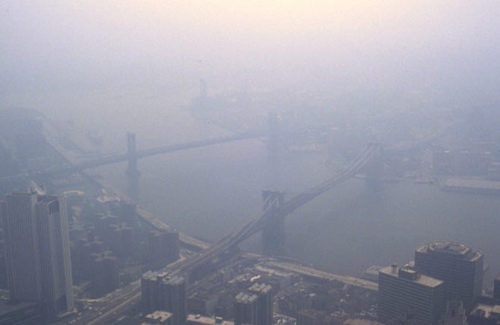
Definition and Key Characteristics
Haze is defined by the International Civil Aviation Organization (ICAO) and the World Meteorological Organization (WMO) as a reduction in horizontal visibility caused by suspended, dry particles too small to be seen individually. These particles, ranging from 0.001 to 10 micrometers (µm), come from dust, combustion byproducts, sulfates, nitrates, sea salt, organic matter, and black carbon.
Core features:
- Appearance: Milky, bluish, or grayish sky, faded colors and contrast.
- Visibility: Typically reduces horizontal visibility to below 10 km (6 mi) but above 1 km (0.62 mi), more severe reduction is classified as fog, smoke, or dust.
- Optics: Particles scatter visible light, especially blue wavelengths, resulting in a whitening or opalescent effect.
- Hygroscopic growth: Many haze particles absorb moisture at high humidity, increasing their size and scattering efficiency.
Scientific Composition and Particle Dynamics
Haze results from a complex mix of fine aerosols in the lower troposphere. These include:
- Mineral dust: From deserts, arid lands, and disturbed surfaces.
- Sulfates/nitrates: Secondary aerosols formed by atmospheric reactions with SO₂ and NOₓ, linked to fossil fuel combustion.
- Organic aerosols: From wildfires, vehicle exhaust, and volatile organic compounds (VOCs).
- Sea salt: Created by wave action and bubble-bursting at the ocean surface.
- Black carbon/soot: Produced by incomplete combustion of fossil fuels or biomass.
Water absorption: Many haze particles are hygroscopic, swelling and scattering more light at relative humidity above 60–75%. This explains why haze can intensify during humid periods, even in the absence of new particle emissions.
Aerosol Optical Depth (AOD): A key metric for haze, AOD quantifies the column-integrated concentration of aerosols. High AOD values indicate severe haze and low surface visibility.
Mechanisms of Formation and Atmospheric Processes
Haze forms and persists through a combination of emission, transport, chemistry, and meteorology:
Natural Sources:
- Dust storms: Wind lifts fine mineral particles from dry surfaces.
- Sea spray: Coastal haze from oceanic salt particles.
- Volcanoes: Eruptions emit ash and sulfate aerosols.
- Biomass burning: Wildfires and agricultural fires.
Anthropogenic Sources:
- Industrial emissions: Factories, power plants, and vehicles release PM, SO₂, NOₓ, and VOCs.
- Agriculture: Field burning, tilling, and livestock operations.
- Urban activity: Dense populations generate a complex mix of primary and secondary aerosols.
Atmospheric Processes:
- Suspension and transport: Particles are lofted by wind, then transported regionally or globally.
- Hygroscopic growth: Particles absorb water, increasing scattering.
- Photochemical reactions: Sunlight transforms gases into secondary aerosols.
- Atmospheric stability: Inversions trap particles near the surface, worsening haze.
- Long-range transport: Fine particles can travel thousands of kilometers, causing regional haze events.
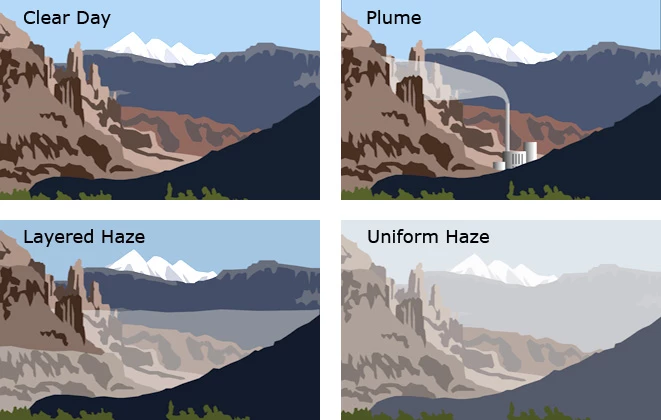
Differentiation from Fog, Mist, Dust, and Smoke
| Phenomenon | Primary Composition | Particle Size | Water Content | Visibility Reduction | Humidity for Formation | Appearance | Key Distinction from Haze |
|---|---|---|---|---|---|---|---|
| Haze | Dry aerosols | 0.001–10 µm | Low | <10 km, >1 km | >60–75% (for swelling) | Milky, faded | Dry, not water droplets |
| Fog | Water droplets | 1–10 µm | Very high | <1 km | 100% (saturated) | Thick, white | Liquid droplets, dense |
| Mist | Water droplets | 1–10 µm | High | 1–10 km | 95–100% | Gray, thin | Water-based, less dense |
| Dust | Mineral particles | 1–100 µm | Very low | Variable | Dry, windy | Brown/yellowish | Larger, visible grains |
| Smoke | Combustion aerosols | 0.01–1 µm | Low | Variable | Dry | Blue-gray/brown | Combustion source |
Haze is unique for its composition of sub-micron to micron-sized dry particles, not visible individually, and its ability to reduce visibility by scattering light. Fog and mist are water-based, dust and sand involve larger, visible particles, smoke arises from combustion.
Types of Haze
- Photochemical Haze: Formed by sunlight-driven chemical reactions of SO₂, NOₓ, and VOCs. Major cause of urban smog.
- Dust Haze: Dominated by mineral dust, prevalent during droughts and desert winds.
- Smoke Haze: From wildfires or combustion, can persist and travel long distances.
- Volcanic Haze (“Vog”): From volcanic eruptions, contains ash and sulfates.
- Salt Haze: From sea salt, common in coastal areas.
Impacts of Haze
Visibility
Haze dramatically reduces visual range, impacting transportation and aesthetics:
- Aviation: Degrades runway, terrain, and traffic visibility, complicates VFR operations.
- Marine/Road: Increases navigation errors and accident risk.
- Scenic loss: Dulls landscapes and obscures distant features.
Aviation & Transport Safety
- Missed approaches/diversions: Visibility below minima can prevent safe landings.
- Increased pilot workload: More reliance on instruments, risk of visual illusions.
- Runway incursions/CFIT: Poor contrast increases operational hazards.
Health
- Respiratory/cardiovascular risk: Fine particles (PM2.5/PM10) cause or worsen asthma, bronchitis, heart disease, and increase mortality.
- Vulnerable populations: Children, elderly, and those with chronic conditions are at higher risk.
- Chronic exposure: Long-term haze raises morbidity and mortality rates.
Environmental & Climate Effects
- Scenic impairment: Faded colors, loss of visual quality in parks and wilderness.
- Acidification: Sulfates/nitrates in haze deposit and acidify soils/water.
- Climate: Aerosols impact radiative balance, cloud formation, and regional weather.
Monitoring, Measurement, and Reporting
Visibility Measurement
- Human observation: Landmarks at known distances.
- Transmissometers: Measure light attenuation over a fixed path.
- Nephelometers: Assess light scattering by particles.
- Remote sensing: Satellites (MODIS, CALIPSO) and ground LIDAR profile aerosols and haze.
Air Quality and Specialized Networks
- PM2.5/PM10 monitors: Track fine/coarse particles in real time.
- AQI: Synthesizes data into health risk categories.
- IMPROVE/AERONET: Specialized networks for protected areas and climate research.
Meteorological Standards
- METAR/SPECI: ‘HZ’ code used when visibility reduction is from dry particles.
- ICAO/WMO: Define international criteria for haze reporting.
Notable Case Studies
National Parks
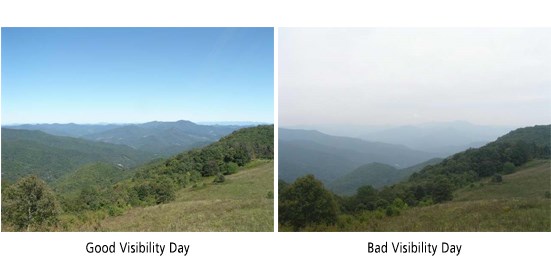
National parks like the Grand Canyon and Great Smoky Mountains experience dramatic visibility loss from haze, reducing views from over 100 miles to under 20 miles.
Asian Haze
Forest and peat fires in Indonesia can produce transboundary haze, impacting air quality and transportation across Southeast Asia. Severe events close airports, disrupt shipping, and create public health crises.
Volcanic Vog
Major eruptions (e.g., Kīlauea, Eyjafjallajökull) inject ash and sulfate aerosols, creating regional or global haze that can persist for weeks to months.
Urban Photochemical Smog
Cities such as Los Angeles and Beijing experience photochemical haze events from vehicle and industrial emissions, sunlight, and atmospheric inversions, causing severe visibility reduction and health risks.
Use Cases and Applications
Aviation Meteorology
- Flight planning: METAR and TAF reports inform pilots/dispatchers about haze.
- Approach/landing: Haze affects the availability of visual and instrument procedures.
- VFR/IFR transitions: Haze can force IFR operations or flight cancellations.
Weather Services
- Warnings/advisories: Issued during severe haze episodes.
- Forecasts: Numerical models predict haze development and movement.
Environmental Policy
- Emission controls: Restrictions may be enforced during severe haze events.
- Regional Haze Programs: Targeted to improve visibility in protected areas.
Remote Sensing & Climate
- Satellite monitoring: Provides real-time haze mapping.
- Climate modeling: Incorporates aerosol effects on radiative forcing and cloud properties.
Public Health
- Advisories: Inform the public about air quality risks and protective actions.
- Research: Epidemiological studies quantify health impacts of haze exposure.
Environmental Impact Assessment
- Visual range studies: Used in reviews for new industrial/power projects to protect scenic vistas.
Haze is a complex, multifaceted phenomenon with critical impacts on transportation, health, environment, and climate. Its monitoring and mitigation are central to aviation safety, air quality management, and preserving the natural beauty of landscapes worldwide.
Frequently Asked Questions
- How does haze differ from fog?
- Haze consists of dry, fine particles (aerosols) that scatter light, reducing visibility and giving the sky a faded look. Fog, by contrast, is made up of suspended water droplets and requires near-saturation humidity, resulting in much denser obscuration and typically lower visibility (<1 km compared to haze’s >1 km).
- Why is haze important in aviation meteorology?
- Haze reduces horizontal visibility, especially near the surface, making it harder for pilots to see runways, terrain, and other aircraft. It is reported on METARs as 'HZ' and can lead to missed approaches, diversions, and increased reliance on instruments, particularly under Visual Flight Rules (VFR).
- What causes haze?
- Haze forms from a mix of natural and human-made aerosols, such as mineral dust, sulfates, nitrates, sea salt, organic compounds, and black carbon. These particles scatter sunlight, and their concentration increases with emissions, transport, and atmospheric stagnation. High humidity can amplify haze by causing hygroscopic particles to swell and scatter more light.
- How is haze monitored and reported?
- Haze is tracked using ground-based visibility observations, transmissometers, nephelometers, and satellite remote sensing (e.g., MODIS, CALIPSO). In aviation, haze is formally reported as 'HZ' in METAR and SPECI codes when visibility reduction is due to dry particles rather than water droplets or precipitation.
- What are the health effects of haze?
- Fine particles in haze (especially PM2.5) can penetrate deep into the lungs, aggravating respiratory and cardiovascular conditions, and increasing the risk of heart attacks, strokes, and premature death. Vulnerable groups include children, the elderly, and those with chronic health conditions.
This is a reference entry. TarmacView provides drone inspection services and doesn't sell the equipment or materials described in this glossary.