What is Marking (Airport Marking)?
Marking – Visual Pattern Painted on Surface – Airport Markings
Airport markings are foundational to the safety and efficiency of airfield operations. These carefully designed and rigorously standardized visual patterns, ranging from lines and stripes to numerals and symbols, are painted on various airport surfaces such as runways, taxiways, aprons, and helipads. Markings provide vital information for pilots, air traffic controllers, ground vehicle operators, and maintenance teams, enabling precise navigation, regulatory compliance, and hazard avoidance on the ground.
1. Definition
Marking (Airport Marking):
A marking is a precisely defined and standardized symbol, line, numeral, or inscription applied to airport surfaces, intended to convey operational information. These markings are engineered for maximum visibility, durability, and clarity, using color-coded paints and often retro-reflective materials to ensure effectiveness under varying lighting and weather conditions.
According to ICAO Annex 14 Volume I:
“A marking is any symbol or group of symbols displayed on the surface of a movement area for the purpose of conveying aeronautical information.”
Markings are not arbitrary, they function as a visual language, instantly recognizable by airport users across the globe. Their consistent application is essential for operational safety, rapid decision-making, and universal understanding in the high-stakes environment of airport ground movement.
2. Functions and Applications
Airport markings serve several critical functions:
- Operational Guidance: Markings provide unambiguous navigation cues for aircraft and vehicles, particularly in low visibility conditions, reducing dependency on verbal air traffic control instructions.
- Boundary Delineation: They define the edges of runways, taxiways, aprons, and other surfaces, as well as intersections and transition zones.
- Positional Information: Markings identify specific runways, taxiways, holding points, parking stands, and navigational checkpoints, essential for situational awareness.
- Safety Warnings: Markings like closed area “X”s and chevrons signal hazards or non-operational areas.
- Regulatory Compliance: Markings help airports comply with ICAO/FAA standards, which are prerequisites for certification, insurance, and international interoperability.
3. Regulatory and Standardization References
The standardization of airport markings is paramount for global aviation safety. Regulations and guidance include:
- ICAO Annex 14, Volume I – Aerodromes: Global standards for marking design, placement, and maintenance.
- FAA Advisory Circular (AC) 150/5340-1M: U.S. technical specifications for marking types, dimensions, and reflectivity.
- Aeronautical Information Manual (AIM): Detailed explanations of marking aids and signs.
- Airfield Marking Handbook (IPRF): Best practices for marking materials and maintenance.
These documents define not just marking appearance, but also inspection and maintenance protocols, ensuring markings remain effective throughout their service life.
4. Types of Airport Markings
Markings are categorized by their operational context:
- Runway Markings: Guide pilots during takeoff, landing, and rollout.
- Taxiway Markings: Direct aircraft and vehicles between runways and terminals.
- Apron and Other Surface Markings: Organize parking areas, vehicle paths, and operational zones.
Each type is specified in regulatory documents for color, width, placement, and meaning.
4.1 Runway Markings
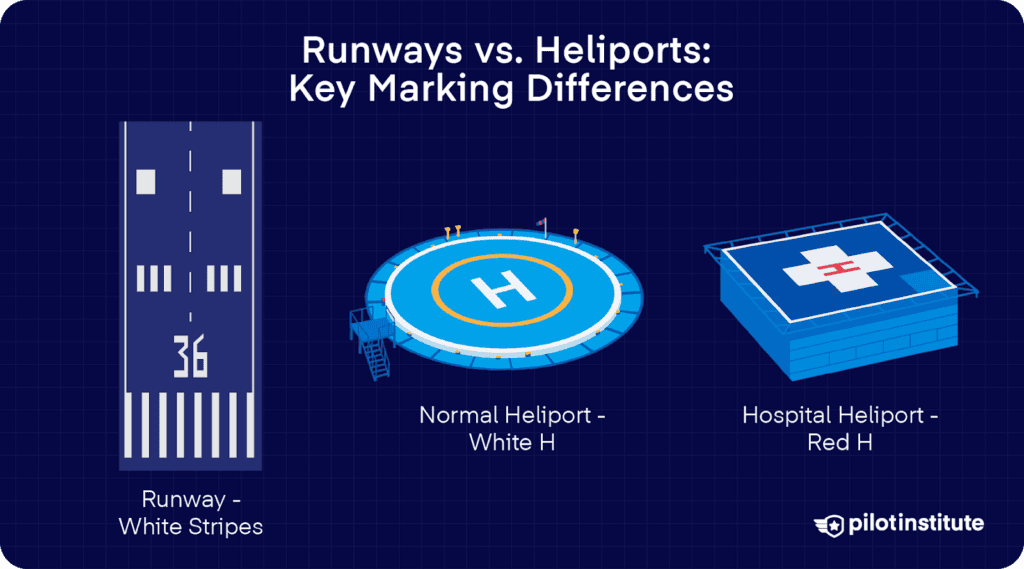
Runway markings are the most prominent and strictly regulated, typically painted in white for maximum contrast and visibility.
4.1.1 Runway Designation Markings
Large white numerals indicate the runway’s magnetic heading (rounded to the nearest 10 degrees). Parallel runways add “L”, “C”, or “R” for left, center, or right.
Example: “27L” for Runway 270°, Left.
4.1.2 Runway Centerline
A dashed white line, aligned with the runway axis, helps pilots maintain direction during takeoff and landing.
4.1.3 Runway Threshold Markings
Longitudinal white stripes mark the beginning of the usable landing area. The number of stripes increases with runway width.
4.1.4 Displaced Threshold
A solid white bar with arrowheads indicates that the start of the pavement is not suitable for landing but may be used for taxi or takeoff.
4.1.5 Aiming Point Markings
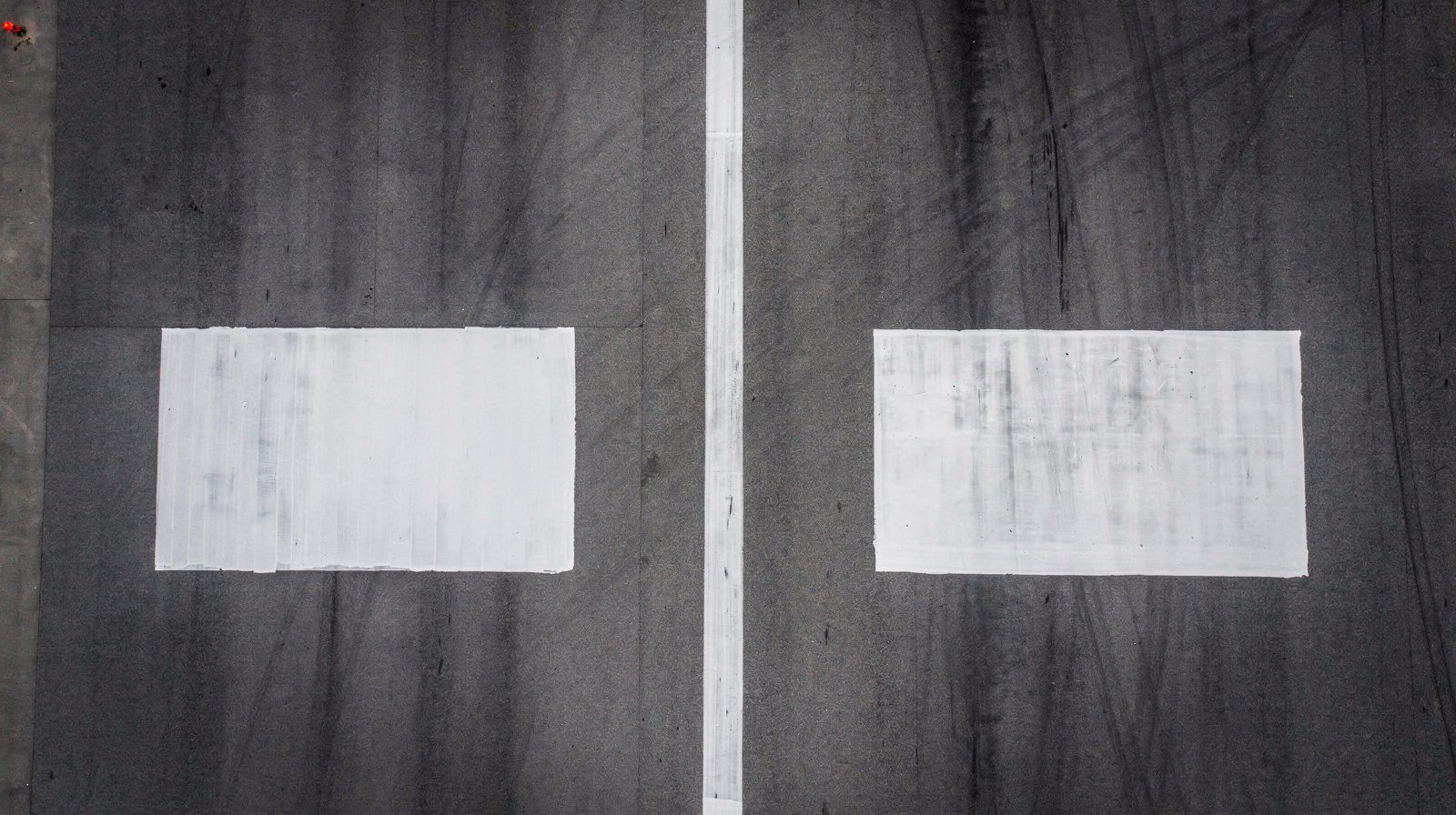
Two broad white rectangles, placed symmetrically about the runway centerline 1,000 feet from the threshold, provide a visual aiming reference for landing.
4.1.6 Touchdown Zone Markings
Paired white bars at 500-foot intervals within the first 3,000 feet identify the optimal touchdown area.
4.1.7 Runway Side Stripe Markings
Continuous white lines along each runway edge define the usable surface.
4.1.8 Runway Shoulder Markings
Yellow lines or chevrons mark areas not intended for aircraft use.
4.1.9 Blast Pad/Stopway/Overrun Markings
Large yellow chevrons indicate areas unsuitable for normal operations, often for jet blast or emergency stopping.
4.1.10 Closed Runway Markings
Large yellow “X”s signal that a runway is closed for use.

Runway markings, including threshold, centerline, aiming point, touchdown zone, side stripes, and shoulder markings.
4.2 Taxiway Markings
Taxiway markings are predominantly yellow, designed for high visibility and clarity.
4.2.1 Taxiway Centerline
A solid yellow line guides aircraft and vehicles along the taxiway.
4.2.2 Taxiway Edge Markings
Double yellow lines define the taxiway boundary. Solid lines separate taxiways from non-load-bearing surfaces, dashed lines are used where the taxiway abuts another pavement.
4.2.3 Taxiway Shoulder Markings
Yellow chevrons indicate areas adjacent to the taxiway unsuitable for aircraft movement.
4.2.4 Surface-Painted Direction and Location Signs
Yellow with black inscriptions for direction, black with yellow inscriptions for location.
4.2.5 Holding Position Markings
Two solid and two dashed yellow lines at intersections with runways or restricted areas indicate where aircraft must stop unless cleared by ATC.
4.2.6 Enhanced Taxiway Centerline Markings
Solid yellow centerline bordered by dashed yellow lines for 150 feet before a runway holding position, increasing conspicuity.
Taxiway centerline, edge, shoulder, and holding position markings.
4.3 Apron and Other Surface Markings
Apron markings organize parking, ground vehicle paths, and operational zones.
4.3.1 Apron Entry Point Markings
Lead-in and lead-out lines (solid and dashed yellow) guide aircraft into and out of parking stands or gates.
4.3.2 Aircraft Stand Markings
Define precise parking locations and alignment for different aircraft types.
4.3.3 Vehicle Roadway Markings
White or yellow lines and zebra patterns designate authorized ground vehicle routes.
4.3.4 No Entry and Safety Zone Markings
Red or yellow dashed lines, symbols, or painted “NO ENTRY” text indicate restricted or hazardous areas.
5. Maintenance and Visibility
To remain effective, airport markings must be maintained for visibility and reflectivity. This includes:
- Durable Paints: Specially formulated for abrasion resistance and retro-reflectivity.
- Reflective Elements: Glass beads are embedded in paint for nighttime and low-visibility conditions.
- Regular Inspections: Required by ICAO/FAA standards for clarity, reflectivity, and adhesion.
- Prompt Repairs: Faded or damaged markings must be repainted to prevent safety risks.
6. Importance for Safety and Efficiency
Consistent, clear markings are non-negotiable in modern aviation. They:
- Prevent runway incursions and wrong-surface landings.
- Streamline ground movement and reduce ATC workload.
- Enable universal recognition, regardless of location or language.
- Support compliance, insurance, and airport certification.
7. Regulatory References & Further Reading
- ICAO Annex 14, Volume I – Aerodromes
- FAA AC 150/5340-1M – Standards for Airport Markings
- Aeronautical Information Manual (AIM)
- IPRF Airfield Marking Handbook
Summary
Airport markings are far more than paint on pavement, they are a globally standardized language critical for the safe, efficient, and predictable operation of airports. Adhering to ICAO and FAA standards, these markings guide, warn, and inform, helping all airport users share a common operational understanding and minimizing the risk of ground incidents.
For airports, airlines, and operators, investing in high-quality, well-maintained markings is essential for safety, efficiency, and compliance.

Airport runway with clear, standardized markings for maximum safety and operational efficiency.
Frequently Asked Questions
- What are airport markings?
- Airport markings are standardized visual patterns, lines, symbols, letters, or numbers, painted on runways, taxiways, aprons, and other operational surfaces. They provide essential guidance, boundaries, and safety warnings, ensuring the safe and efficient movement of aircraft and vehicles. These markings are governed by international and national aviation standards.
- Who sets the standards for airport markings?
- International standards are set by the International Civil Aviation Organization (ICAO) in Annex 14, while national standards, such as those in the United States, are provided by the Federal Aviation Administration (FAA) through Advisory Circulars like AC 150/5340-1M. These standards ensure consistency, safety, and interoperability at airports worldwide.
- Why are airport markings important?
- Markings are crucial for aviation safety. They provide clear visual cues for pilots and ground crews, helping to prevent runway incursions, guide aircraft during takeoff and landing, define operational boundaries, and indicate warnings or restrictions. Uniform markings reduce confusion and miscommunication, especially at large or complex airports.
- What are the main types of airport markings?
- The three principal categories are runway markings, taxiway markings, and apron/other surface markings. Each serves a unique role: runway markings guide aircraft during takeoff and landing, taxiway markings direct movement between runways and terminals, apron markings organize parking and ground vehicle routes.
- How are markings maintained for visibility?
- Markings use highly durable, color-coded paints, often embedded with reflective glass beads to ensure visibility in low light or adverse weather. Regular inspections and maintenance are required by aviation authorities to uphold clarity, reflectivity, and compliance with regulatory standards.
This is a reference entry. TarmacView provides drone inspection services and doesn't sell the equipment or materials described in this glossary.