What is Prestressed Concrete Pavement?
Prestressed Concrete Pavement – Pre-tensioned and Post-tensioned Rigid Pavements (Infrastructure): In-depth Guide
Definition of Prestressed Concrete Pavement
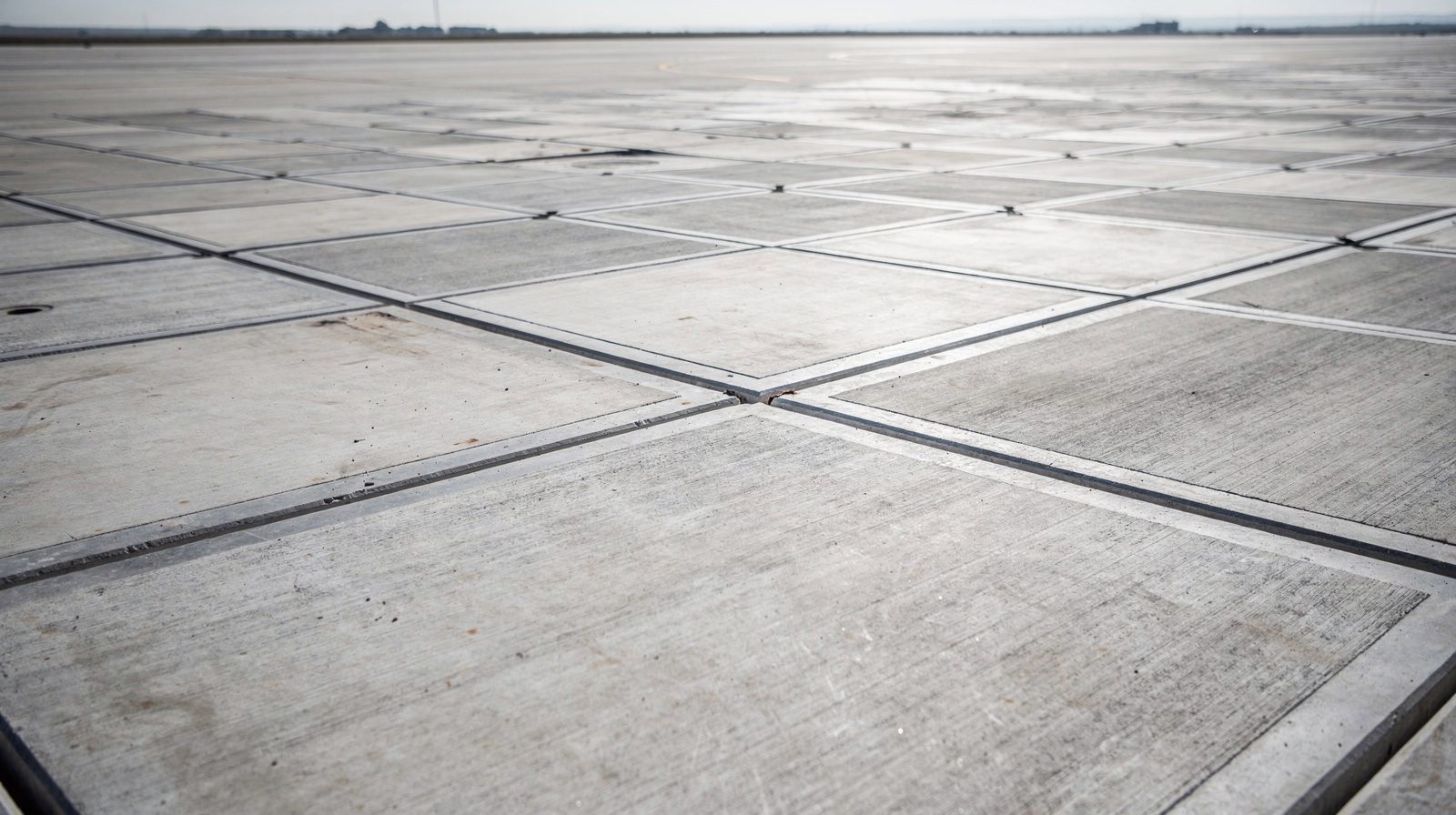
Prestressed concrete pavement (PCP) is a rigid pavement system in which deliberately induced compressive stresses are introduced into concrete slabs using high-strength steel tendons before the structure is subjected to service loads from aircraft, vehicles, or thermal changes. The pre-tensioning or post-tensioning methods apply mechanical stress to embedded steel elements, creating a state of compression throughout the pavement thickness. This intentional compression counteracts the tensile stresses that would otherwise develop under traffic loading, temperature cycles, and moisture changes. By offsetting tensile stresses before they accumulate, prestressed concrete pavements achieve exceptional durability, support much longer joint-free spans than conventional reinforced concrete, and require substantially thinner slabs for equivalent structural capacity. PCP is applied at civil airports on high-demand surfaces including runways, taxiways, and aprons, where its superior performance under heavy aircraft loads justifies higher initial material and construction costs.
Historical Development and Adoption
Prestressed concrete technology emerged in the mid-20th century as an advancement in structural engineering, first applied to bridges and buildings. Airport pavement applications developed more gradually, driven by the need for pavements capable of supporting progressively heavier aircraft without excessive maintenance. Research and demonstration projects in the United States, Europe, and other regions demonstrated that prestressing extended pavement life and reduced cracking, leading to inclusion in design standards and advisory circulars. The technology remains less common than conventional jointed plain concrete pavements (JPCP) or asphalt systems, but is considered a proven design option for critical, heavily loaded airport facilities.
Design Principles and Stress Management
Prestressed concrete pavement operates on a fundamental principle: compressive stress introduced during construction offsets tensile stress developed during service life. The mechanism functions as follows:
- Induced Compression: High-strength steel tendons (often 270 ksi or higher yield strength) are tensioned to impart compressive force into the concrete slab, creating a “stress envelope” that resists cracking.
- Offset of Tensile Stress: When aircraft landing gear or thermal contraction would normally pull concrete fibers apart (tensile stress), the prestress first consumes that tension, delaying or preventing crack formation.
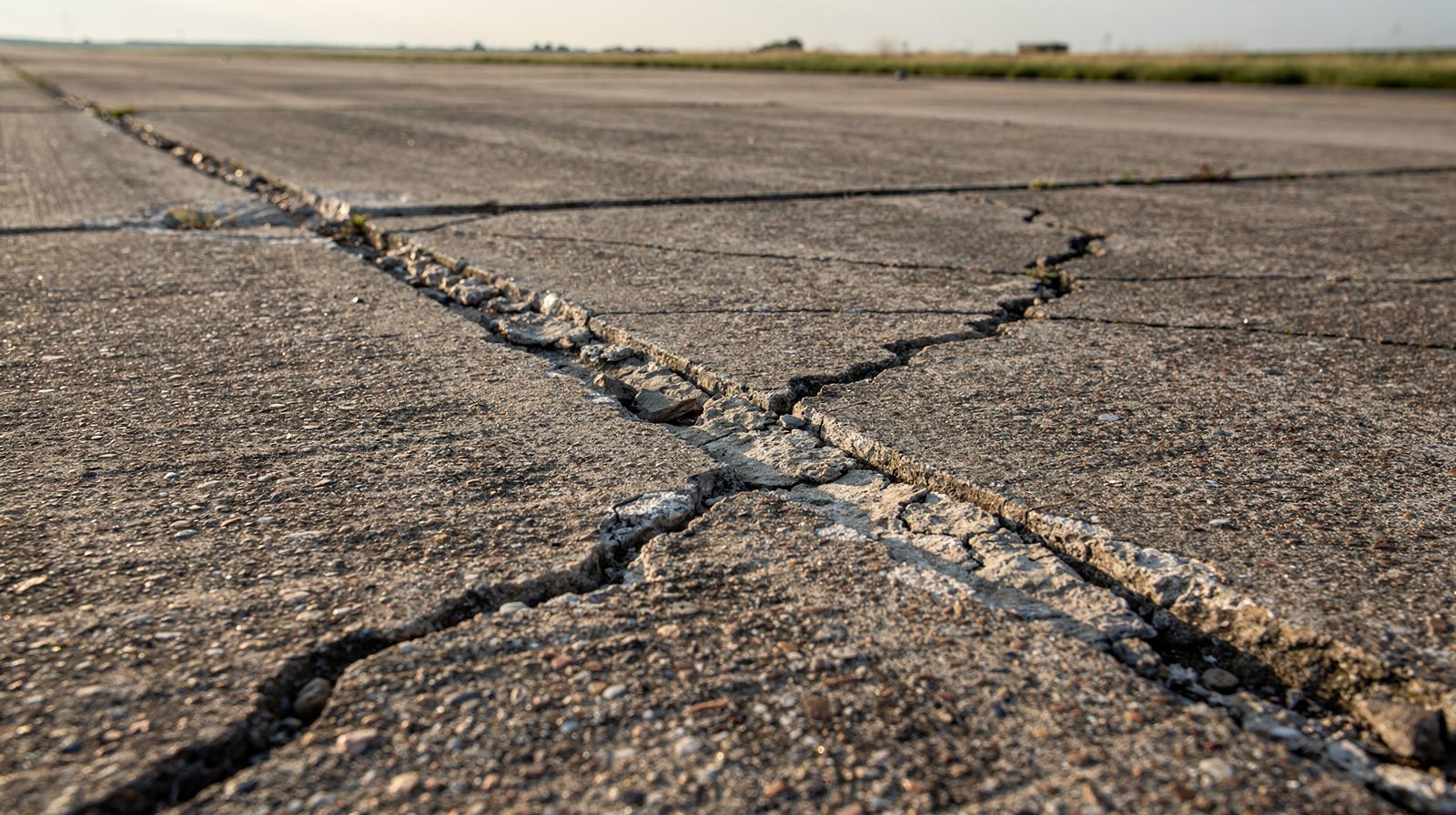
- Crack Control: By maintaining a net compressive stress state longer into the pavement’s service life, prestressed design suppresses transverse cracks that would otherwise develop at regular intervals in conventional concrete.
- Longer Spans: Without frequent joints every 4 to 6 meters as in JPCP, prestressed pavements can span 30 to 180 meters between joints, reducing water infiltration at joints and extending pavement life.
Pre-tensioning vs. Post-tensioning Methods
Two primary techniques apply prestressing to airport pavements:
- Pre-tensioning: Steel tendons are tensioned before concrete is cast around them. The concrete adheres to the tensioned steel through mechanical bond. Once concrete reaches design strength, the external tension is released, transferring the load to the concrete through this bond. Pre-tensioning is common in precast pavement elements and is well-suited to repetitive, standardized production.
- Post-tensioning: Concrete is cast with ducts (empty tubes) running through the slab. After concrete hardens, high-strength tendons are threaded through the ducts and tensioned using jacks, transferring the load directly to the concrete through anchors at the slab ends. Post-tensioning is more flexible for cast-in-place pavements and allows final tension adjustment during or after construction.
Both methods are recognized in FAA Advisory Circular 150/5320-6G. Post-tensioning is more frequently applied in long-span airport pavements due to its flexibility and suitability for varied site conditions.
| Method | Pre-tensioning | Post-tensioning |
|---|---|---|
| Timing of Stress Application | Before concrete is cast | After concrete hardens |
| Construction Sequence | Tension steel, cast concrete, release tension | Cast concrete with ducts, thread tendons, apply stress |
| Stress Transfer | Mechanical bond through concrete | Anchors at slab ends |
| Span Capability | Moderate to long (precast elements) | Long (continuous cast-in-place) |
| Flexibility | Limited (standardized elements) | High (adjustable after casting) |
| Common Application | Precast pavement units | Long-span airport runway pavements |
| Cost | Generally lower per element | Higher due to jacking and anchorage |
Applications in Airport Pavements
Prestressed concrete pavements are applied in civil airport contexts where pavement durability and reduced maintenance are high priorities:
- Runways: Long, straight surfaces that naturally accommodate long joint-free spans. Aircraft landing gear loads are predictable and intense, justifying the added structural investment.
- Taxiways: Movement areas where repeated turning and braking stresses occur. The reduced joint count and lower crack susceptibility improve drainage and reduce maintenance.
- Aprons: Ramp areas near terminals, hangars, and cargo facilities where heavy aircraft stand for extended periods. Prestressing reduces rutting and maintains surface integrity under sustained loads.
- Specialized Areas: High-volume parking, cargo staging, and fuel farm areas where compressive strength and crack resistance are beneficial.
Prestressed pavements are less commonly applied to low-traffic areas or where conventional systems are fully adequate, due to higher design and construction cost.
Structural Performance Comparison
Prestressed concrete pavements deliver measurable advantages in structural design parameters compared to conventional systems:
| Parameter | Prestressed Concrete Pavement | Jointed Plain Concrete Pavement | Conventional Reinforced Concrete |
|---|---|---|---|
| Typical Joint Spacing | 30 to 180 meters | 4 to 6 meters | 10 to 20 meters |
| Slab Thickness for Same Load | 20 to 40% thinner | Baseline | 10 to 20% thinner |
| Transverse Crack Frequency | Minimal to none (depends on prestress level) | Regular at joints, occasional between | Regular at reinforcement spacing |
| Water Infiltration at Joints | Significantly reduced | Higher (frequent joints) | Moderate |
| Fatigue Resistance | Excellent (compression dominates) | Good | Good |
| Initial Cost | Highest | Lowest | Moderate |
| Life-Cycle Cost | Competitive (fewer repairs) | Moderate | Moderate |
The table demonstrates that while initial cost is higher, the structural and durability advantages often justify the investment over a 20 to 30 year pavement life.
Material Requirements and Quality Control
Prestressed concrete pavements demand stricter material and construction specifications than conventional pavements:
- Concrete Strength: Concrete compressive strength must reach specified minimums, typically 35 to 45 MPa (5,000 to 6,500 psi), before tendons are tensioned, ensuring bond and preventing micro-cracking.
- Steel Tendons: High-strength, low-relaxation steel wire or strand is essential. Relaxation (stress loss over time) is minimized through material selection and stress-relief heat treatment.
- Durability: Tendons must be protected from corrosion through concrete cover, corrosion inhibitors, or stainless steel in aggressive environments (coastal areas with salt spray).
- Construction Tolerances: Joint spacing, slab thickness, and tendon positioning are closely controlled. Deviation from design specifications can compromise prestress effectiveness.
- Testing: Strand samples, concrete cylinder tests, and pull-tests on tendons verify material conformance before and during construction.
Quality control procedures are more rigorous than in JPCP because prestress state directly depends on material and installation accuracy.
Performance Benefits and Durability Factors
Prestressed concrete pavements deliver several performance advantages when properly designed and constructed:
- Crack Resistance: The continuous compressive stress dramatically reduces transverse cracking, extending intervals between major repairs or overlays.
- Joint Integrity: Fewer joints (or very wide spacing) reduce the frequency of joint-related failures such as spalling, faulting, and water infiltration.
- Rut Resistance: Compressive stress state suppresses plastic deformation under sustained or repeated loading, maintaining surface profile and drainage.
- Thermal Stability: Reduced cracking minimizes water entry through cracks, improving resistance to freeze-thaw cycles and salt intrusion.
- Noise: Long, uncracked spans can produce slightly lower tire-pavement noise than jointed systems, though this is pavement-type dependent.
Durability benefits are most pronounced in regions with high temperature swings, high traffic volume, or aggressive chemical environments (de-icing salts, coastal zones).
FAA and ICAO Standards
Prestressed airport pavement design is governed by established standards:
- FAA Advisory Circular 150/5320-6G: Includes design procedures, load calculations, prestress requirements, material specifications, quality control, and construction sequencing for both civilian and military airports. The circular provides methodologies for determining panel dimensions, tendon spacing, and stress levels.
- ICAO Annex 14: References flexible and rigid pavement design, though detailed prestressed specifications are primarily in national FAA/EASA documents rather than ICAO itself.
- ASTM Standards: ASTM D5340 (Standard Practice for Airport Pavement Condition Index Surveys) addresses evaluation methods applicable to all rigid pavements, including prestressed systems.
Compliance with FAA AC 150/5320-6G is mandatory for U.S. civilian airport projects receiving federal funding.
Inspection and Condition Assessment
Condition assessment of prestressed concrete pavements requires specialized techniques:
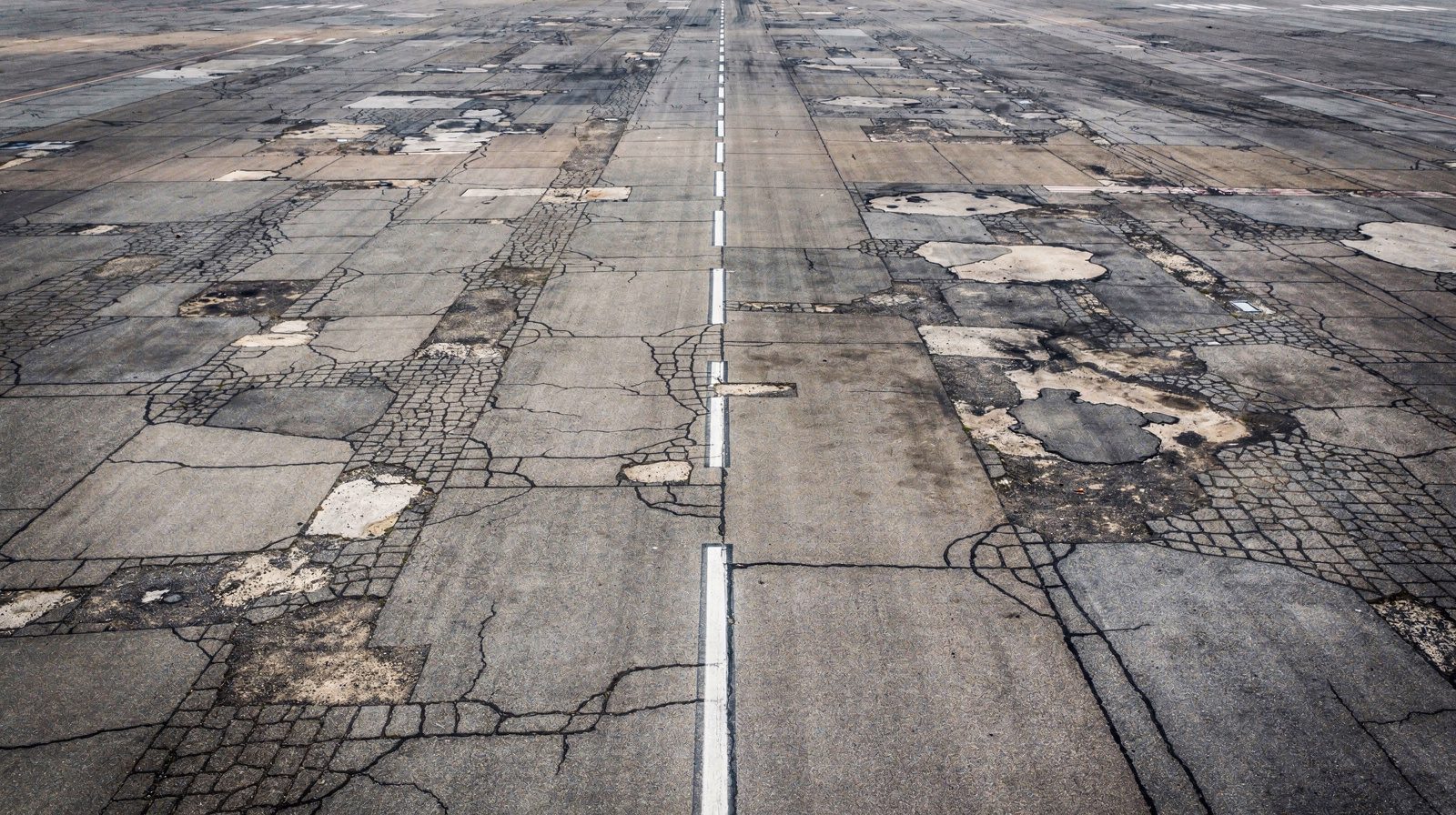
- Visual Inspection: Surface distress including spalling, corner breaks, longitudinal cracks, and foreign object damage are evaluated and documented.
- Surface Texture and Friction: Pavement friction characteristics are measured to ensure operational safety, especially on runways and high-speed taxiways.
- Subsurface Assessment: Ground-penetrating radar (GPR) and other non-destructive methods detect voids, delamination, and loss of prestress in the slab.
- Drone-Based Imaging: High-resolution imagery from unmanned aircraft provides rapid, safe assessment of large areas, capturing surface condition and distress patterns with precision.
- Condition Indices: Pavement Condition Index (PCI), International Roughness Index (IRI), and other metrics guide maintenance decisions and funding allocation.
Regular inspection is essential because early detection of cracking, joint deterioration, or prestress loss allows cost-effective repair or overlay before major structural compromise.
Maintenance and Repair Considerations
Maintenance of prestressed pavements differs from conventional systems:
- Joint Maintenance: While prestressed systems have fewer joints, those present require sealing and periodic maintenance to prevent water infiltration and joint spalling.
- Crack Repair: If transverse cracks develop (due to design inadequacy, construction defects, or unexpected environmental conditions), repair must address not only the crack but also any loss of prestress in the affected zone.
- Overlay Strategy: When overlay becomes necessary after 20 to 30 years, the existing prestressed slab provides excellent structural support for thin asphalt or composite overlays.
- Load Transfer: Dowel bars at remaining joints must be verified to transfer load effectively between slabs, preventing differential settlement and faulting.
Timely maintenance of joint seals and drainage systems maximizes the durability advantage of long-span prestressed design.
Economic and Environmental Considerations
Prestressed concrete pavements present a mixed economic and environmental profile:
- Higher Initial Cost: Material, labor, and specialized equipment for tensioning increase upfront capital expense compared to JPCP.
- Reduced Maintenance: Fewer cracks and joints mean lower long-term maintenance costs, potentially offsetting initial premium over a 20 to 40 year life cycle.
- Material Efficiency: Thinner slabs (20 to 40% reduction) reduce concrete volume, lowering material consumption and embodied carbon.
- Extended Service Life: Long-span design and crack resistance can extend pavement life beyond conventional systems, deferring overlay or reconstruction.
Life-cycle cost analyses are essential to justify prestressed design. The decision depends on expected traffic volume, maintenance budget, and long-term facility strategy.
Conclusion
Prestressed concrete pavement is a proven, high-performance rigid pavement system that introduces compressive stress into concrete slabs via pre-tensioned or post-tensioned steel tendons, enabling longer spans, thinner slabs, and superior crack resistance compared to conventional jointed or reinforced concrete designs. Widely applied at civil airports on runways, taxiways, and aprons, prestressed systems offer exceptional durability under heavy aircraft loading and variable thermal conditions. Design and construction must strictly comply with FAA Advisory Circular 150/5320-6G and relevant material standards to ensure prestress effectiveness and long-term performance. Regular condition assessment using visual, drone-based, and non-destructive inspection methods is essential to detect early signs of distress and optimize maintenance strategies. While initial costs exceed conventional systems, the reduced cracking, extended joint spacing, and lower maintenance burden often justify the investment over the pavement’s service life, making prestressed concrete an excellent choice for critical, heavily used airport facilities.
Często zadawane pytania
- What is the main difference between prestressed concrete pavement and conventional reinforced concrete?
- Prestressed concrete pavement introduces intentional compressive stress into the slab using high-strength steel tendons before service loads are applied, whereas conventional reinforced concrete only resists loads passively. This prestressing offsets tensile stresses from traffic and thermal changes, enabling longer joint spacing, thinner slabs, and reduced cracking.
- How does prestressing reduce transverse cracking?
- The continuous compressive stress created by tensioned tendons counteracts the tensile stresses that traffic loads and temperature gradients would normally impose on the concrete. Cracks form only when cumulative tensile stress exceeds the concrete strength. The prestress delays or prevents this threshold from being reached.
- Are there different methods for prestressing airport pavements?
- Yes. Pre-tensioning applies stress to steel tendons before concrete is poured around them, commonly used in precast elements. Post-tensioning tensions the tendons after concrete hardens, allowing longer continuous spans in cast-in-place airport pavements and providing adjustability during construction.
- What thickness reduction does prestressing allow?
- Prestressed concrete pavements typically require 20 to 40 percent less thickness than conventional jointed concrete designs for equivalent structural capacity, reducing material costs and environmental impact while maintaining or improving durability.
- Which FAA standards cover prestressed airport pavement design?
- FAA Advisory Circular 150/5320-6G includes design procedures, material specifications, and quality requirements for prestressed concrete pavements on civil airports. It addresses both pre-tensioned and post-tensioned systems.
- How do airport inspections assess prestressed concrete pavement condition?
- Drone-based and ground inspections evaluate surface distress (spalling, cracks, rutting), joint condition, surface texture, and foreign object damage. Specialized equipment can detect subsurface voids and loss of prestress, requiring advanced inspection techniques beyond visual assessment.