What is course deviation?
Course Deviation
Course deviation is the sideways offset of an aircraft from its intended course, shown as an angle or a distance.
Course, track and heading
Three terms are easy to confuse. The FAA Pilot’s Handbook of Aeronautical Knowledge defines them as follows:
- Course is the intended path of the aircraft over the ground, as an angle from a reference direction.
- Heading is the direction in which the nose of the aircraft points.
- Track is the actual path over the ground. If the pilot corrects for the wind, track and course are identical.
The angle between the heading and the track is the drift angle. The wind correction angle is the correction that the pilot applies to the course. It gives a heading that makes the track match the course. If the wind blows from the left, the aircraft drifts to the right. The pilot then points the nose to the left.
Course deviation is the gap between the track and the course. Wind drift is one cause. AC 90-105A lists other error sources below.
How an indicator shows course deviation
A course deviation indicator (CDI) has a course selector, a left-right needle and a TO/FROM indicator. The needle moves away from center when the aircraft leaves the selected course. The three main kinds of signal give different scales.
VOR: an angle
A very high frequency omnidirectional range (VOR) station sends radials. A radial is a line of magnetic bearing that extends outward from the station. Radials are numbered from 001, which is 1 degree east of magnetic north, up to 360. On a CDI in VOR mode, each dot of the scale is approximately 2 degrees.
ILS localizer: an angle with a set width at the runway
The localizer of an instrument landing system (ILS) gives course guidance to the runway centerline. The signal is set for a course width of 213 m (700 ft) at the runway threshold, from full-scale fly-left to full-scale fly-right. The approach course of the localizer is the front course. The line along the runway centerline in the opposite direction is the back course. Without reverse sensing, the pilot must steer away from the needle on a back course, and on the front course when flying outbound.
GPS and other area navigation modes: a distance
In area navigation (RNAV) and GPS modes, the CDI shows a distance, not an angle. The Aeronautical Information Manual (AIM) gives these full-scale values:
| Phase of flight | Full scale each side of course |
|---|---|
| En route | ±9.3 km (±5 NM) |
| Terminal area | ±1.85 km (±1 NM) |
| At the final approach waypoint | ±556 m (±0.3 NM) |
The sensitivity changes smoothly from ±1 NM to ±0.3 NM over the last 2 NM (3.7 km) before the final approach waypoint. If the needle is not centered, the deflection grows as the scale narrows. This can look as if the aircraft moves away from the course, even on an acceptable intercept heading. The AIM says that the digital cross-track error, if the receiver shows it, helps the pilot stay oriented.
Full-scale deflection is the needle position at the edge of the scale.
Reading the needle correctly
The CDI shows where the course is, relative to the aircraft. In a VOR crosswind example, the aircraft drifts to the left of the radial. The needle moves to the right of center, in the direction of the desired radial.
Fly the selected course with a TO indication when you fly toward the station. Fly it with a FROM indication when you fly away. If you do this wrongly, the needle action is reversed. The needle then points away from the course.
How a pilot corrects it
A pilot does not just turn toward the needle. That overshoots the course and makes an S turn to the left and right of it. The Pilot’s Handbook gives this method:
- Fly a heading that returns the aircraft toward the course, for example a turn to the right if the needle is to the right.
- When the needle centers, turn back toward the original heading, but not all the way. The wind drift correction must stay in the heading.
- If the needle moves again, adjust in small steps. The handbook example starts with a 10 degree correction, then reduces it to 5 degrees when the needle shows that 10 is too much.
For minor needle fluctuations, wait a moment. If the needle does not recenter, correct the heading.
Measuring it in performance-based navigation
In performance-based navigation, FAA AC 90-105A splits the error into parts:
- Flight technical error (FTE) is the accuracy of aircraft control, measured against the indicated desired position. It does not include blunder errors.
- Path definition error is the difference between the defined path and the desired path at a specific point.
- Navigation system error is the difference between the true position and the estimated position.
- Total system error is the difference between the true position and the desired position. It equals the vector sum of the three errors above.
The cross-track error is the difference between the path that the system computes and the aircraft position relative to that path. The circular also calls it the cross-track deviation.
A required navigation performance (RNP) value is the lateral navigation performance, in NM, that the aircraft meets for 95 percent of the flight time. For normal operations, the cross-track error should stay within half the RNP value. For RNP 1, that is 0.5 NM (926 m). Brief excursions of up to one times the RNP value are allowed in turns.
On the final approach segment of an RNP approach, the total system error must stay within ±0.3 NM (556 m). This holds for 95 percent of the flight time. The 95 percent flight technical error should not exceed 0.25 NM (463 m).
Other terms with the word deviation
- Compass deviation. Magnetic fields inside the aircraft deflect the compass needle. This deflection is compass deviation. It differs for each aircraft and each heading. A deviation card near the compass lists the correction, usually at 30 degree intervals. It is not the offset from a course. Magnetic variation is a third term. It is the angle between true north and magnetic north.
- Pilot deviation. FAA Order JO 8020.16E defines it as an action of a pilot that violates a regulation in Title 14 of the Code of Federal Regulations. The definition also covers an air defense identification zone tolerance. It is a regulatory term. It does not describe a distance from a course.
What it means on an airfield
The term describes aircraft navigation, not airfield inspection. It links to airfields in three ways:
- Approach type. In AC 150/5300-13B, a non-precision approach is one that gives course deviation information but no glidepath deviation information.
- Localizer alignment. The ILS localizer defines the course to the runway centerline. Its course width is 213 m (700 ft) at the threshold.
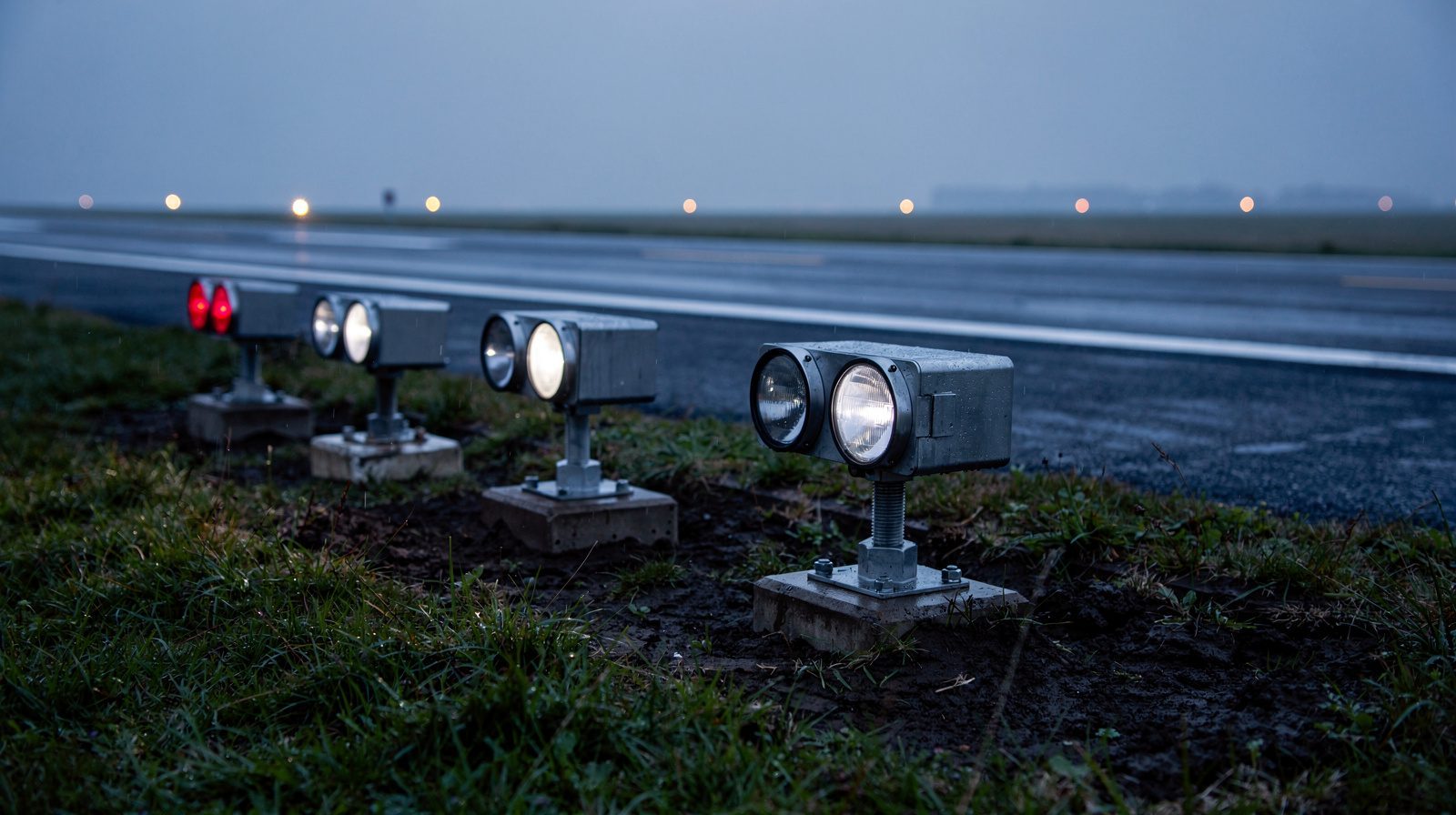
- Visual guidance. A precision approach path indicator (PAPI) shows the glide path, not the course. The AIM says that the runway or the runway lights give lateral course guidance. The PAPI units do not give the pilot a course.
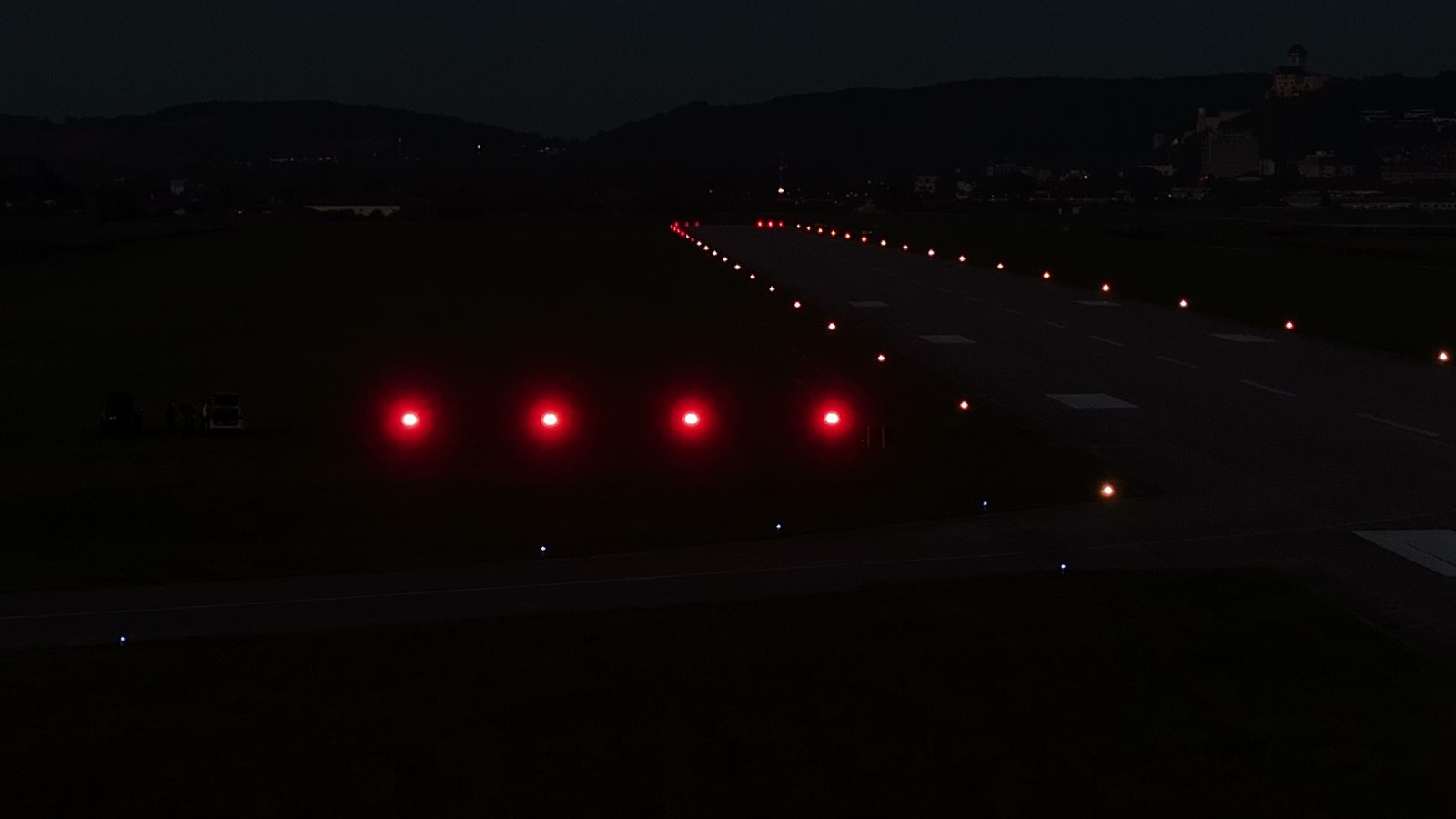
TarmacView does not measure course deviation. It inspects airfield lighting by drone, including the PAPI units and the runway lights that pilots use for the last part of an approach.
Frequently Asked Questions
- What is course deviation?
- Course deviation is the sideways offset of an aircraft from its intended course. A course deviation indicator (CDI) shows it as a needle that moves left or right of center. The FAA Pilot/Controller Glossary defines the course as the intended direction of flight in the horizontal plane, measured in degrees from north.
- How does a CDI show course deviation?
- A CDI shows it as a left-right needle. On a VHF omnidirectional range (VOR), each dot is approximately 2 degrees. On a GPS, the needle shows distance. Full scale is ±5 NM en route, ±1 NM in the terminal area and ±0.3 NM on final approach.
- What is aircraft route deviation?
- Aircraft route deviation is the cross-track error, which is the distance between the aircraft and its planned path. FAA AC 90-105A defines it as the difference between the path that the RNP system computes and the aircraft position relative to that path.
- Is turning toward the CDI needle enough to correct a deviation?
- No. Turning toward the needle makes the aircraft overshoot the course and fly an S turn from side to side. The pilot flies a heading that includes a wind correction angle, so that the aircraft keeps the course or re-intercepts it.
- What is a pilot deviation?
- A pilot deviation is an action of a pilot that violates a regulation in Title 14 of the Code of Federal Regulations. It also covers an air defense identification zone tolerance. FAA Order JO 8020.16E gives this definition. It is a regulatory term, not an offset from a course.
- What is the difference between course deviation and compass deviation?
- Compass deviation is the error that magnetic fields inside the aircraft cause in the magnetic compass. Course deviation is the offset of the aircraft from its intended course. A deviation card near the compass lists the compass correction for each heading.
- What is flight technical error?
- Flight technical error is the accuracy with which the aircraft is controlled, measured against the indicated desired position. It does not include blunder errors. FAA AC 90-105A treats it as one of three parts of total system error.
- How wide is the ILS localizer course?
- The localizer is adjusted for a course width of 700 feet (213 m) at the runway threshold, from full-scale fly-left to full-scale fly-right. The FAA Aeronautical Information Manual gives this value. The localizer gives course guidance to the runway centerline.
References
- faa-phak-ch16
- Pilot's Handbook of Aeronautical Knowledge (FAA-H-8083-25C), Chapter 16: Navigation FAA
- faa-pcg-course
- Pilot/Controller Glossary, entry COURSE FAA
- faa-jo-8020-16e
- FAA Order JO 8020.16E, Air Traffic Organization Aircraft Accident and Aircraft Incident Notification, Investigation, and Reporting FAA
- faa-ac-150-5300-13b
- AC 150/5300-13B, Airport Design, Change 1 FAA
This is a reference entry. TarmacView provides drone inspection services and doesn't sell the equipment or materials described in this glossary.