Airfield Lighting Inspection Companies Compared, Drone and Ground
Who inspects and calibrates PAPI and airfield lighting in Europe: drone services, ground photometry vendors and flight inspection units, on what each measures.
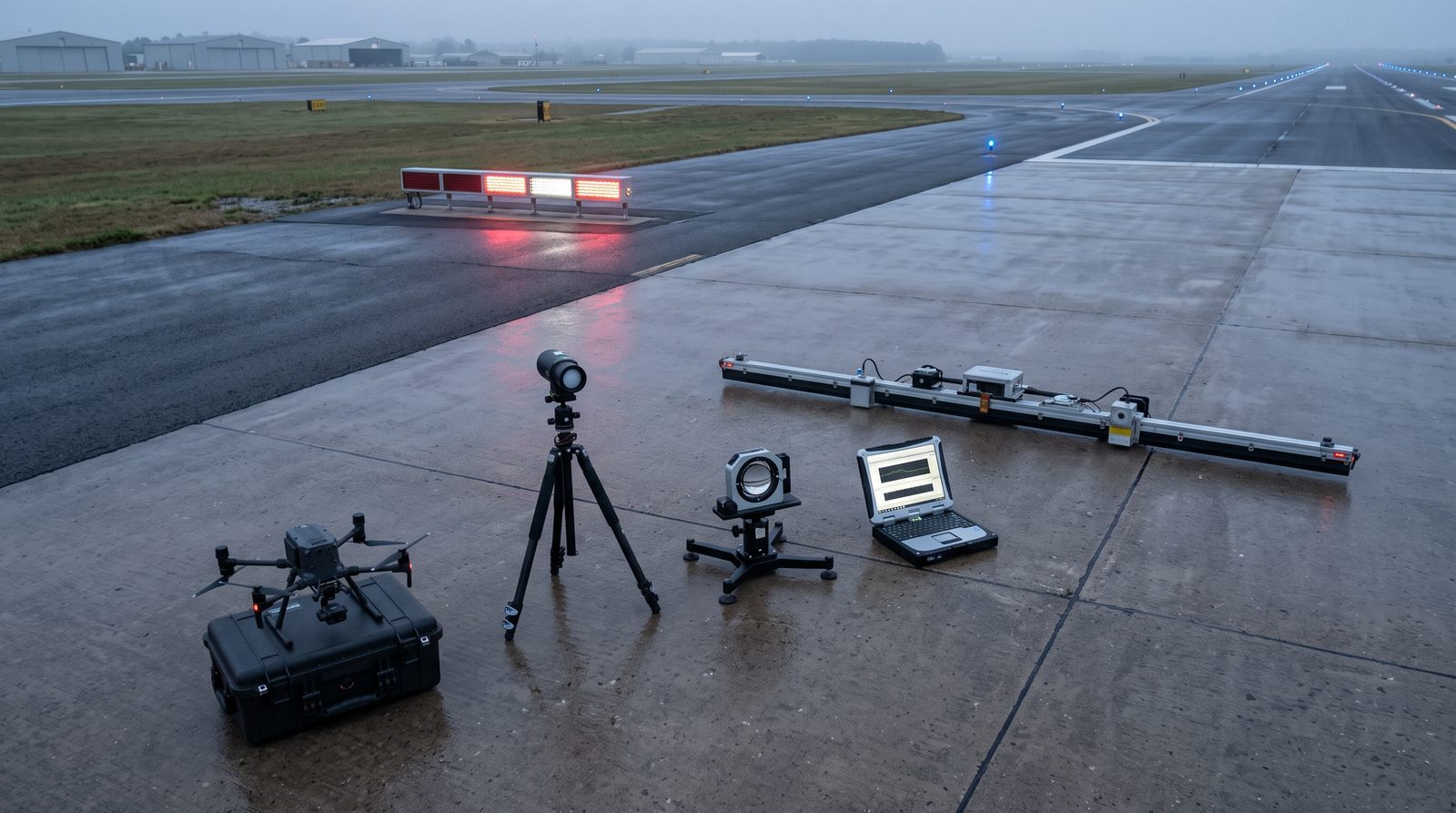
- 01 The parameter decides the vendor: aiming and colour favour a drone, candelas against a minimum favour a ground photometer, radio aids need an aircraft.
- 02 The drone services differ less in the aircraft than in what they retain. Raw imagery, method version and stated uncertainty are what make a number evidence.
- 03 Approvals are national, so check that an acceptance from one State applies in yours. Ask each vendor which authority accepted which parameter.
- 04 Ground photometry vendors sell equipment and testing, and their published times include the runway occupancy. Drone times do not, because there is none.
- 05 Directory listings are one place buyers meet these companies, so the claims there are worth checking.
Disclosure TarmacView is one of the drone services compared on this page, so read its column as a first-party claim. Check every vendor claim against the source listed for it at the end.
Who runs into this
The tender is open, or the maintenance manager has been told to get the PAPI checked. The first search returns a directory listing, a vendor site, a photometer manufacturer’s PDF and a flight inspection company’s page. The question underneath is simple and nobody on the first page answers it: which of these companies measures the thing we have to prove.
This page sorts the companies by what they measure. It names them, it says where each claim comes from, and it says where TarmacView sits among them, because TarmacView is one of them.
Where this applies, and where it does not
This applies to a European aerodrome buying verification of visual aids: PAPI, approach lighting, runway and taxiway lights. It covers the drone services that have appeared since about 2021. It also covers the ground photometry vendors that have measured intensity for decades, and the flight inspection organisations that own the radio aids.
It is not a comparison of drones or photometers as products. It does not cover the United States, where flight inspection is a federal service and the drone vendors are different. Radio navigation aid calibration is summarised only to say who does it.
- Drone-based inspection services
- Aerodromes whose question is geometry, colour, coverage, dimming behaviour and change since the last visit, and whose binding constraint is runway availability.
- Ground photometry and flight inspection
- Aerodromes whose question is absolute intensity in candelas against a published minimum, or radio navigation aids, which an aircraft still has to fly.
- What flips this
- If a ground photometry campaign is already contracted, a drone service earns its place only by removing occupancy or adding parameters the photometer misses. If a flight inspection is already contracted for the radio aids, the visual aids may ride along. The drone then competes on fixture-level detail rather than on the visit.
The field, and what each one measures
- TarmacView
- Drone. PAPI angles, approach and edge light arrays, colour, relative output, dimming steps. Pavement and obstacle services in active development, not offered yet. Between movements. Retained imagery, stated uncertainty, versioned method.
- CANARD Drones
- Drone. PAPI, approach lighting, runway lights, ILS measurements and pavement condition index (PCI) survey. States a DGAC France certification in its listing.
- FRACS
- Drone. PAPI calibration by the CAVOC colorimetric method developed with the DSNA and approved by STAC in 2021, in commercial operation since July 2022. Its 2025 article cites work at Geneva.
- Colibrex / FCS
- Drone inside a flight inspection organisation. NavAidDrone for ILS inspection, with a PAPI payload announced as in design on its page. FCS operates the aircraft for the radio aids.
- ADB Safegate, MALMS
- Vehicle photometry. Absolute intensity, chromaticity and coverage per fixture from a calibrated instrument on the runway. ADB Safegate states a full precision runway in under two hours as a booked occupancy.
- Flight inspection units
- Aircraft. FCS, FCSL, Flight Precision and ENAV list ILS flight inspection. Visual aids are checked from the aircraft on the same flight.
What each kind of company delivers
| Dimension | Drone services | Ground photometry | Flight inspection |
|---|---|---|---|
| PAPI transition angles | Measured per unit from the approach, with a stated uncertainty at the transparent vendors | Not measured, because the photometer sees intensity, not the angle from the pilot's eye | Checked from the aircraft against the flight inspection organisation's protocol. Ask for per-unit angles |
| Absolute intensity, candelas | Relative output only, unless a calibrated reference is in the chain | Measured directly per fixture, which is the instrument's purpose | Not measured |
| Colour and chromaticity | Ratios between channels and drift toward a boundary | Chromaticity measured against the standard's coordinates | Checked from the aircraft against the organisation's protocol |
| Approach lighting pattern | Imaged from the pilot's eye position, which finds missing and misaligned units and sequenced flashing | Per-fixture output from the ground, with the pattern not assessed as a whole | Assessed from the aircraft on the approach |
| Runway occupancy | None booked, flown between movements | Booked closure, with a vendor claim of under two hours for a full precision runway | The approach for each run |
| Radio navigation aids | Colibrex offers an ILS payload, TarmacView has it in development, and ICASC calls it a supplement to the aircraft | Not applicable | The core of the service |
| Evidence retained | Varies by vendor: ask for raw imagery, positioning log, method version and uncertainty | Instrument readings and calibration certificate | Instrumented flight record |
| Acceptance | National and parameter-specific: STAC approval for FRACS, a DGAC certification in CANARD's listing, and a documented method at TarmacView | Established in maintenance programmes and acceptance tests | Regulated flight inspection organisations |
| Where the claims live | Vendor articles and directory listings, and TarmacView publishes its method | Product catalogues and service PDFs | Corporate pages |
Governance and the record
Three questions separate the companies on this page more than their hardware does, and they are the questions to put in the tender.
What is retained after the visit: raw imagery and positioning logs, or a PDF. Which version of the method computed the number, and can the same data be reprocessed later. And what uncertainty is stated per measurement. A vendor who answers all three can show its method.
What each family is good and bad at
Drone-based inspection services
- A crew that drives, so no ferry charge and no waiting for a calibration flight to be in the area
- Fixture-level geometry from the pilot's eye position, which is what a PAPI or an approach array is judged on
- Every unit in an array covered rather than a sample, on every visit
- Repeatable missions, so the second visit measures change rather than a fresh state
- Absolute intensity in candelas needs a calibrated reference or another method
- Acceptance is national and recent, so ask which authority accepted which parameter
- Transparency varies between vendors, so ask what is retained
- Radio navigation aids still need an aircraft
Ground photometry and flight inspection
- Absolute photometry from a calibrated instrument, which is what an acceptance test asks for
- Decades of use inside maintenance programmes and by authorities
- Radio aids verified in the signal environment an aircraft actually flies
- Equipment vendors publish specifications a tender can quote
- A vehicle on the runway is a booked closure, and the aircraft charges ferry when it comes for the lights alone
- Per-fixture intensity says little about geometry or pattern from the pilot's eye
- Sampling and periodicity are often set by cost, so drift between visits may go unmeasured
- Published times exclude processing and reporting
Evidence and the honest limits
The strong claim on this page is the sorting: which parameter each family measures. That follows from physics and from the vendors’ own descriptions, and it does not depend on TarmacView’s view of itself.
The weaker claims are the vendors’ figures. Minutes per set and approvals are taken from the companies’ sites and listings as of early September 2026 and were not audited. CANARD’s numbers come from a directory listing, FRACS’s from its own articles, ADB Safegate’s from a service PDF. They are labelled as claims in the table for that reason.
What this page does not do is rank the companies. A ranking would need the same scope quoted by each, which no buyer has published, and it would be written by a competitor.
Objections worth raising before you buy
“CANARD is certified in France.” Its listing states a DGAC certification and says others were requested. Ask which parameters the certification covers, and what evidence is retained after a visit.
“FRACS is approved by the French authority.” Its method has a published STAC approval from 2021. Ask your own authority what it accepts, and ask any vendor for the parameter list the approval covers.
“The photometer vendor has been doing this for decades.” True, and for absolute intensity that is the right purchase. It does not measure the PAPI’s angle from the approach, which is the parameter that drifts.
“Our flight inspection already checks the PAPI.” From the aircraft, against the flight inspection organisation’s protocol, on a periodicity set by the radio aids. Whether that is enough is the subject of drone survey versus flight inspection .
Related tasks
If the question is what a PAPI visit costs, the PAPI calibration cost guide gives planning bands. If it is what the drone method delivers and where it stops, drone airport inspection is the method page. If it is the procedure for a photometric campaign, the photometric measurement procedure sets it out. And the service TarmacView sells against this page is the PAPI inspection .
Frequently Asked Questions
- Which company should calibrate our PAPI?
- Start from the parameter, not the vendor. A PAPI calibration is a geometric question. It covers the transition angle of each unit, the set angle, the spacing, and whether the colour transition sits where the standard says. The drone services on this page that list PAPI calibration measure that. The differences to ask about are in the method's transparency. Ask whether raw imagery is retained, whether the uncertainty is stated and whether the method has a version. A ground photometer measures intensity, which is a different question. A flight inspection aircraft can check the PAPI from the pilot's eye, but its instruments are built for the radio aids. So for a PAPI alone, shortlist the drone services and ask each what it retains.
- Does a drone service replace ground photometric testing?
- Not where the question is absolute intensity in candelas against a published minimum. A vehicle-mounted photometer from ADB Safegate or MALMS measures that directly, with a calibrated instrument. That is what an acceptance test or a Category II and III maintenance programme asks for. A drone measures relative output between units under one exposure, colour ratios and geometry, and needs a calibrated reference to state candelas. The two overlap on drift, symmetry and colour. They do not overlap on absolute photometry. A programme may need both, on different periodicities.
- What has each drone service had accepted, and by whom?
- Acceptance is national and parameter-specific, and the vendors describe it differently. CANARD Drones states a Direction générale de l'aviation civile (DGAC) France certification in its listing. FRACS's CAVOC method was developed with the French Direction des services de la navigation aérienne (DSNA). It has a published Service technique de l'aviation civile (STAC) approval from 2021. Colibrex works with Flight Calibration Services (FCS), a flight inspection company owned by DFS, Austro Control and Skyguide. Its drone work sits inside an existing flight inspection organisation. TarmacView documents its method and states uncertainty per measurement, and does not claim an accreditation. Ask any of the four the same question: which authority accepted which parameter, in writing.
- Why do the vendors' times differ so much?
- Because they count different things. FRACS publishes about thirty minutes per PAPI set with a drone. The airport-technology listing for CANARD says under twenty minutes per set with about six minutes of flight. ADB Safegate says a full precision runway in both directions takes under two hours with a mobile photometer. The drone figures are time on site between movements with no closure, while the photometer figure is a booked runway occupancy. Neither includes the processing and the report. The number that matters to an operations director is occupancy, and for the drone services it is zero by design.
- Who inspects the radio aids?
- A flight inspection organisation, with an aircraft, and that has not changed. FCS in Germany, FCSL and Flight Precision in the United Kingdom, and ENAV in Italy are examples that list instrument landing system (ILS) flight inspection. Aircraft verify these aids in the signal environment an aircraft actually flies through. Colibrex offers a drone payload for ILS inspection. International Committee for Airspace Standards and Calibration (ICASC) published a 2024 paper that calls the drone a valuable supplement to conventional, crewed flight inspection. Drone-based [radio aid verification](/products/ils-flight-inspection/) is in development at TarmacView and is not offered today.
- How much does any of this cost?
- The public procurement records found for this page are at contract level. A Highlands and Islands Airports notice for aeronautical flight inspection has an estimated value of 600,000 pounds. It covers a network framework with no stated term and was awarded to Flight Calibration Services. A Luton notice for ILS flight inspection is one aerodrome, but it is an ILS-only contract of 84 months valued at around 455,000 pounds. Neither is a per-visit price. What can be stated for Central Europe comes from operators. Aircraft flight calibration costs about 3,000 euros per measurement flight hour. It takes about an hour for the glide slope indicators, approach lighting and runway lighting of one bidirectional runway. Ferry is charged separately when the visit is not shared with a radio aid calibration. TarmacView quotes its drone survey per aerodrome. Treat any competitor figure you receive as a quote for a scope, and compare scopes before prices.
- Where do these companies actually show up when we search?
- On directories, vendor articles, product catalogues and PDFs. CANARD Drones has an airport-technology.com listing, MALMS has an airport-suppliers.com listing, and ADB Safegate publishes a service PDF. FRACS publishes articles, and TarmacView publishes a glossary, guides and blog posts. A buyer should treat a claim read in a listing as a claim, and ask the vendor to repeat it in the tender.
References
- airport-technology-canard
- PAPI Calibration, CANARD Drones product listing Airport Technology
- fracs-papi-2025
- Revolutionizing PAPI Calibration with Drone Technology FRACS, France Aviation Civile Services
- icasc-uas-2024
- UAS-Based NAVAID Flight and Ground Inspection International Committee for Airspace Standards and Calibration
- adbsafegate-photometric
- Photometric Testing and Performance of AGL Assets ADB SAFEGATE
- colibrex-papi
- PAPI measurement with the NavAidDrone Colibrex GmbH
- fracs-icao-grp21-ip21
- PAPI calibration using drones, information paper IP/21 ICAO, GREPECAS 21st meeting
- uk-caa-flight-inspection-organisations
- Approved flight inspection organisations UK Civil Aviation Authority
- fcs-gmbh-atc-network
- FCS Flight Calibration Services GmbH ATC Network
- enav-flight-inspection
- Flight inspection and validation ENAV
- malms-mobile
- MALMS Mobile Airport Suppliers, listing for Tailor Made Systems
- hial-flight-inspection
- Aeronautical Flight Inspection Services, Highlands and Islands Airports Limited UK public procurement record, via Stotles
- luton-ils-flight-inspection
- L22073-T-MC, ILS Calibration Service, notice 002848-2023 London Luton Airport Operations Limited, via Find a Tender
- tarmacview-papi-cost
- PAPI calibration cost in Europe: ranges and drivers TarmacView