What is a Photometer?
A photometer is an instrument that measures photometric quantities, which are light quantities weighted for the sensitivity of the human eye.
What a photometer measures
The CIE defines a photometer as an instrument for measuring photometric quantities. Photometry covers only visible light, which NIST gives as the range 360 nm to 830 nm. It takes the sensitivity of the human visual system into account. The CIE standard photometric observer has the relative spectral responsivity of the photopic luminous efficiency function, V(λ), or of the scotopic function, V’(λ). The SI units candela, lumen and lux carry information about human vision.
The main photometric quantities and units are:
- Luminous intensity: light emitted in a given direction, in candela (cd). The candela is the SI base unit of luminous intensity.
- Luminous flux: the light that a source emits in all directions, in lumen (lm). One lumen is one candela steradian.
- Illuminance: luminous flux falling on a surface per unit area, in lux (lx). One lux is one lumen per square metre.
- Luminance: luminous intensity per projected area in a given direction, in candela per square metre (cd/m²).
A radiometer is a different instrument. It measures radiometric quantities, which are not weighted for the eye. Irradiance is the radiometric counterpart of illuminance. The SI sets the luminous efficacy of radiation at 540 × 10^12 Hz at 683 lm/W, and that value ties the lumen to the watt.
How a photometer works
A photometer head has a detector and a filter that makes the detector respond like the eye. The standard photometers at NIST have a silicon photodiode, a V(λ)-matching filter and a precision aperture in a cylindrical housing. The filter is made of several layers of glass.
Three details decide how good a reading is:
- The reference plane. A head needs a limiting aperture or a flat diffuser in front of the filter. This defines the plane of measurement. NIST says that without it the responsivity can vary with the distance to the source, and serious errors can occur at close range.
- Temperature. The responsivity of a photometer depends on temperature. If the photometer is not temperature controlled or monitored, use it close to its calibration temperature, or apply a correction.
- The spectrum of the source. NIST calibrates photometers with incandescent lamps at 2856 K. When the photometer measures any other kind of source, spectral mismatch errors occur. To compensate for them, someone must measure the relative spectral responsivity of the photometer.
Types of photometer
The CIE names photometers by what they measure:
- An illuminance meter is an instrument for measuring illuminance.
- A luminance meter is an instrument for measuring luminance.
- A goniophotometer is a photometer for measuring the directional light distribution of sources, luminaires, media or surfaces. It gives the intensity of a light in many directions.
- A photometer on an integrating sphere measures luminous flux. The sphere has a diffusely reflecting interior. The illuminance on the wall is theoretically proportional to the luminous flux that enters or arises in the sphere. A photometer reads it through a small window.
A sphere can also carry a spectroradiometer. The CIE calls that combination a sphere-spectroradiometer, and it measures the total spectral radiant flux of a source. NIST says that goniophotometers traditionally realised the luminous flux unit, and that they need a large dark room. NIST now uses an absolute integrating sphere method.
Photometer, spectrophotometer and spectroradiometer
A photometer gives one value of a photometric quantity. The CIE defines a spectrophotometer as an instrument for measuring the quotient of two values of a radiometric quantity at the same wavelength. It does not weight the result for the eye. A spectroradiometer measures radiometric quantities in narrow wavelength intervals. A spectrometer is the general name for an instrument that splits light by wavelength.
Calibration and accuracy
NIST realises the candela with a detector-based method. It maintains the candela on a group of standard photometers, which are traceable to its primary optical watt radiometer. NIST recalibrates these standard photometers every year. The relative expanded uncertainty (k = 2) of its illuminance responsivity unit is 0.39 %.
NIST calibrates a customer photometer by direct comparison with its standard photometers. The test uses a 1000 W lamp at 2856 K (CIE Illuminant A) on a photometry bench. The usual distances are 2.4 m and 3.6 m, at about 75 lx and 180 lx. NIST reports the error of the meter at each illuminance level. It does not adjust the reading, unless the customer asks and the meter can be adjusted. NIST also sells lamp standards for luminous intensity, luminous flux and colour temperature.
Photometers and airfield lighting
The 50 percent rule
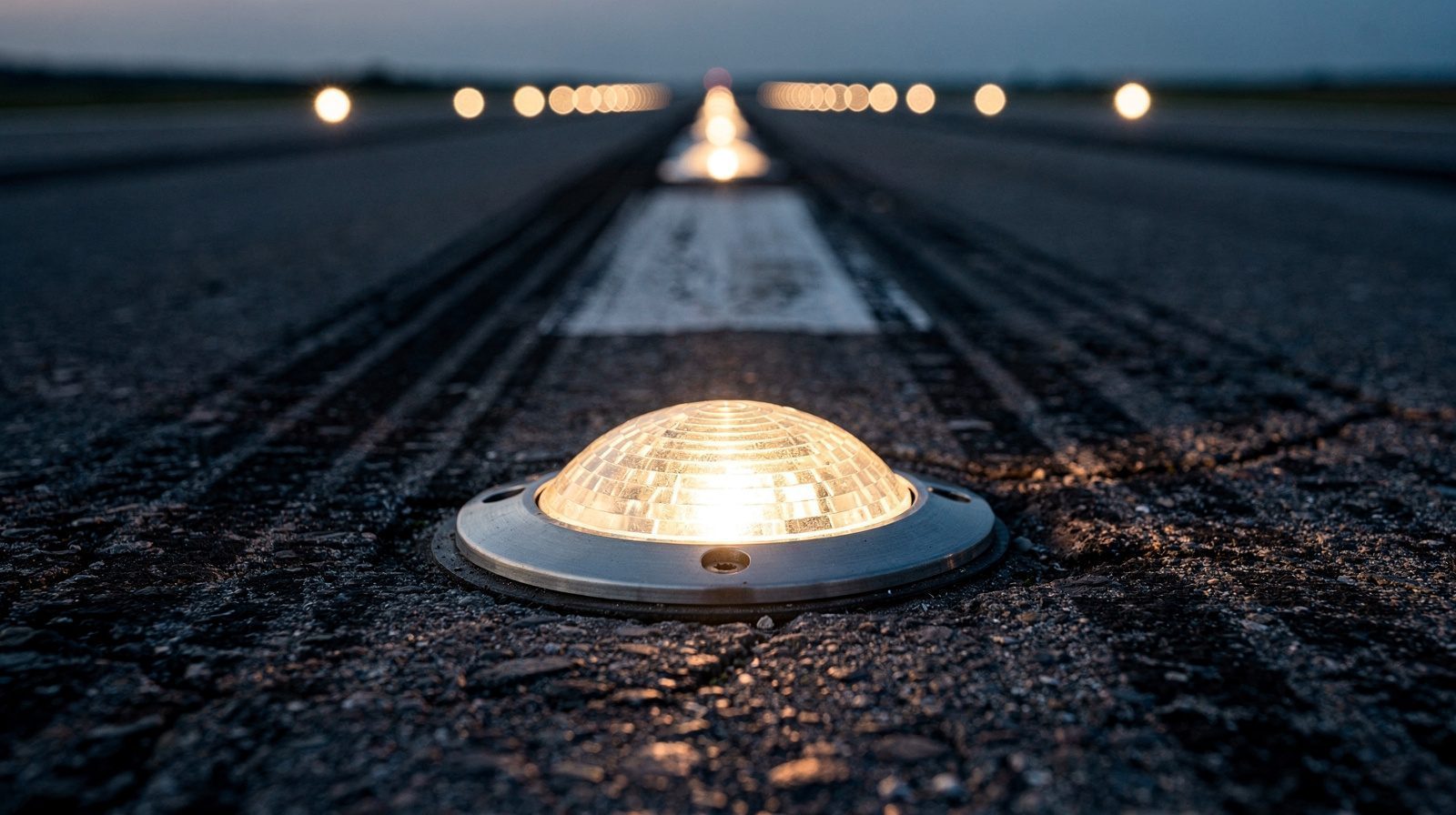
The rules for aerodromes set a limit in terms of a photometric quantity. A light is unserviceable when its main beam average intensity is below 50 % of the value in the specification. This is a Standard in ICAO Annex 14 section 10.5.1. The same rule is a requirement of Regulation (EU) No 139/2014, in ADR.OPS.C.015(c)(1). For a light unit that is designed to give more than the specified value, the 50 % applies to the higher design value.
The main beam average intensity is the arithmetic average of the intensities at the grid points. The grid points lie inside and on the edge of the ellipse of the main beam. Annex 14 Appendix 2 says that the average intensity should never fall below 50 % of the figure value. It adds that airport authorities should aim to keep the light output close to the specified minimum average.
Measurement in the field
EASA guidance says that the aerodrome operator should ensure the serviceability of the lights with photometric measurements at appropriate intervals. This is part of the maintenance programme. It comes in addition to the daily checks for light failures, breakage and gross misalignment.
For a Category II or III precision approach runway, Annex 14 section 10.5 and the matching EASA AMC recommend more:
- in-field measurement of the intensity, beam spread and orientation of the lights in the approach and runway lighting systems
- measurement of all lights, as far as practicable
- a mobile measuring unit, or an appropriate measuring unit, of sufficient accuracy to analyse the characteristics of each light
- a frequency that follows traffic density, local pollution, equipment reliability and earlier results
- at least two measurements a year for in-pavement lights and one a year for other lights
These are Recommendations and AMC. They are not binding requirements.
The FAA gives a stricter maintenance target in AC 150/5340-26C. It says to clean or service runway lights when the brightness is below 70 % of the minimum output for full intensity. FAA says that a hand-held spot meter can only detect gross differences between lights and cannot account for alignment errors. Mobile systems can test each fixture. Some of them produce an isocandela diagram of each light, and some give the GPS position of each light. The FAA also recommends photometric tests before and after cleaning, re-lamping or realignment. The aim is to learn whether maintenance is necessary and whether it worked.
Apron lighting
An illuminance meter checks apron floodlighting. CS ADR-DSN.M.750 asks for an average horizontal illuminance of at least 20 lux on an aircraft stand. The uniformity ratio (average to minimum) is not more than 4 to 1. It asks for a vertical illuminance of 20 lux at a height of 2 m above the apron in relevant directions. Other apron areas need 50 % of the average illuminance on the stands.
Switch-over time
CS-ADR-DSN also gives photometric measurement as a good practice to evaluate switch-over time. Switch-over time is the time for a light to fall from 50 % intensity and recover to 50 % during a power supply changeover. The light runs at 25 % intensity or more.
What a drone can and cannot do
A photometer measures candela. A drone camera records counts. The counts depend on the lens, the exposure and the distance. A drone survey can therefore compare each light with its neighbours and show a unit whose output drifts. TarmacView reports the output of lights relative to the neighbouring units. An absolute value in candela needs a calibrated photometer, as a reference reading on site or as a cross-calibration. See airfield lighting inspection for what a drone survey covers and what stays with the ground measurement.
Frequently Asked Questions
- What is a photometer used for?
- A photometer measures how much light a source emits, or how much light reaches a surface. The units follow the sensitivity of the human eye. On an airfield it checks the output of aeronautical ground lights and the illuminance on aprons. A photometer also serves as the reference instrument when other light meters are calibrated.
- What does a photometer measure on an airfield?
- It measures the light output of aeronautical ground lights, in candela for luminous intensity, and the illuminance on aprons, in lux. EASA guidance says the aerodrome operator should ensure the serviceability of the lights with photometric measurements at appropriate intervals, as part of the maintenance programme.
- What instrument measures luminous flux?
- A photometer measures luminous flux, in lumen, with an integrating sphere or a goniophotometer. In a sphere, the wall illuminance is proportional to the luminous flux that enters or arises in the sphere. A goniophotometer measures the light in many directions. NIST says the unit was traditionally realised with goniophotometers, and it now uses an integrating sphere method.
- What is the difference between a photometer and a radiometer?
- A photometer measures photometric quantities, a radiometer measures radiometric quantities. Photometric units such as the lumen and the lux carry information about human vision. Irradiance is the radiometric counterpart of illuminance.
- What is a goniophotometer?
- A goniophotometer is a photometer that measures how a source emits light in different directions. The CIE defines it as a photometer for measuring directional light distribution characteristics of sources, luminaires, media or surfaces.
- How is a photometer calibrated?
- A photometer is calibrated by comparison with reference photometers that are themselves traceable to the candela. NIST calibrates photometers on a photometry bench with a 1000 W lamp at 2856 K, and it recalibrates its own standard photometers every year. NIST reports the error of the meter at each illuminance level and does not adjust the reading unless the customer asks.
- What is the difference between a photometer and a spectrophotometer?
- A photometer measures photometric quantities, which are weighted for the human eye. The CIE defines a spectrophotometer as an instrument for measuring the quotient of two values of a radiometric quantity at the same wavelength. A spectrophotometer has no eye weighting built in.
- Can a drone replace a photometer for airfield lighting?
- No. A drone camera records counts, not candela, and the counts depend on the lens, the exposure and the distance. A drone survey can compare lights with their neighbours. A value in candela needs a calibrated photometer, on the ground or as a reference reading.
References
- cie-ilv-photometer
- CIE S 017:2020 International Lighting Vocabulary, 2nd edition (e-ILV): photometer, illuminance meter, luminance meter, goniophotometer, radiometer CIE
- cie-ilv-quantities
- CIE S 017:2020 International Lighting Vocabulary, 2nd edition (e-ILV): illuminance, luminance, CIE standard photometric observer CIE
- cie-ilv-integrating-sphere
- CIE S 017:2020 International Lighting Vocabulary (e-ILV), entry 17-25-028: integrating sphere CIE
- cie-ilv-spectrophotometer
- CIE S 017:2020 International Lighting Vocabulary (e-ILV), entry 17-25-008: spectrophotometer CIE
- cie-ilv-sphere-spectroradiometer
- CIE S 017:2020 International Lighting Vocabulary (e-ILV), entry 17-25-009: sphere-spectroradiometer CIE
- bipm-si-brochure-9
- The International System of Units (SI), 9th edition (2019), SI Brochure BIPM
- nist-photometry
- Photometry NIST
- nist-sp-250-95
- NIST Special Publication 250-95, NIST Measurement Services: Photometric Calibrations (Zong, Nadal, Tsai, Miller, July 2018) NIST
- easa-ear-aerodromes
- Easy Access Rules for Aerodromes (Regulation (EU) No 139/2014), including CS-ADR-DSN Issue 7 EASA
- icao-annex-14-vol-i
- Annex 14 to the Convention on International Civil Aviation, Volume I, Aerodrome Design and Operations, 9th edition (July 2022) ICAO
- faa-ac-150-5340-26c
- AC 150/5340-26C, Maintenance of Airport Visual Aid Facilities (20 June 2014) FAA
This is a reference entry. TarmacView provides drone inspection services and doesn't sell the equipment or materials described in this glossary.