What is Taxiing?
Taxiing is the movement of an aircraft on an airport surface under its own power.
What counts as taxiing
The FAA Pilot/Controller Glossary defines taxiing as the movement of an airplane under its own power on the surface of an airport. The same entry covers the surface movement of wheeled helicopters. EASA, ICAO and the FAA all write “taxiing” and “taxi”. “Taxing” is a misspelling.
Pushback is not taxiing, because a tug moves the aircraft. FAA AC 150/5300-13B recommends a pushback area. It needs enough space to push aircraft back to a point where they start to manoeuvre under their own power.
Taxiing from stand to runway and back
EASA specifies taxiway centre line marking that gives continuous guidance between the runway centre line and the aircraft stands. A flight uses this path twice:
- Before take-off the aircraft taxis from the stand toward the runway. This is “taxiing for take-off”.
- After landing the aircraft leaves the runway and taxis to its stand. A flight status of “taxiing” after landing means this movement.
A rapid exit taxiway joins a runway at an acute angle. It lets a landing aeroplane turn off at a higher speed than on other exit taxiways, so the aeroplane occupies the runway for less time.
Where aircraft taxi
A taxiway is a defined path on a land aerodrome for the taxiing of aircraft. It links one part of the aerodrome to another. ICAO and EASA name two kinds on an apron:
- An aircraft stand taxilane is a part of an apron that gives access to aircraft stands only.
- An apron taxiway is a part of the taxiway system on an apron. It gives a through taxi-route across the apron.
The manoeuvring area is the part of an aerodrome for take-off, landing and taxiing, excluding aprons. Aircraft can therefore also taxi on a runway. EASA specifies a taxiway centre line marking on a runway when the runway is part of a standard taxi-route.
The aerodrome operator assesses the need for standard taxi-routes. It does this as part of the surface movement guidance and control system. If the operator provides standard routes, it identifies them. It also gives the information for the Aeronautical Information Publication (AIP) to the aeronautical information services provider.
How wide a taxiway is
The width of a straight taxiway depends on the outer main gear wheel span of the aircraft. This is the distance across the outer edges of the main wheels. EASA specifies these minimum widths:
| Outer main gear wheel span | Minimum taxiway width |
|---|---|
| under 4.5 m | 7.5 m |
| 4.5 m up to under 6 m | 10.5 m |
| 6 m up to under 9 m | 15 m |
| 9 m up to under 15 m | 23 m |
Clearances and holding positions
In Class D airspace at an airport with an operating control tower, 14 CFR 91.129(i) applies. It says no person may operate an aircraft on a runway or taxiway without an appropriate clearance from air traffic control.
Sometimes the air traffic service provider does not manage the apron. Then the operator coordinates start-up clearances, push-back clearances and taxi instructions with that provider.
A runway-holding position protects a runway. Taxiing aircraft and vehicles must stop and hold there, unless the aerodrome control tower authorises otherwise. Radiotelephony calls it the holding point. Two aids mark the position:
- A runway-holding position marking on the taxiway, specified in CS ADR-DSN.L.575.
- A stop bar of red lights across the taxiway. The lights sit at most 3 m apart. EASA says to provide one at every runway-holding position. This applies to a runway that operates in runway visual range below 550 m, with exceptions.
Helicopters
A wheeled helicopter can taxi on the ground. EASA specifies a helicopter ground taxiway for the surface movement of a wheeled helicopter under its own power.
A helicopter can also air taxi along a helicopter air taxiway. This is movement above the surface, at a height normally associated with ground effect and at a ground speed below 37 km/h (20 kt).
Guidance for the taxiing crew
EASA specifies these aids for taxiways:
- A yellow taxiway centre line marking, at least 15 cm wide and continuous. It breaks only where it meets a holding position marking.
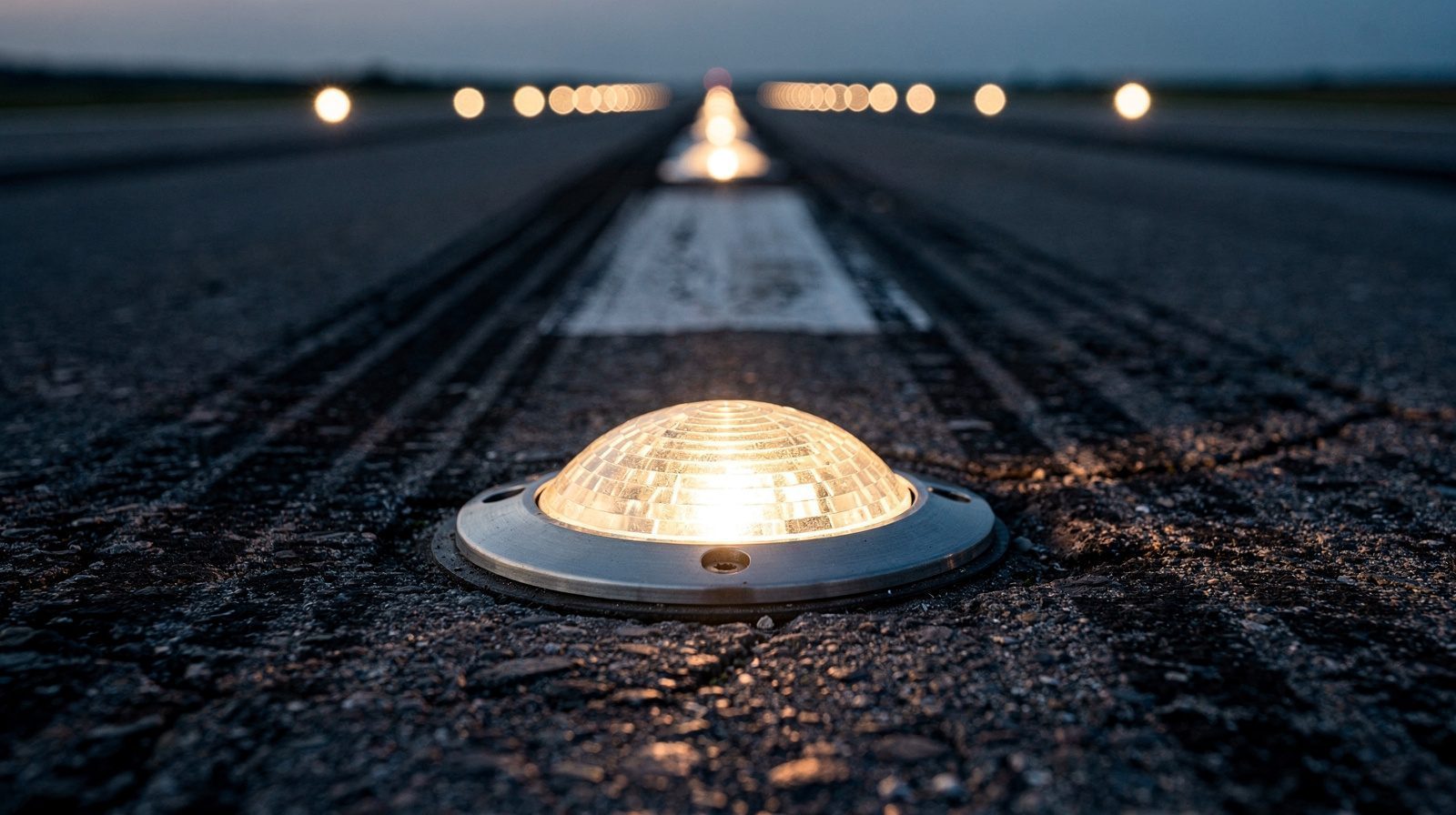
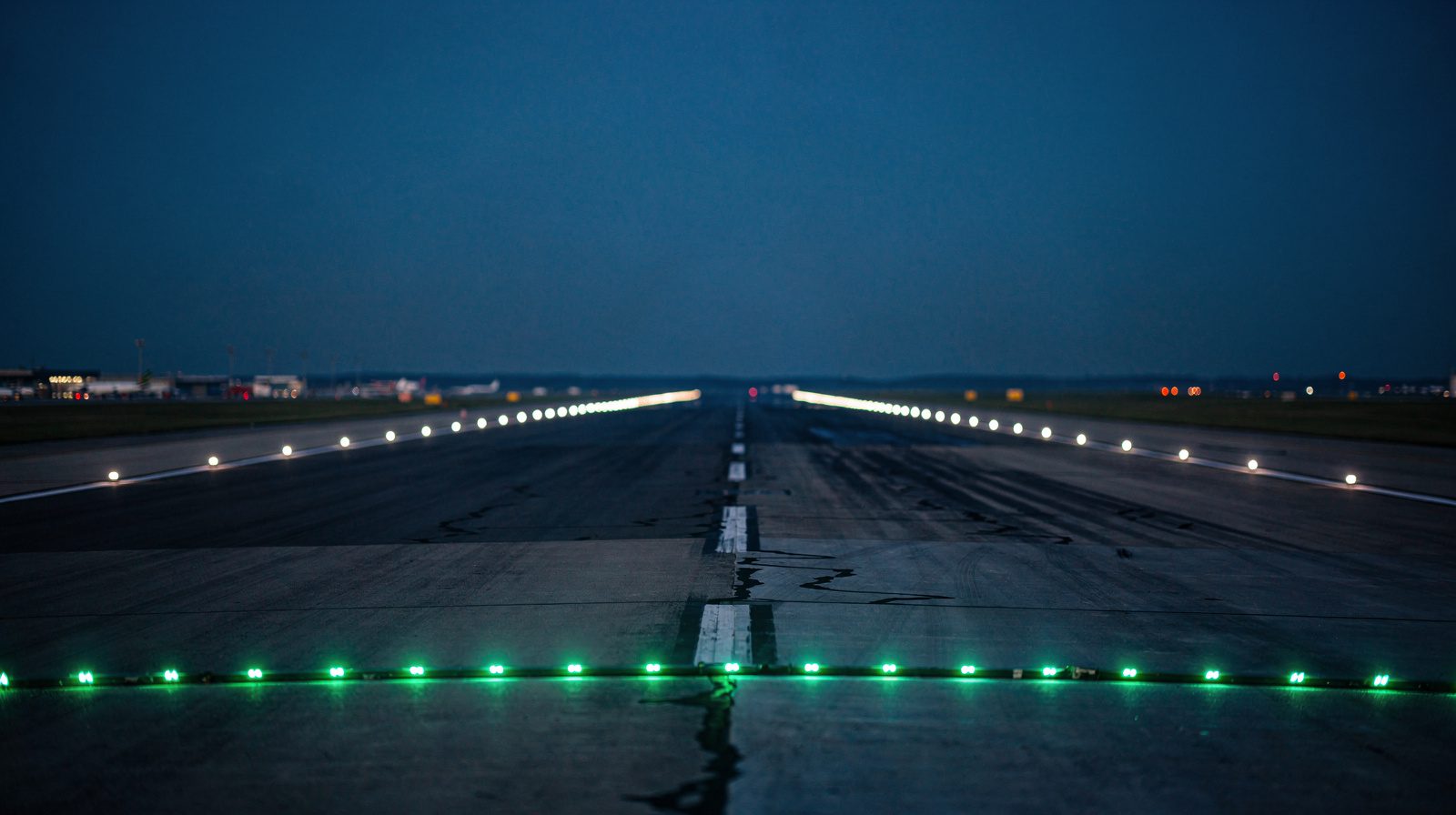
- Blue taxiway edge lights. On a straight section they sit at most 60 m apart.
- Green taxiway centre line lights, for example where the runway visual range is below 350 m.
The FAA describes the same colours for taxiway edge and centerline lights. Edge lights outline the taxiway in darkness or restricted visibility. Centerline lights help ground traffic in low visibility.
Taxiing and airfield inspection
Taxiway lights are one of the aids that guide a crew at night and in low visibility. TarmacView inspects taxiway edge and centreline lights with a drone.
Frequently Asked Questions
- What does taxiing mean in aviation?
- Taxiing is the movement of an aircraft on an airport surface under its own power. The FAA glossary also uses the term for the surface movement of helicopters that have wheels.
- What does taxiing for take-off mean?
- It means the aircraft moves under its own power on taxiways from the stand toward the runway it will use. Taxi guidance links the aircraft stands and the runway centre line. The aircraft has not yet started its take-off roll.
- What does taxiing to the terminal mean?
- The aircraft leaves the runway and moves under its own power to its stand at the terminal. It follows taxiways and apron taxi routes. Taxi guidance covers the path between the runway and the aircraft stands.
- Is it taxing or taxiing?
- The correct term is taxiing. The FAA, EASA and ICAO texts use taxiing and taxi. Taxing is a common misspelling.
- Is pushback the same as taxiing?
- No. During pushback a tug moves the aircraft. Taxiing is movement under the aircraft's own power. It starts when the aircraft can manoeuvre by itself.
- Do aircraft taxi on runways?
- Yes. The runway is part of the manoeuvring area, which is used for take-off, landing and taxiing. A runway can also be part of a standard taxi-route.
- What colours guide a taxiing crew?
- Taxiway markings are yellow, taxiway edge lights show blue and taxiway centre line lights show green. These are the EASA specifications. The FAA describes the same blue and green lights.
- Where must a taxiing aircraft stop?
- At a runway-holding position, unless the aerodrome control tower authorises otherwise. EASA defines it as a position that protects a runway, and a stop bar of red lights can supplement the marking.
References
- faa-pcg-taxi
- Pilot/Controller Glossary, entry TAXI FAA (third-party copy at angleofattack.com)
- faa-ac-150-5300-13b
- AC 150/5300-13B, Airport Design FAA
- easa-ear-aerodromes
- Easy Access Rules for Aerodromes (Regulation (EU) No 139/2014), including CS-ADR-DSN Issue 7 and CS-HPT-DSN EASA
- faa-aim-2-1
- Aeronautical Information Manual, Chapter 2 Section 1, paragraph 2-1-10 Taxiway Lights FAA
- icao-annex-14-vol-i
- Annex 14 to the Chicago Convention, Aerodromes, Volume I, 9th edition (July 2022), Definitions ICAO, copy hosted by the Swiss FOCA
- ecfr-14-cfr-91-129
- 14 CFR 91.129, Operations in Class D airspace, paragraph (i) US Code of Federal Regulations (eCFR)
This is a reference entry. TarmacView provides drone inspection services and doesn't sell the equipment or materials described in this glossary.