What is a Runway Guard Light?
Runway Guard Light
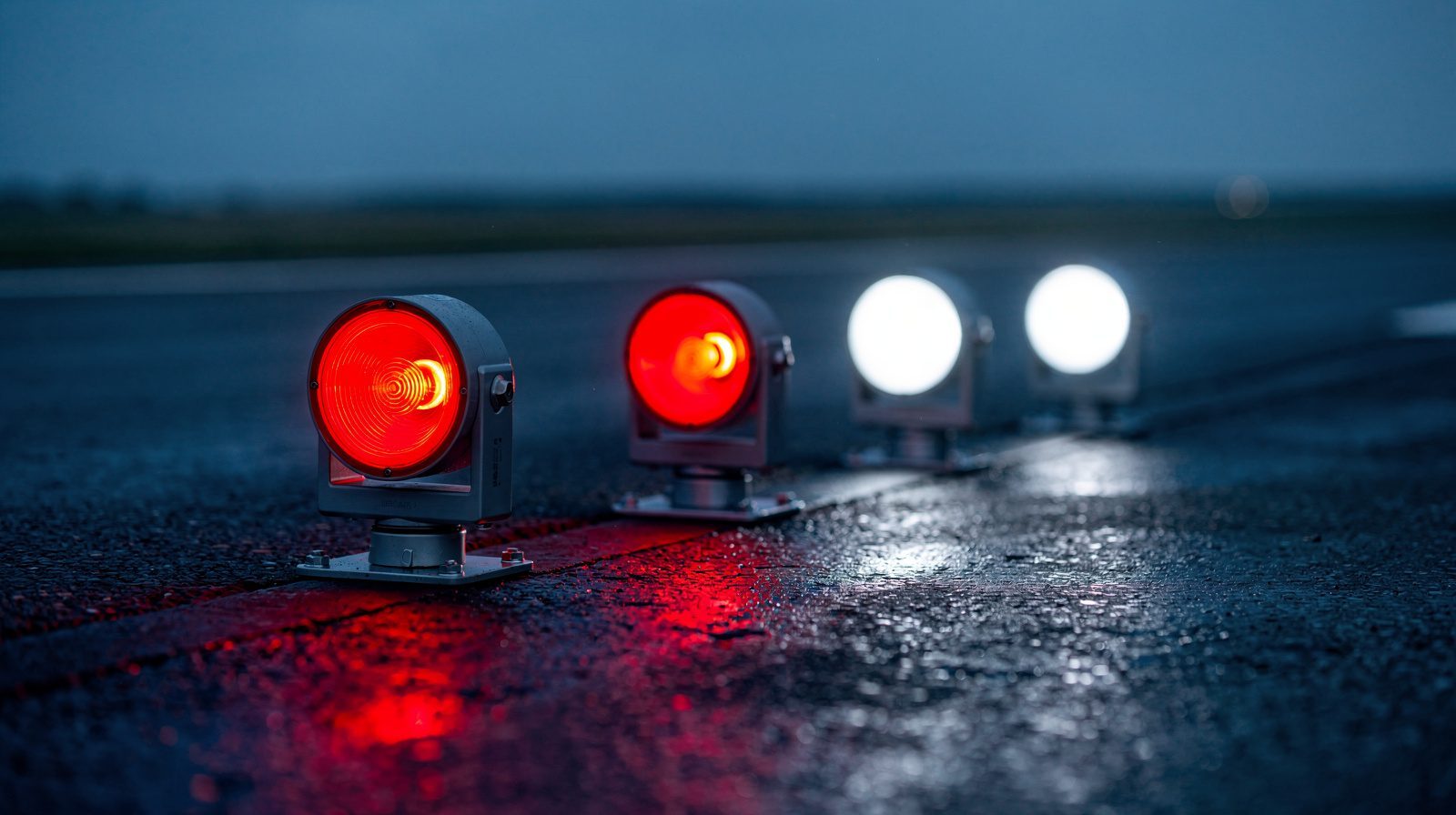
A runway guard light (RGL) is a light system that warns pilots and vehicle drivers that they are about to enter an active runway. This is the Annex 14 definition. The lights are yellow, unidirectional and flash. They sit at the runway-holding position of a taxiway. The FAA uses the short form RGL (AC 150/5340-30J), and Annex 14 and CS-ADR-DSN use the plural, runway guard lights.
Wig-wag lights
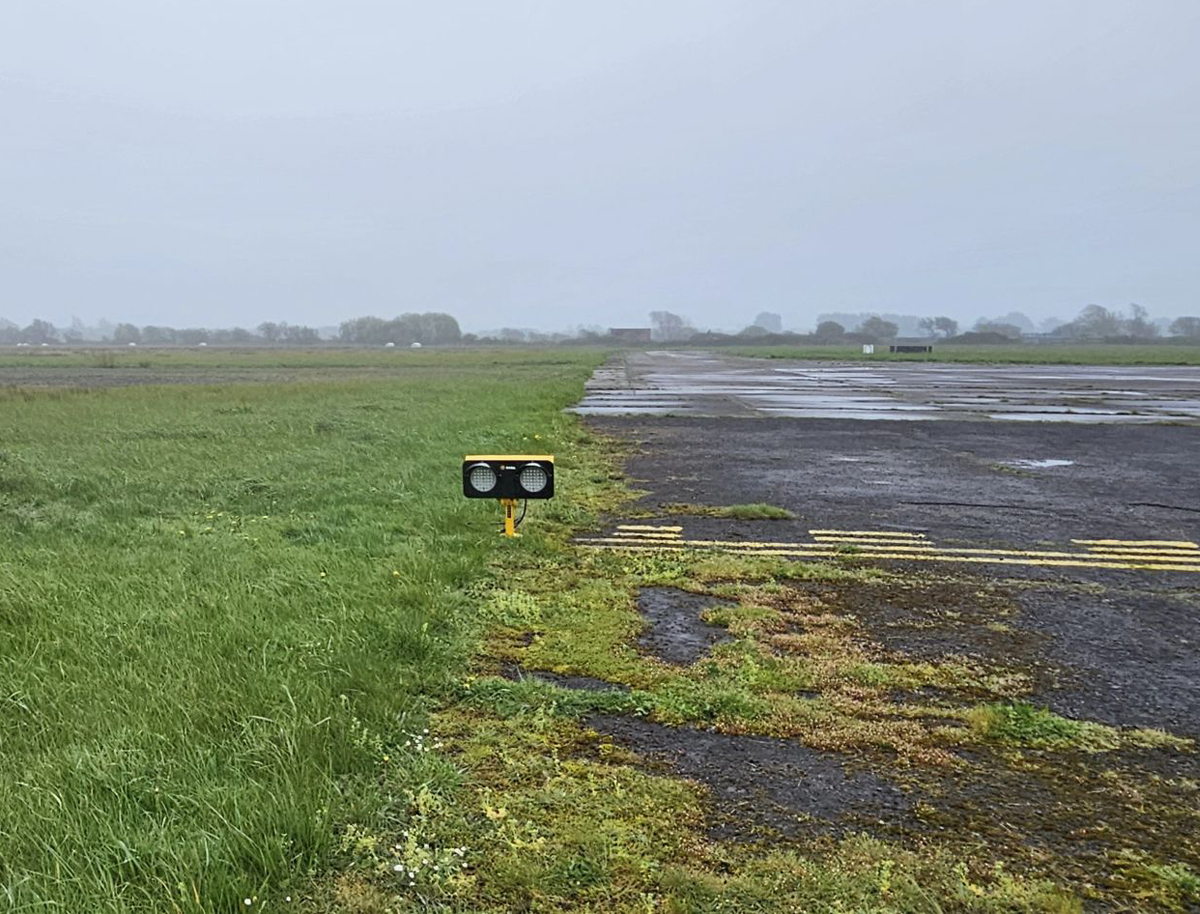
Wig-wag is a nickname for runway guard lights. The UK CAA handbook says that runway guard lights are often called wig wags. It describes them as pairs of alternately flashing yellow lights, one pair on each side of the taxiway (CAP 637, 10.3.1). The FAA names the same form an elevated RGL, and its fixture type is L-804 (AC 150/5340-30J, 4.4.6.3).
Two configurations
Annex 14 and CS-ADR-DSN describe two standard configurations.
- Configuration A is two pairs of yellow lights, one pair on each side of the taxiway. The lights of each unit are lit alternately. The FAA calls the same form an elevated RGL.
- Configuration B is a row of yellow lights across the taxiway at intervals of 3 m. Adjacent lights are lit alternately, and alternate lights are lit together. The FAA calls the same form an in-pavement RGL. The FAA names its fixture types L-852E and L-852F.
The FAA chooses by taxiway (AC 150/5340-30J, 4.4.2):
- An elevated RGL goes where the taxiway has no centreline lights and is 45 m (150 ft) wide or less.
- An in-pavement RGL goes where the taxiway has centreline lights or is wider than 45 m. It also goes where a stop bar stands at the ILS critical area holding position.
- If the taxiway has a stop bar at the runway holding position, the elevated RGL stands with the stop bar, whatever the taxiway width.
- At the airport’s option, a combination fixture holds a red and a yellow light. The circuit never lights both colours together (4.4.2.3 and 4.8.8.2.1).
Snow can hide in-pavement lights. The FAA then allows elevated lights as a supplement. It does the same where the approach to the holding position meets it at an acute angle (4.4.1). EASA guidance says pilots can miss the side lights of Configuration A on a very wide taxiway. A row across the taxiway may then be added (GM1 ADR-DSN.M.745(b)).
Flash rate
The lights flash between 30 and 60 cycles per minute. The light and dark periods are equal (Annex 14, 5.3.23.19, CS ADR-DSN.M.745(d)(12)). A note in Annex 14 and EASA guidance says the best rate depends on the lamp. On 6.6 A series circuits, Configuration A looks best at 45 to 50 flashes per minute per lamp. Configuration B looks best at 30 to 32.
The FAA gives the same two ranges. An in-pavement row pulses at 30 to 32 flashes per minute. The even-numbered lights pulse together and, as they go out, the odd-numbered lights pulse together. Each set has power for 50 percent of the cycle, with a tolerance of 0.5 percent (AC 150/5340-30J, 4.8.6.2.5). An elevated RGL flashes at 45 to 50 cycles per minute (F.3.14).
For use in daylight, Annex 14 asks for higher intensity figures. For Configuration A it also recommends a visor above each lamp. The visor keeps sunlight out of the lens and so keeps the contrast between the on and off state (5.3.23.8, 5.3.23.12 and 5.3.23.15).
Where they are provided
- Annex 14: Configuration A shall be provided at a taxiway and runway intersection in two cases. One is runway visual range below 550 m with no stop bar. The other is runway visual range from 550 m to 1 200 m with heavy traffic (5.3.23.1).
- Hot spots: at runway incursion hot spots, Configuration A or B should be provided and used in all weather, day and night (5.3.23.2).
- EASA: CS-ADR-DSN says should for all of these cases (M.745(b)). EASA guidance says stopbars and runway guard lights should be at all runway entrances, and preferably lit at all hours and in all weather. More incursions happen in good weather (GM1 ADR-DSN.D.240).
- FAA: below 1,200 ft (365 m) runway visual range, all taxiways that give access to an active runway should have runway guard lights. The SMGCS working group may decide that an intersection does not need them (AC 120-57A, 8b(1)). The FAA says the lights protect against incursions in any visibility. It recommends them at problem intersections (AC 150/5340-30J, 4.2.1.1). The AIM names low visibility as the main use and allows use in all weather (2-1-10).
- Service roads: EASA guidance says that the operator should consider runway guard lights or road-holding position lights where a road meets a runway. This is part of the incursion prevention programme (GM1 ADR-DSN.T.900).
Where an intersection has more than one runway-holding position, only the set at the operational position is lit (Annex 14, 5.3.23.4).
Where they stand and how they aim
Annex 14 puts both configurations on the holding side of the runway-holding position marking. Configuration A is at each side of the taxiway and Configuration B is across it (5.3.23.5 and 5.3.23.6). The beam is unidirectional and shows yellow in the direction of approach (5.3.23.10).
The FAA sets these values (AC 150/5340-30J, 4.4.3 to 4.4.6):
- In-pavement: the lights lie on a line 0.6 m (2 ft) from the marking, on its holding side. The spacing across the whole taxiway is 3 m with a tolerance of 51 mm. Each beam faces away from the runway, square to the marking within 1 degree.
- Elevated: the fixture stands 3 to 5 m (10 to 17 ft) from the taxiway edge. It may move up to 3 m farther from the runway, but not toward it. If a stop bar is present, the RGL stands at least 1 m outboard of the elevated stop bar light.
- Aim of an elevated light: the beam centre points at the cockpit of an aircraft. The aircraft is 45 m to 60 m (150 ft to 200 ft) from the holding position. The vertical angle is 5 to 10 degrees above the horizontal. At those viewing points the steady intensity is at least 300 cd for an incandescent lamp at the highest step.
Runway guard light and other lights at a holding position
- A stop bar is a row of steady red lights at the same holding position. The FAA says that an RGL tells anyone who approaches that they are about to enter an active runway. A stop bar gives a distinctive stop signal (AC 150/5340-30J, 4.1.2 and 4.1.3). A Configuration B row should not share the position of a stop bar (CS ADR-DSN.M.745(b)(3)).
- A row of three or five yellow in-pavement lights at a taxiway and runway intersection is not a clearance bar. The AIM says so, because the FAA clearance bar is three steady yellow lights at a holding position (2-1-10).
- Runway status lights (RWSL) are a separate FAA system. The red Runway Entrance Lights and Takeoff Hold Lights come on from surveillance data. The FAA states that RWSL does not replace or convey an ATC clearance (AIM 2-1-6).
Power, control and monitoring
The FAA puts RGLs on dedicated circuits. This gives on and off control that is independent of the other lights, for example for use in daylight. It also lets the RGLs go off when the runway is closed (AC 150/5340-30J, 4.8.6.1.1). RGLs often need a different intensity setting from the runway and taxiway edge lights. On a precision approach Category II/III runway, EASA allows a switch-over time of 15 seconds for runway guard lights. For stop bars it allows one second (Table S-1).
In one FAA control method, an in-pavement RGL row gives two monitoring signals. A “caution” signal shows when at least one light, one local control device or one control module fails. A “fault” signal shows when two adjacent lights, or three lights in total, fail in a row (4.8.6.2.3).
If a lamp fails, the rest of the row keeps pulsing. If control communication fails, the lights keep pulsing in sequence for eight hours (4.8.6.2.6).
Inspection and limits
A guard light that is out removes a warning at a place where an aircraft or vehicle can enter the runway. The FAA maintenance table sets these limits (AC 150/5340-26C, Table A-8):
- Elevated RGL: no more than one light in a fixture unserviceable.
- In-pavement RGL: no more than three lights per location unserviceable, and no two adjacent lights.
If an airport does not meet a limit, the FAA says to reroute traffic or to use other procedures (AC 120-57A, 8g). The FAA also says that each pair of elevated RGLs must use the same light technology. An in-pavement bar must not mix LED and incandescent fixtures (AC 150/5340-30J, 1.4).
An inspection counts each unit at each holding position and examines these items:
- The unit flashes, and the two lights of a pair or the two sets of a row flash in turn.
- The light shows yellow and faces the approaching traffic.
- The count of dark lights stays inside the limit.
- Only the set at the operational holding position is lit.
- The monitor status agrees with the real state of the lights. The FAA asks for a visual inspection before low-visibility operations to confirm this. Without electronic monitoring it asks for repeats every 2 to 4 hours (AC 120-57A, 8f).
Related terms: runway holding position , runway incursion .
Frequently Asked Questions
- What are runway guard lights?
- Runway guard lights are flashing yellow lights at the runway-holding position of a taxiway. They warn pilots and vehicle drivers that they are about to enter an active runway. RGL is the short form.
- What are wig-wag lights?
- Wig-wag is a nickname for runway guard lights. The UK CAA handbook says that runway guard lights are often called wig wags. It describes them as pairs of alternately flashing yellow lights, one pair on each side of the taxiway.
- How fast do runway guard lights flash?
- They flash between 30 and 60 cycles per minute, with equal light and dark periods. On 6.6 A series circuits, Configuration A looked best at 45 to 50 flashes per minute per lamp. Configuration B looked best at 30 to 32.
- Where are runway guard lights installed?
- At the runway-holding position of a taxiway. Configuration A has a unit on each side of the taxiway. Configuration B is a row of lights across the taxiway. Annex 14 puts both on the holding side of the runway-holding position marking.
- Are runway guard lights required?
- In some cases. Annex 14 says Configuration A shall be provided where runway visual range is below 550 m and there is no stop bar. It also applies from 550 m to 1 200 m when traffic is heavy. At runway incursion hot spots, Annex 14 says they should be provided. CS-ADR-DSN says should for all these cases.
- What is the difference between in-pavement and elevated runway guard lights?
- An elevated runway guard light is a pair of flashing yellow lights on each side of the taxiway. An in-pavement runway guard light is a row of flashing yellow lights across the taxiway. The FAA chooses by taxiway width and centre line lights.
- What is the difference between a runway guard light and a stop bar?
- A stop bar is a row of steady red lights, and a runway guard light is a flashing yellow light. A stop bar gives a stop signal. A runway guard light warns the crew that the runway is ahead.
- How many runway guard lights can be out of service?
- The FAA maintenance table allows no more than one light unserviceable in an elevated fixture. For an in-pavement row it allows no more than three lights per location, and no two adjacent lights.
References
- easa-ear-aerodromes
- Easy Access Rules for Aerodromes (Regulation (EU) No 139/2014), CS-ADR-DSN Issue 7, CS ADR-DSN.M.745 Runway guard lights and GM1 European Union Aviation Safety Agency
- easa-gm-d240-t900
- Easy Access Rules for Aerodromes, GM1 ADR-DSN.D.240 Taxiways general and GM1 ADR-DSN.T.900 Emergency access and service roads European Union Aviation Safety Agency
- easa-table-s1
- Easy Access Rules for Aerodromes, CS ADR-DSN.S.875 Table S-1 Secondary power supply requirements European Union Aviation Safety Agency
- icao-annex-14-v1
- Annex 14 to the Convention on International Civil Aviation, Volume I: Aerodrome Design and Operations, 9th edition, July 2022, paragraph 5.3.23 Runway guard lights International Civil Aviation Organization
- faa-ac-150-5340-30j
- AC 150/5340-30J, Design and Installation Details for Airport Visual Aids (2018), paragraphs 1.4, 4.1.2, 4.2.1, 4.4, 4.6 and 4.8.6, appendix F.3.14 FAA
- faa-ac-120-57a
- AC 120-57A, Surface Movement Guidance and Control System (19 December 1996), paragraphs 5k, 5l, 8b, 8c, 8f and 8g FAA
- faa-ac-150-5340-26c
- AC 150/5340-26C, Maintenance of Airport Visual Aid Facilities (20 June 2014), Table A-8 Runway and Taxiway Lighting Systems FAA
- caa-cap-637
- CAP 637 Visual Aids Handbook, Issue 2 (May 2007), Chapter 1 paragraph 10.3 UK Civil Aviation Authority
This is a reference entry. TarmacView provides drone inspection services and doesn't sell the equipment or materials described in this glossary.