Airfield Inspection Cost: Lighting, Pavement and OLS
Airfield inspection cost across lighting, pavement and obstacle surfaces. What each quote is made of, what to put in a quotation request and what is left out.
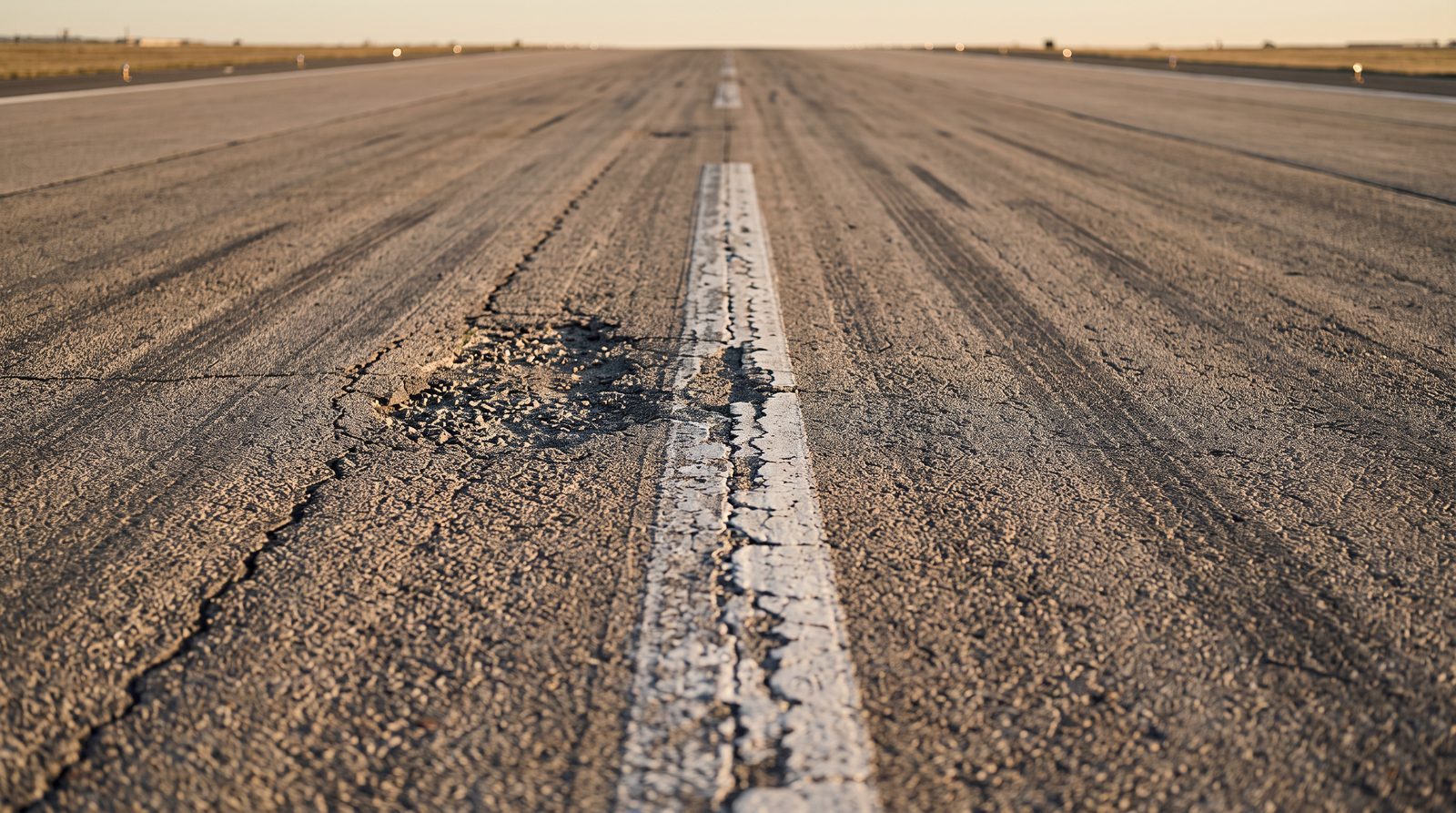
- 01 None of the three lines carries a rate card. TarmacView quotes lighting per aerodrome from a published formula, and its pavement and obstacle services are not offered yet.
- 02 Aircraft flight calibration of the lights is the one line with a rate an operator has quoted. The PAPI cost guide carries that arithmetic in full.
- 03 A pavement quote from any supplier scales with paved area, section split and whether a baseline exists. TarmacView's pavement service is in active development.
- 04 An OLS quote scales with runway directions and approach categories, because those decide how many surfaces exist and how far out they reach.
- 05 The physical fix is not in the price: adjusting a light, repairing a slab or removing an obstacle belongs to the aerodrome, not the inspector.
What this guide prices, and what it does not
The cost object is one aerodrome. It buys three inspections over a year. They are a drone survey of the visual aids, a condition assessment of the pavement, and a survey of the obstacle limitation surfaces. Quotes are in euros excluding value added tax (VAT) for the European market. The lighting formula below was checked against its published service page on 22 September 2026.
The lighting line covers the glide slope indicators, the runway edge, threshold and end lights, the approach lighting and the dimming steps. The pavement line covers runways, taxiways and aprons rated to the pavement condition index (PCI) of ASTM D5340.
The obstacle line covers the obstacle limitation surfaces (OLS). The International Civil Aviation Organization (ICAO) defines them in Annex 14 and, in Europe, the European Union Aviation Safety Agency defines them in CS-ADR-DSN. TarmacView offers the lighting line today. Its pavement and obstacle services are not offered yet and are in active development.
One disclosure. TarmacView sells the lighting line, is developing the other two, and writes this page, so it has an interest in how the total reads. Where a figure exists for a competing method it is stated. Where none exists, the page says what the price is made of instead of inventing a range.
The assumptions are these. A single aerodrome rather than a framework across several. Euros excluding VAT, added at whatever rate applies where the work is done. No correction work included, because the adjustment, the repair and the obstacle removal belong to the aerodrome. And no runway closure booked, because the drone works between movements.
What is priced how
| Item | Low | Typical | High | Unit | Source |
|---|---|---|---|---|---|
| Aircraft flight calibration of the glide slope indicators, approach and runway lighting, bundled with an instrument landing system (ILS) or VHF omnidirectional range (VOR) visit, Slovakia, Czechia and Hungary | 3 000 | 3 000 | 3 000 | per visit | tarmacview-papi-cost-guide |
| The same aircraft visit unbundled, with an hour of ferry each way | 6 600 | 6 900 | 7 200 | per visit | tarmacview-papi-cost-guide |
| The same aircraft work in Poland, Germany or Austria, bundled | 3 900 | 4 200 | 4 500 | per visit | tarmacview-papi-cost-guide |
| Drone survey of the visual aids, TarmacView: indicators, edge and approach arrays, dimming steps | quoted | quoted | quoted | per aerodrome per visit | tarmacview-papi-service |
| Pavement condition assessment, TarmacView | not offered yet | not offered yet | not offered yet | in active development | tarmacview-pavement-service |
| Obstacle limitation surface survey, TarmacView | not offered yet | not offered yet | not offered yet | in active development | tarmacview-ols-service |
| Lighting and pavement on one coordinated visit, TarmacView | not offered yet | not offered yet | not offered yet | in active development | tarmacview-pricing |
| Adjusting a light, repairing a section, removing an obstacle | not included | not included | not included | aerodrome's own contractor | All three service pages |
How each line builds its price
The three lines are priced from different inputs. A buyer who understands the inputs can predict which way a quote will move before asking for it. TarmacView quotes the lighting line today. The pavement and obstacle sections describe what any supplier’s quote is built from, because TarmacView’s own services there are not offered yet.
Airfield lighting
The lighting quote has four inputs. First comes the number of precision approach path indicator (PAPI) installations to be measured. Then whether a verification flight after adjustment is included, whether other lighting systems share the visit, and travel to the aerodrome. A runway with a PAPI at each end counts as two installations. Every further installation measured on the same visit shares the mobilisation the first one already paid for.
This is the one line where an operator has quoted a figure for the competing method. Aircraft flight calibration is billed by the flight hour. In Slovakia, Czechia and Hungary that rate is around 3,000 EUR. The indicators, approach lighting and runway lighting take about an hour when an ILS or VOR check already brings the aircraft to the field. Ferry, when the visit is not bundled, is charged at sixty to seventy percent of that rate and usually exceeds the measurement. The PAPI calibration cost guide carries that arithmetic, the regional uplift and three worked scenarios. The comparison of the two methods on scope rather than fee is in drone survey against flight inspection . What this page adds is only the scope difference. The flight verifies the PAPI transition angles and the approach and runway lighting. The drone visit measures each of those lights unit by unit, which a verification flight does not.
Pavement condition assessment
TarmacView’s pavement condition assessment is not offered yet and is in active development. The platform already plans the survey flights and captures the imagery. The software already rates cracks to ASTM D5340 and computes the PCI of each sample unit on TarmacView’s own flights. So there is no TarmacView price or formula. The facts that scope the job for any supplier are the paved area and the number of separate surfaces with their section split. The other two are whether a baseline already exists and travel to the aerodrome.
Area is the obvious driver, but the section split is the one buyers miss. A pavement condition index is produced per section. A section is a stretch of pavement with one construction history, one traffic pattern and one condition. A runway with three overlays of different ages is at least three sections, and each one is inspected, rated and reported on its own. Two aerodromes with the same paved area can be different jobs because one is a single homogeneous slab and the other is a patchwork. If your aerodrome already holds a section map from a pavement management system, send it with the enquiry, because it fixes this input.
Baseline against repeat is the second thing to state. A first assessment builds the section map, the sample units and the flight plan from nothing, and a repeat reuses them. TarmacView states no figure for either, because it does not offer the service yet.
Obstacle limitation surface survey
An OLS survey quote has four inputs. The first is the number of runway directions and their approach categories, which decide how many surfaces exist and how far out they reach. The others are the state of the existing obstacle data, whether the survey is a first baseline or a repeat, and travel. TarmacView’s OLS survey is not offered yet and is in active development, so it has no formula.
The approach category is the input that sets the scale of the job. Annex 14 defines a set of surfaces per runway direction. The dimensions of the approach and transitional surfaces grow with the category. So a precision approach direction carries far more ground under its surfaces than a non-instrument one. A bidirectional runway with a precision approach at one end and a visual one at the other is two different-sized surveys sharing one mobilisation.
The existing obstacle data is the second input. The obstacle register is the State’s responsibility. An OLS survey supplies measured data for it rather than handing the aerodrome a register of its own. Where current coordinates and heights already exist in a usable format, the survey verifies and updates them. Where the last record is a paper chart from an earlier survey, or there is none, the survey starts from nothing. It has to find, position and measure the height of every candidate object rather than confirm a known list. TarmacView does not measure obstacle heights from imagery. Its register is entered by hand, imported from OpenAIP or seeded from the Slovak electronic aeronautical information publication (eAIP). Its full OLS evaluation is in development. Say which case you are in, because the two quotes are not comparable and a supplier who is not told will assume the cheaper one.
What the TarmacView platform already has is the obstacle register. It holds each obstacle’s position, its height above ground and its mean sea level (MSL) and ellipsoid (HAE) heights. The register exports as a JSON, CSV or PDF data sheet. The platform also warns in flight planning where an obstacle penetrates the approach surface. These are software features, not a service on sale. Electronic terrain and obstacle data (eTOD) sets and Type A chart inputs are not part of them.
What moves the number across all three
Travel and mobilisation. Every line pays it once per visit, and it is the reason a combined visit costs less than the sum of three. It is also why a supplier’s home region matters more than its rate. The same crew is cheaper at an aerodrome two hours away than at one that needs a flight and a night.
Baseline or repeat. Pavement and obstacle quotes name it outright, and the lighting formula has a related input, the verification flight after adjustment. A first job builds the reference, and every later one is measured against it. Buying the baseline from one supplier and the repeat from another forfeits most of that saving. The second supplier rebuilds what the first already holds.
What else is on the visit. The lighting formula asks whether the visit is combined with the other lighting systems, and the answer changes the number. A pavement or obstacle survey flown on a visit that is already at the field shares that mobilisation, where a supplier offers both. Booked alone in a different month it needs its own.
How the aerodrome is laid out. Runway directions, approach categories, paved area and section split are all properties of the field, not choices the buyer makes. They are also the facts a supplier needs before it can quote. An enquiry that states them gets a number back, and one that does not gets questions back.
What the record has to contain. A lighting survey delivering angles alone is a smaller job than one delivering angles, colour transition, intensity, coverage and dimming behaviour with retained evidence. A pavement report delivering a single rating is smaller than one delivering a rating per section with the distress inventory behind it. Two quotes at different prices are often quoting different records, and the parameter list in the standard is the way to normalise them.
What is not in the price
The correction. Finding the fault is the point of the exercise and fixing it is a separate purchase. Adjusting an out-of-tolerance unit, resealing a pavement section, felling a tree and lighting a mast are all work for the aerodrome’s own team or contractor. An inspection quote does not include them, and a budget that stops at the inspection is short by the amount that matters.
Airfield staff time. Somebody coordinates with the tower, escorts the crew, operates the lighting panel through the dimming steps and switches to the standby supply. Work flown between movements spreads that over the day but does not remove it.
The engineering that follows. A pavement rating tells you which sections need attention and how urgently. The design of the overlay is a separate engagement. An obstacle survey tells you what penetrates a surface. Deciding whether to remove it, light it or amend the procedure is the aerodrome’s and the authority’s decision, not the surveyor’s.
Programme upkeep. The maintenance programme has to describe what is installed and the obstacle data has to describe what stands. After an LED conversion, a resurfacing or a construction project it usually does not, and reconciling it is real engineering time.
The out-of-cycle check. A resurfacing forces a pavement repeat and a lighting check. A new instrument approach procedure forces an obstacle survey and may change the approach category. An audit finding forces whichever line it names. A five-year budget should allow for at least one.
VAT. Every quote is stated excluding it, at whatever rate applies where the work is performed.
Ways to control the cost
Buy the visit, not the inspection. The marginal cost of adding a line to a visit already coordinated is the smallest number in this whole guide. It is available to an aerodrome with or without a radio aid calibration.
Fix the scope before asking for prices, so that three quotes describe the same job. State the runway directions and approach categories, the paved area and section split, and the state of the existing obstacle data. A supplier who has to guess those will guess low, and the difference arrives as a variation later.
Keep the baseline with the supplier who will do the repeat. A supplier that holds the baseline can reuse it, and splitting the two across suppliers pays for the reference twice.
Ask what is retained. Raw imagery, positions and measurements let a disputed finding be re-examined without flying again. A PDF does not, and the second visit that results is a cost created by the first purchase. This applies to all three lines equally.
Schedule around the events that force a check. A resurfacing is the natural moment for the pavement baseline and the lighting verification together, because both are due anyway. Budget the year’s inspections in one line and place them at those moments rather than on three unrelated calendars.
Preparing to ask for a quote
Seven facts turn a vague enquiry into three comparable quotations, and none of them takes long to assemble.
The aerodrome, its runways and the approach directions with glide slope indicators. The approach category of each runway end, because it sets the obstacle surfaces. The paved area you want rated, and whether a section map exists. Whether a pavement baseline or current obstacle data already exists and who produced it. Whether a radio navigation aid calibration flight is already scheduled, since that changes the aircraft route for the lights. Which lines you want on the same visit, listed explicitly rather than as “the inspection”. And the date window.
Send those and you should get back a figure per line, a scope note and a date. If a supplier returns a single number with no scope note, that is the thing to fix before comparing it against anything. The pricing page describes what the lighting visit contains, which is a fair checklist to compare a scope note against.
Sources and verification
The lighting formula on this page was checked against its published service page on 22 September 2026. The next review is due on 22 December 2026, because pricing pages of this kind go stale quickly.
The lighting formula is first-party: it is the formula TarmacView publishes on its own service page. This page does not add inputs that page does not name. The aircraft figures are carried over from the PAPI calibration cost guide, sourced there to a flight inspection operator in Slovakia, Czechia and Hungary. The derived rows there show their arithmetic. They are one operator’s rates rather than a published tariff. No figure is given for the pavement and obstacle lines because TarmacView does not offer them yet and no market source for one exists. A range without a source would be a guess dressed as a fact.
If you have a real quotation that contradicts something here, that quotation is better evidence than this page. The page should be corrected rather than defended.
Ready to price the lighting for your aerodrome? Send the runway directions, the PAPI installations and the date window to TarmacView and a scope note comes back with a price. To talk about the pavement and obstacle services in development, or a pilot, use the same address.
Frequently Asked Questions
- Why is there no price list for an airfield inspection?
- Because none of the three lines scales with a line item. A lighting survey scales with the precision approach path indicator (PAPI) installations and lighting systems on the field. A pavement assessment with the paved area and its sections. An obstacle survey scales with the runway directions and their approach categories. A rate card would misprice most aerodromes it was asked about, so providers quote the number from the scope, as TarmacView does for lighting. A figure without a scope note beside it is not comparable to anything.
- What is a pavement condition assessment quote built from?
- TarmacView does not offer a pavement condition assessment yet. It is in active development. The platform already plans the survey flights and captures the imagery. The software already rates cracks to ASTM D5340 and computes the pavement condition index (PCI) of each sample unit on TarmacView's own flights. For a supplier that does offer one, the quote rests on four inputs. Those inputs are the paved area, the surfaces and how they split into sections, whether a baseline already exists, and travel to the aerodrome.
- What is an OLS survey quote built from?
- The number of runway directions and their approach categories come first. They decide how many surfaces exist and how far out each one reaches. A precision approach direction carries larger surfaces than a non-instrument one, and every direction adds its own set. Then the state of the existing obstacle data. A survey that has to find and measure every candidate object is a bigger job than one that verifies a known list. The obstacle register itself is the State's responsibility, and an OLS survey supplies measured data for it. TarmacView does not offer an obstacle limitation surface (OLS) survey yet. It is in active development. The platform already keeps the obstacle register and warns on approach-surface penetration in flight planning, without measuring heights from imagery. Then whether this is a baseline or a repeat, and travel.
- How does the PAPI and lighting price fit into this?
- The lighting line is quoted per aerodrome per visit and has four inputs. First comes the number of PAPI installations. Then whether a verification flight after adjustment is included, whether other lighting systems share the visit, and travel. It is also the one line where an operator has quoted a rate for the alternative method. Aircraft flight calibration is billed by the flight hour. The PAPI calibration cost guide carries those figures and their arithmetic, and this page does not repeat them.
- Is it cheaper to buy the three inspections together?
- Yes, and the reason is mechanical rather than a discount. Travel, tower coordination and mission setup are paid once per visit. So adding the approach lighting to a visit already booked for the indicators costs the marginal flying, not a second mobilisation. The same holds for a supplier that puts pavement and obstacle work on the same visit. TarmacView offers only the lighting inspections today, and its pavement and obstacle services are in active development. Three visits across a year cost more than one that covers the field. They produce three partial records dated differently instead of one complete one.
- What is not in any of the three prices?
- The correction. Adjusting a light found out of tolerance, repairing a pavement section and removing an obstacle are all work for the aerodrome's own team or contractor. Also outside the price are the airfield staff who coordinate the visit and operate the lighting panel, and any electrical work at the vault. The design work that follows a pavement rating is outside it too, as is value added tax (VAT), because every quote is stated excluding it.
- How often does each line need to be budgeted?
- The lights annually, as a default that the aerodrome's own approved maintenance programme overrides. The pavement on the interval your pavement management programme sets. A repeat comes forward after a resurfacing, a severe winter or a rise in foreign object debris (FOD) reports. The obstacle surfaces when the obstacle data is due for verification. Also when construction, tree growth or a new instrument approach procedure changes what sits under them. An out-of-cycle check in any one line is the normal case over five years, not the exception.
References
- tarmacview-papi-cost-guide
- PAPI Calibration Cost in Central Europe TarmacView
- tarmacview-pricing
- Pricing TarmacView
- tarmacview-papi-service
- PAPI Inspection by Drone TarmacView
- tarmacview-pavement-service
- Pavement Condition Assessment TarmacView
- tarmacview-ols-service
- Obstacle Limitation Surface Survey TarmacView
- astm-d5340
- ASTM D5340-24, Standard Test Method for Airport Pavement Condition Index Surveys ASTM International
- icao-annex-14
- Annex 14 to the Convention on International Civil Aviation, Aerodromes, Volume I: Aerodrome Design and Operations International Civil Aviation Organization
- easa-cs-adr-dsn
- Certification Specifications and Guidance Material for Aerodrome Design, CS-ADR-DSN, Issue 7 European Union Aviation Safety Agency