What is Pavement Strength?
Pavement strength is the load-carrying capacity of an airport pavement, which an aerodrome reports as a pavement classification rating (PCR).
What the rating means
ICAO Annex 14 requires the aerodrome to determine the bearing strength of its pavements. Some pavements serve aircraft with an apron mass above 5 700 kg (12,500 lb). For these, the aerodrome uses the aircraft classification rating - pavement classification rating (ACR-PCR) method. The FAA says ICAO adopted this method with Amendment 15 to Annex 14.
The method gives each side one number. The ACR expresses the relative effect of one aircraft on a pavement for a standard subgrade strength. The PCR expresses the load-carrying capacity of a pavement for unrestricted operations. Both numbers come from the same technical basis. For this reason, an aircraft with an ACR equal to or less than the PCR may operate on the pavement. Any limit on tire pressure or aircraft mass still applies.
In the FAA wording, “unrestricted” does not mean “unlimited”. The rating does not take pavement life into account. The PCR must be enough for the traffic that the engineer analyzed, and it needs a new evaluation when traffic changes significantly. A new aircraft type is one such change.
The ACR-PCR system is not a design method. The FAA says the PCR must not be used for pavement design or as a substitute for an evaluation.
How to calculate the ACR
The aircraft manufacturer provides the official ACR. The calculation needs data such as the maximum aft center of gravity, the maximum ramp weight, the wheel spacing and the tire pressure. The manufacturer takes the weight and center of gravity that give the largest ACR.
The calculation turns the landing gear into a derived single wheel load. This load puts the same stress on the pavement as the real gear, so the pavement thickness need not be known. The method equates the thickness for the gear to the thickness for a single wheel. That wheel has a tire pressure of 1.5 MPa (218 psi). The ACR is two times the derived single wheel load, expressed in hundreds of kilograms.
One aircraft has a different ACR on rigid and on flexible pavement, and for each of the four subgrade categories. ICAO provides software to compute any ACR at any mass. The FAA includes the same application, ICAO-ACR, in its FAARFIELD program.
Rigid and flexible pavements
The ACR-PCR method classifies a pavement as rigid or flexible. The two types carry load in different ways.
- Flexible pavement: each structural layer rests on the layer below and, in the end, on the subgrade. The layers spread the load from the surface downward. The surface course is usually asphalt mix.
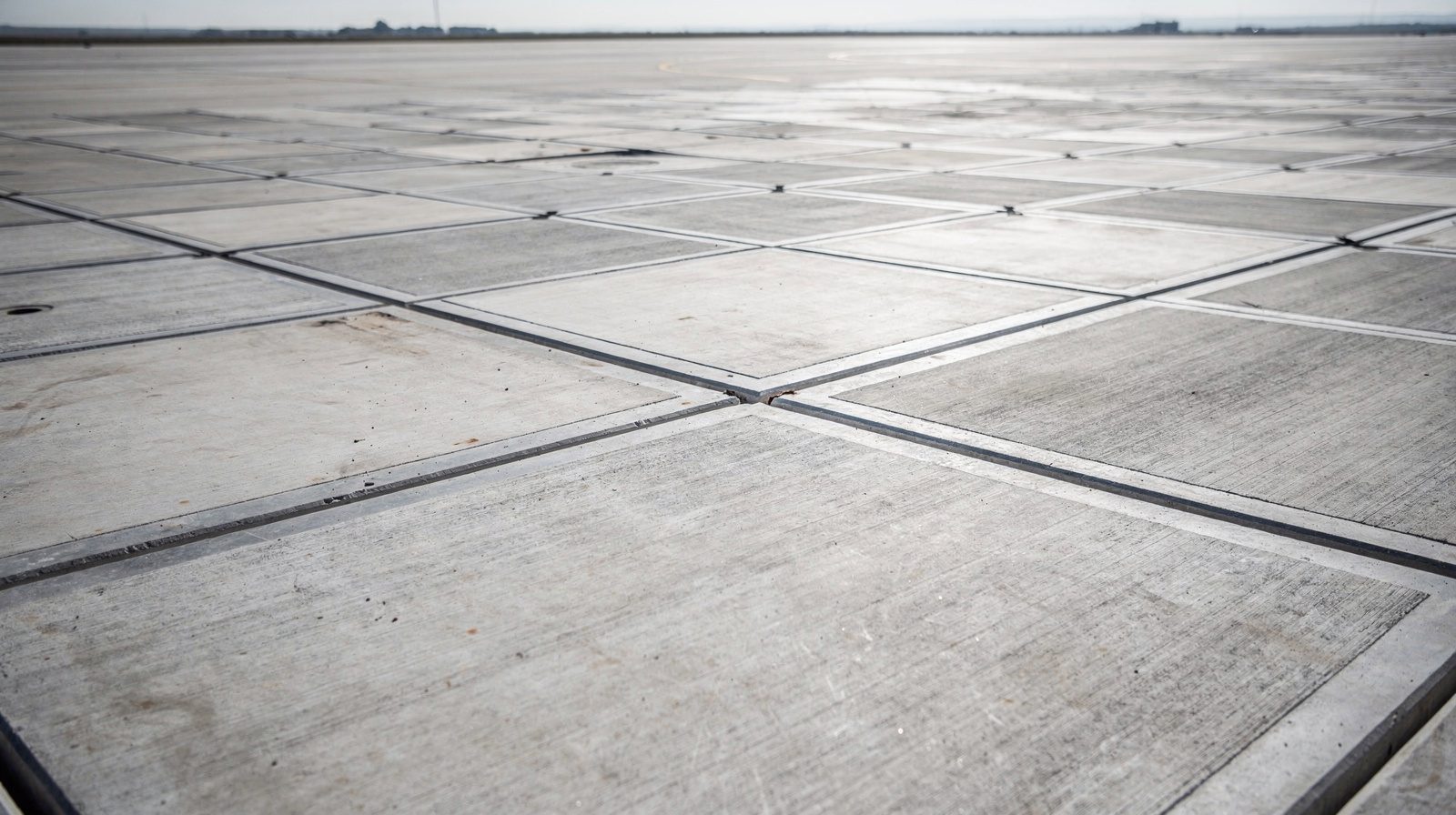
- Rigid pavement: the surface concrete layer gives the main resistance to load. It acts as a stiff beam and spreads the load over a large area of the subgrade. Its capacity depends on the strength of that layer and on uniform support beneath it.
- Composite pavement: this is a mix of both, often an overlay on an older surface. Report the type that best matches how the pavement behaves, and add a note that the construction is composite.
For a concrete pavement, the critical strength is the flexural strength, because a concrete pavement fails mainly by bending. ASTM C78 is the test method. FAA AC 150/5320-6G recommends a design flexural strength of 600 to 750 psi (4.14 to 5.17 MPa) for most airfield uses. For an existing concrete pavement, the evaluation takes the flexural strength from construction records or from nondestructive test data.
Tire pressure matters differently for the two types. Concrete resists the tire pressures of current commercial aircraft, so a rigid pavement can usually be rated W. On asphalt, the stability of the mix sets the limit. A mix that meets FAA Item P-401 can withstand a pressure in excess of 1.5 MPa (218 psi).
The five parts of the report
The report has five items. The first is the PCR number. The other four use codes. The FAA says a report must contain all five.
- Pavement type: R for rigid, F for flexible.
- Subgrade strength: the elastic modulus E sets the category.
- A (high): E of 150 MPa or more, with 200 MPa as the characteristic value.
- B (medium): 100 to under 150 MPa, characteristic value 120 MPa.
- C (low): 60 to under 100 MPa, characteristic value 80 MPa.
- D (ultra-low): under 60 MPa, characteristic value 50 MPa.
- Tire pressure: W (no limit), X (up to 1.75 MPa), Y (up to 1.25 MPa) and Z (up to 0.50 MPa).
- Evaluation method: T for technical evaluation, U for using aircraft experience.
Annex 14 gives two examples.
- PCR 760 / R / B / W / T is a rigid pavement on a medium-strength subgrade. It has no tire pressure limit, and a technical evaluation gave the rating.
- PCR 550 / F / A / Y / U is a composite pavement that behaves like a flexible one. It rests on a high-strength subgrade and has a 1.25 MPa limit. Using aircraft experience gave the rating.
Annex 14 also notes that an aerodrome may report different PCRs if the strength changes significantly with the season.
A pavement for aircraft of 5 700 kg or less has a simpler report. Annex 14 asks for the maximum allowable aircraft mass and the maximum allowable tire pressure, for example 4 800 kg / 0.60 MPa.
How to find the PCR
Two methods exist. The report must say which one the aerodrome used.
The using aircraft method finds the ACR of every aircraft that may use the pavement now. The largest ACR is the PCR. It is easy to apply and does not need detailed knowledge of the pavement structure. When the subgrade is not known, the FAA recommends category B. The method has weak points. An aircraft that damages the pavement and flies rarely can make the PCR too high. A PCR that is too low keeps out acceptable traffic. The FAA advises a consistent rule based on a minimum of 250 annual departures, and it discourages the method on a long-term basis.
The technical evaluation method is a specific study of the pavement. It needs three inputs.
- The mix and frequency of aircraft traffic.
- The thickness, material and strength of each layer.
- The elastic modulus of the subgrade.
The FAA procedure finds the critical aircraft and the maximum allowable gross weight at which that aircraft uses up the pavement life exactly. The PCR is the ACR of the aircraft at that weight. The PCR is valid only for the life period that the engineer selected. After a rehabilitation, or when traffic changes, the engineer must evaluate again.
When the strength varies along a pavement, the PCR of the weakest segment is normally reported. The FAA allows engineering judgment when the weakest segment is not in the most used part of the runway.
For the layers and the subgrade, engineers use cores and borings. Nondestructive and minimally destructive tests help as well. These are the falling weight deflectometer (FWD), the heavy weight deflectometer (HWD), the dynamic cone penetrometer (DCP) and ground penetrating radar (GPR). FWD or HWD data help to evaluate the subgrade strength.
When an aircraft is heavier than the PCR
Annex 14 recommends that the aerodrome sets criteria for an aircraft with an ACR above the PCR. This is a Recommended Practice. Attachment A of Annex 14 gives guidance for a simple method:
- Occasional movements by aircraft with an ACR up to 10 per cent above the PCR should not harm the pavement. A pavement with PCR 600 can take limited traffic of ACR 660.
- The annual overload movements should stay under about 5 per cent of the total annual movements, excluding light aircraft.
- Overloads should not normally be allowed on a pavement that shows distress. They should also be avoided in a thaw after frost, or when water could weaken the pavement or the subgrade.
- The aerodrome should inspect the pavement condition regularly while overloads continue.
Annex 14 explains why this works. Except for massive overloading, a pavement does not fail all at once. A larger load shortens the life, and a smaller load uses it up more slowly. Too many overloads can still shorten the life of the pavement a great deal, or bring a major rehabilitation forward.
ACR-PCR and the older ACN-PCN
The previous method was the aircraft classification number - pavement classification number (ACN-PCN) method. There is no mathematical correlation between the two systems, so an ACN is not an ACR and a PCN is not a PCR. The FAA recommends the ACR-PCR method for all paved runways, taxiways and aprons. It requires gross weight and PCR data for public-use paved runways with air carrier service at Part 139 airports by 28 November 2025. The EASA Easy Access Rules of March 2026 still name the ACN-PCN method in the guidance to ADR.OPS.A.005. Check which method a given publication uses.
In the United States, the airport owner enters the data in the Airport Master Record. The FAA publishes it in the National Airspace System Resources database and in the Chart Supplements.
Pavement strength and drone inspection
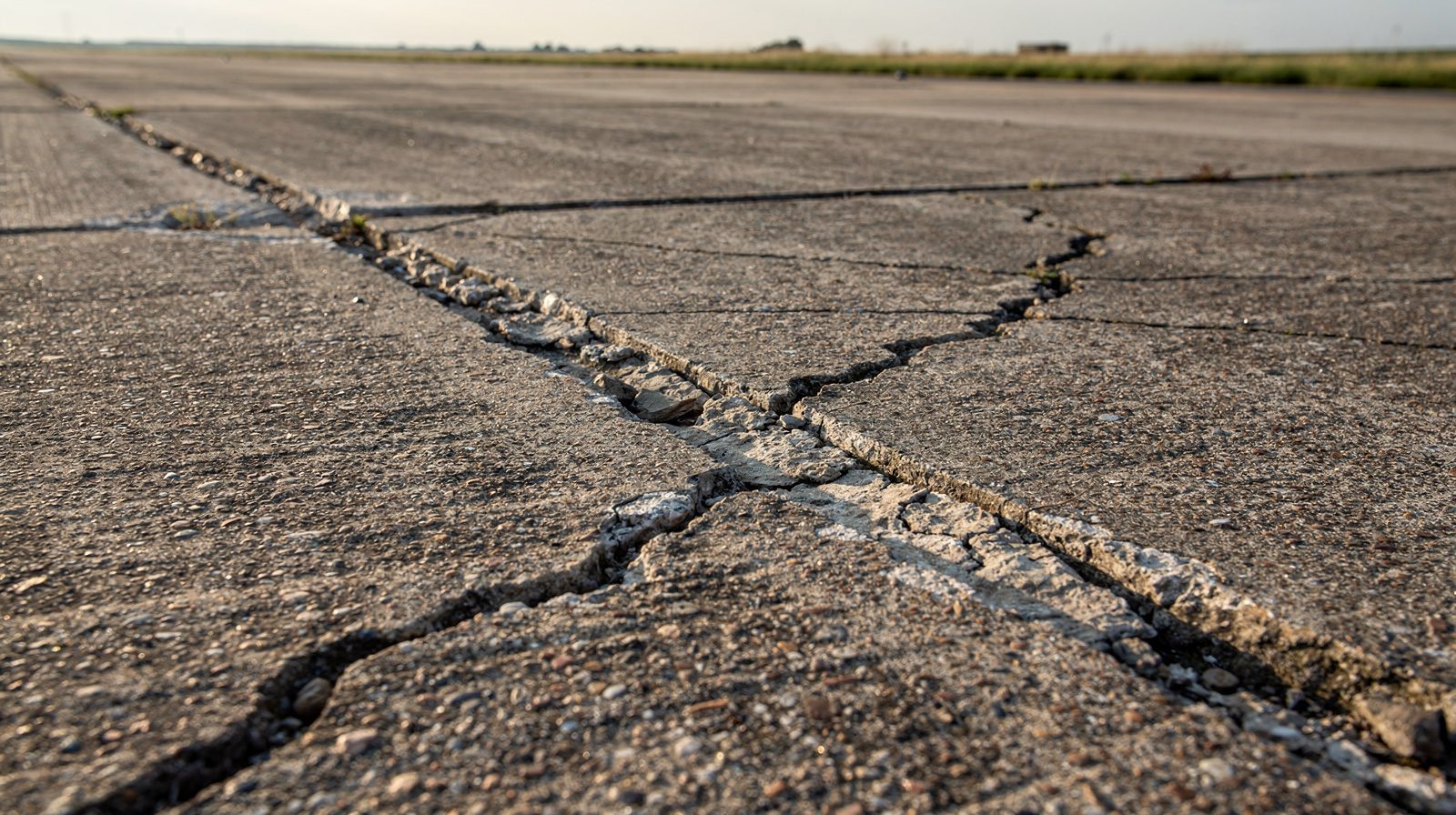
Strength and condition are two different things. A drone survey sees the surface. It can record cracks, rutting and other distress for a pavement condition index (PCI) according to ASTM D5340. FAA AC 150/5380-6C says a PCI may also give an indication of structural performance. AC 150/5335-5D attributes a loss of serviceability to roughness or to local distress such as rutting or cracking. A drone survey cannot measure the thickness of the layers or the strength of the subgrade.
FAA AC 150/5380-7B says nondestructive or destructive tests may be necessary to determine the load-carrying capacity. An engineer can use the survey records with such tests to decide where to test and when to re-evaluate the PCR.
Frequently Asked Questions
- What is the difference between ACR and PCR?
- The aircraft classification rating (ACR) is a number for the effect of one aircraft on a pavement. The pavement classification rating (PCR) is a number for the load-carrying capacity of the pavement. An aircraft with an ACR equal to or less than the PCR may operate on the pavement, subject to any tire pressure or mass limit.
- What does the code PCR 760 / R / B / W / T mean?
- It is the ICAO example for a rigid pavement on a medium-strength subgrade with no tire pressure limit, assessed by technical evaluation. The number 760 is the PCR. R is the pavement type, B the subgrade category, W the tire pressure category and T the evaluation method.
- What is AC 150/5335-5D?
- AC 150/5335-5D is the FAA advisory circular on the standardized method of reporting airport pavement strength as a PCR. It follows Amendment 15 to ICAO Annex 14. It sets out how to find the ACR, how to find the PCR, and how to report the five-part code.
- How is the PCR of a pavement determined?
- An engineer uses one of two methods. The using aircraft method reports the largest ACR among the aircraft that use the pavement now. The technical evaluation method uses the traffic, the layers of the pavement and the subgrade modulus. The FAA discourages the using aircraft method on a long-term basis.
- Can an aircraft operate on a pavement if its ACR is higher than the PCR?
- Sometimes. ICAO Annex 14 recommends that the aerodrome sets criteria for such use. Its guidance suggests that occasional movements with an ACR up to 10 per cent above the PCR should not harm the pavement. The annual overload movements should stay under about 5 per cent of all movements, and not on a pavement that shows distress.
- How is the strength of a concrete pavement measured?
- The critical strength of a concrete pavement is its flexural strength, which ASTM C78 measures. FAA AC 150/5320-6G recommends a design flexural strength of 600 to 750 psi (4.14 to 5.17 MPa) for most airfield uses. For an existing pavement, the evaluation uses construction records or nondestructive test data.
- What is the difference between PCN and PCR?
- The pavement classification number (PCN) belongs to the older ACN-PCN method, and the PCR belongs to the ACR-PCR method that replaced it. The FAA says the two systems have no mathematical correlation. A PCN is not a PCR, and an ACN is not an ACR.
- Does a drone survey measure pavement strength?
- No. A drone survey records the visible condition of the surface, such as cracks and rutting. FAA AC 150/5380-7B says nondestructive or destructive tests may be necessary to determine the load-carrying capacity of a pavement.
References
- icao-annex-14-vol-i
- Annex 14 to the Convention on International Civil Aviation, Aerodromes, Volume I, 9th edition (July 2022, with Amendment 18) ICAO
- faa-ac-150-5335-5d
- AC 150/5335-5D, Standardized Method of Reporting Airport Pavement Strength - PCR (29 April 2022) FAA
- faa-ac-150-5320-6g
- AC 150/5320-6G, Airport Pavement Design and Evaluation (7 June 2021) FAA
- faa-ac-150-5380-7b
- AC 150/5380-7B, Airport Pavement Management Program (10 October 2014) FAA
- faa-ac-150-5380-6c
- AC 150/5380-6C, Guidelines and Procedures for Maintenance of Airport Pavements (10 October 2014) FAA
- easa-ear-aerodromes
- Easy Access Rules for Aerodromes (Regulation (EU) No 139/2014), March 2026 EASA
This is a reference entry. TarmacView provides drone inspection services and doesn't sell the equipment or materials described in this glossary.