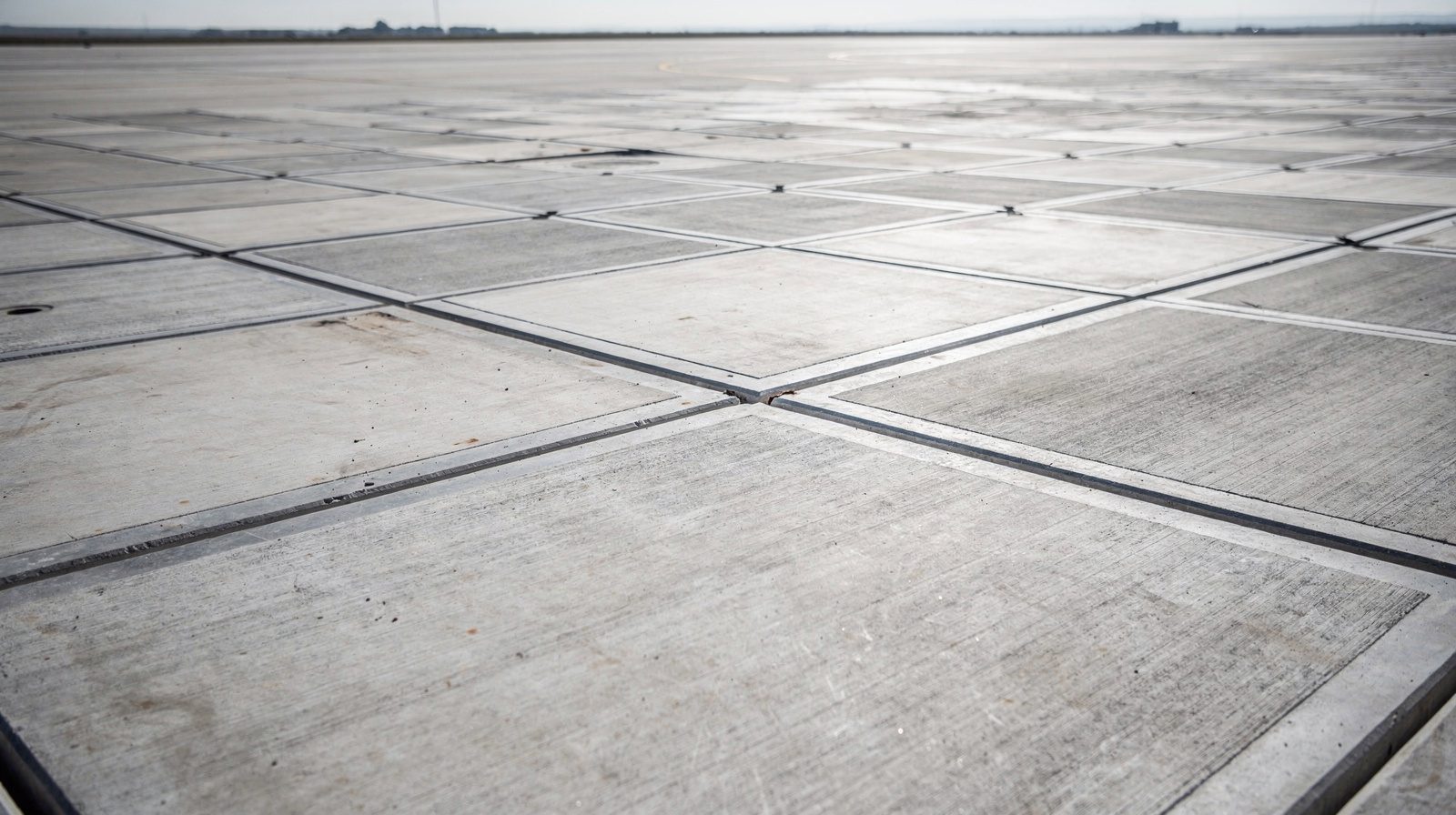
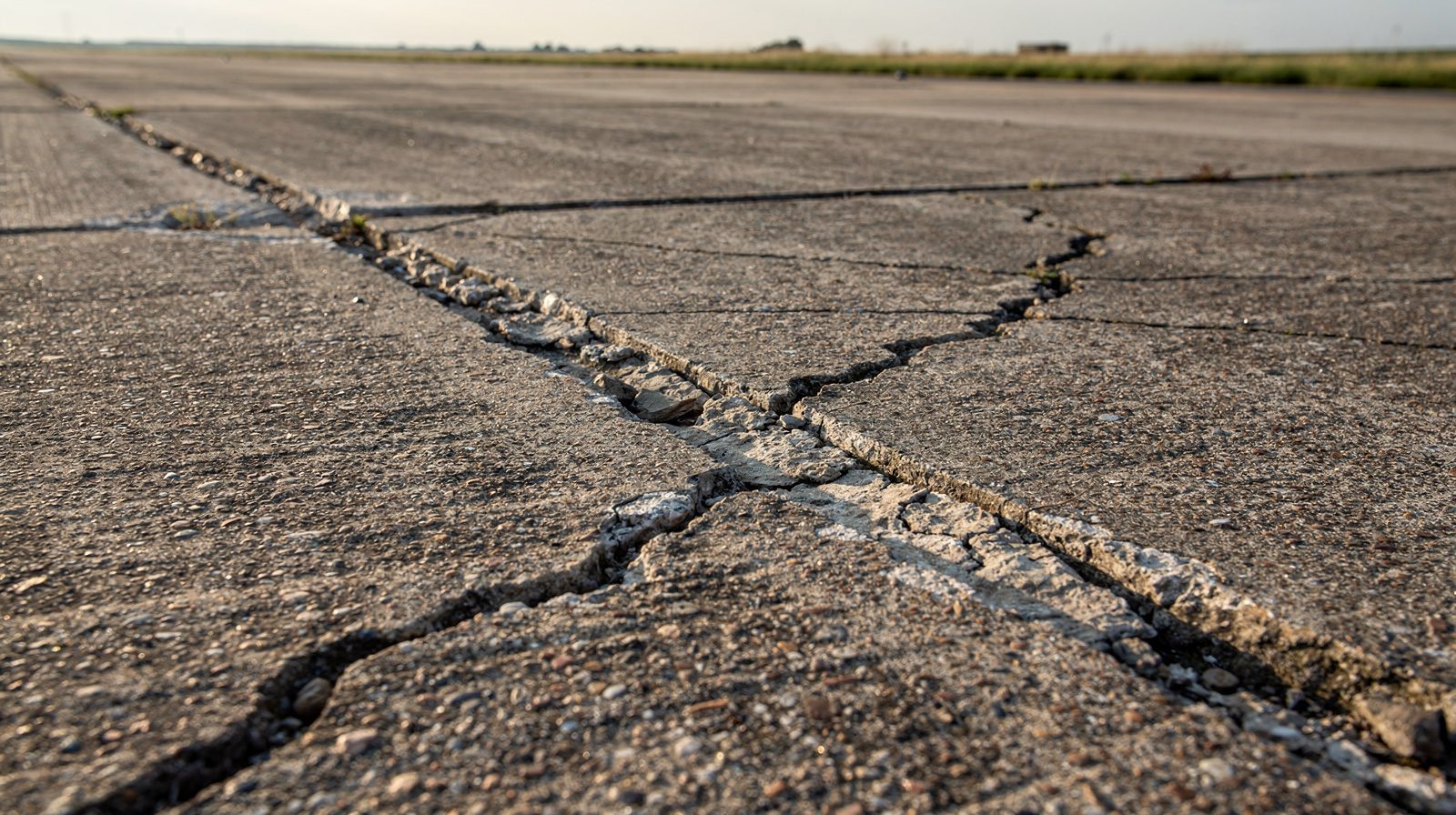
What is the Pavement Classification Number (PCN)?
The pavement classification number (PCN) is a number that reports the bearing strength of a pavement for aircraft heavier than 5,700 kg. It is part of the aircraft classification number - pavement classification number (ACN-PCN) method. EASA applies the method to pavements for aircraft with an apron (ramp) mass above 5,700 kg. For lighter aircraft, EASA asks for the maximum allowable aircraft mass and tire pressure instead.
The FAA defines the PCN as a number that expresses the load-carrying capacity of a pavement for unrestricted operations (AC 150/5335-5C 1.2.2). Unrestricted does not mean unlimited. It means that an aircraft may operate without a weight restriction when its rating is not above the pavement rating (AC 150/5335-5D 4.1).
ACN and PCN
In 1977, ICAO set up a study group to find one international method to report pavement strength. The group developed the ACN-PCN method, and ICAO adopted it (AC 150/5335-5C 1.2). The method uses two numbers.
- The aircraft classification number (ACN) expresses the relative effect of an aircraft at a given configuration on a pavement structure. It applies to a standard subgrade strength.
- The PCN expresses the load-carrying capacity of the pavement.
The two numbers have the same technical basis. A pavement with a given PCN can therefore support an aircraft with an ACN up to that PCN. The tire pressure limit also applies.
The ACN depends on the aircraft weight and configuration (tire pressure and gear geometry), the pavement type and the subgrade strength. The aircraft manufacturer provides the official ACN. The ACN uses the weight and center of gravity that give the highest value.
The method turns the aircraft load into one derived single wheel load. For a flexible pavement it uses the California bearing ratio (CBR) method. For a rigid pavement it uses the Westergaard solution with a concrete working stress of 399 psi (2.75 MPa). The ACN is two times the derived single wheel load, in thousands of kilograms. The standard tire pressure is 181 psi (1.25 MPa), and the method fixes the load at 10,000 coverages. The FAA program COMFAA calculates ACN values (AC 150/5335-5C 2.1 to 2.7 and 3.3.1).
The reported code
EASA lists five items to report. The FAA writes them as one code with slashes, in this order: number, pavement type, subgrade category, tire pressure category, and evaluation method.
| Item | Codes under ACN-PCN (EASA) |
|---|---|
| Pavement type | R rigid, F flexible |
| Subgrade category | A high: K above 120 MN/m³ or CBR above 13. B medium: K 60 to 120, CBR 8 to 13. C low: K 25 to 60, CBR 4 to 8. D ultra low: K below 25, CBR below 4. |
| Tire pressure | W no limit, X up to 1.75 MPa, Y up to 1.25 MPa, Z up to 0.50 MPa |
| Evaluation method | T technical evaluation, U using aircraft experience |
The subgrade is the natural or modified soil under the pavement layers. K is the modulus of subgrade reaction, which EASA uses for rigid pavements. CBR is the value for flexible pavements.
Here is how to read the FAA example 80/R/B/W/T. The number 80 is the PCN. R is a rigid pavement. B is a medium strength subgrade. W is no tire pressure limit. T is a technical evaluation (AC 150/5335-5C 4.6.6).
The ICAO examples for ACR-PCR use the same layout. PCR 760/R/B/W/T is a rigid pavement on a medium subgrade. PCR 550/F/A/Y/U is a composite pavement that behaves like a flexible one. It has a high strength subgrade and a tire pressure limit of 1.25 MPa.
The number is a whole number. For a pavement of diverse strengths, the report normally uses the weakest segment (AC 150/5335-5C 4.6.1). If the pavement is composite, report the type that best reflects its structural behavior. It is good practice to add a note (AC 150/5335-5D 4.5.2.3).
Tire pressure and pavement type
The tire pressure code reports the highest tire pressure that the pavement accepts. Aircraft tire pressure has little effect on a concrete pavement, and the FAA says it can usually be rated W (AC 150/5335-5D 4.5.4.1).
On a flexible pavement the limit depends on the quality of the asphalt mix and on the climate. A poorly built asphalt pavement can show rutting under load. The FAA says that a mix which meets Item P-401 can withstand a tire pressure in excess of 218 psi (1.5 MPa). A lower quality mix can show distress at 100 psi (0.7 MPa) or less. A well placed asphalt layer of 4 to 5 inches (10.2 to 12.7 cm) can generally take code X or W. A thinner pavement of poorer asphalt should not be rated above Y (AC 150/5335-5D 4.5.4.2).
Finding the number
A technical evaluation (T) is a specific study of the pavement. The FAA procedure needs the aircraft traffic, the thickness, material and strength of each layer, and the elastic modulus of the subgrade. It can need on-site inspection, load-bearing tests and engineering judgment. The FAA says its accuracy is better than that of the using aircraft method (AC 150/5335-5D 4.4.2).
In the using aircraft method (U), the rating comes from the aircraft that use the pavement without causing distress. Under ACR-PCR, the largest ACR among those aircraft is the PCR. The method is easy to apply and does not need detailed knowledge of the pavement structure. If the subgrade is not known, the FAA recommends category B (AC 150/5335-5D 4.3).
The method has limits. One very damaging aircraft that uses the pavement rarely can make the rating too high. A rating that is too low can keep acceptable traffic off the pavement. The FAA says to use a consistent method, based on a minimum of 250 annual departures over the design period. It discourages the method on a long-term basis (AC 150/5335-5D 4.3.2).
A rating applies only to the traffic it covers. Evaluate it again after a rehabilitation and when the traffic changes, for example with a new aircraft type (AC 150/5335-5D 4.1 and 4.4.3). ICAO says a State may report different PCRs when the strength changes much with the season (Annex 14 2.6.3, Note).
PCR replaces PCN
In Amendment 15 to Annex 14 Volume I, ICAO adopted a new method, ACR-PCR. It replaces ACN-PCN. ICAO set 28 November 2024 as the date it applies. EASA deferred that date for its Member States and works on the EU rules. The EASA rules text of March 2026 still describes ACN-PCN. The FAA AC 150/5335-5 page covers how airports report pavement strength as a PCR.
The FAA now reports a pavement classification rating (PCR). It set 28 November 2025 as the date for gross weight and PCR data. This applies to public use paved runways with air carrier service at 14 CFR Part 139 airports. The Czech L 14 also uses ACR-PCR.
The code keeps the same five parts and the same tire pressure categories. Four things change:
- The subgrade categories use the elastic modulus E. A is 200 MPa, B is 120 MPa, C is 80 MPa and D is 50 MPa.
- The ACR uses layered elastic analysis as its only model. The ACN used the CBR method and the Westergaard solution.
- The standard tire pressure for a flexible pavement is 218 psi (1.5 MPa), and the ACR is in hundreds of kilograms. The ACN used 181 psi and thousands of kilograms.
- The ACR for a flexible pavement uses 36,500 passes of the aircraft. The ACN used 10,000 coverages.
There is no mathematical correlation between PCN and PCR. You cannot convert one into the other. The sources are AC 150/5335-5D 1.4, 2.2, 2.5, 2.6, 3.1 and 4.5.4.
Comparing an aircraft with the pavement
A pavement with a given PCR can support an aircraft with an ACR equal to or less than that PCR. The tire pressure limit also applies. Annex 14 recommends setting criteria for an aircraft with a rating above the reported pavement rating (Annex 14 2.6.3 and 2.6.7).
In the EU, the aerodrome operator must set criteria for overload operations when aircraft that may damage the pavements use the aerodrome regularly (ADR.OPS.C.011). EASA gives overload criteria for the older ACN-PCN method.
- Occasional movements by aircraft with an ACN up to 10 % above the PCN should not adversely affect a flexible pavement.
- For a rigid or composite pavement with a rigid layer, the limit is 5 %. The same 5 % applies when the structure is unknown.
- Overload movements should be about 5 % or less of the total annual movements.
Under ACR-PCR, ICAO gives 10 % for both flexible and rigid pavements. It gives the same yearly limit of about 5 %, which excludes light aircraft (Annex 14 Attachment A 19.1.1). The FAA example is a pavement with PCR 600. It can support some limited traffic of aircraft with ACR 660 (AC 150/5335-5D C.1.3).
ICAO says that, except for massive overloading, a pavement does not fail suddenly. Occasional minor overloading costs a limited part of the pavement life (Annex 14 Attachment A 19.1.1). Three cautions apply:
- Do not permit overload movements on a pavement that shows signs of distress or failure.
- Avoid them during a thaw after frost penetration, and when water could weaken the pavement or the subgrade.
- Where overloads occur, inspect the pavement condition regularly and review the criteria from time to time. Repeated overloads can severely shorten the pavement life or require a major rehabilitation.
These cautions come from AMC1 ADR.OPS.C.011 (b), Annex 14 Attachment A 19.1.2 and AC 150/5335-5D C.1.3.
A technical analysis can show that the traffic mix needs more than the calculated PCR. The FAA then lists three options. Keep the PCR and let some aircraft operate above it or at a reduced weight. Strengthen the pavement with an overlay or reconstruction. Or raise the PCR to the highest ACR and accept possible severe maintenance and a shorter remaining life (AC 150/5335-5D C.2.3).
Where airports report the number
The EASA list of aerodrome data for the aeronautical information service includes the pavement surface type. It also includes the bearing strength by the ACN-PCN method (AMC3 ADR.OR.E.005, Part D item 6.8). In the United States the airport sponsor enters the data in the Airport Master Record, in the Airport Data and Information Portal (ADIP). The FAA then passes it to the NASR database and the Chart Supplements (AC 150/5335-5D 1.1).
The reported PCR must have all five elements, for example 573/F/C/W/T. The record also holds allowable gross weights for the gear types S, D, 2D and 2D/2D2 (AC 150/5335-5D Appendix D). The Slovak AIP lists ACN and PCN in its abbreviations (GEN 2.2).
What the number does not show
ACR-PCR is a reporting method. It is not a procedure to design or evaluate a pavement. The FAA says a pavement rating is an estimate of a representative value, not an absolute one. Two pavements with different cross sections can report a similar strength and still allow very different traffic (AC 150/5335-5D 1.4 and 4.4.1).
The number also does not describe the surface. The FAA notes that a pavement loses serviceability mostly through a rougher surface or local distress such as rutting or cracking. It rarely leaves service through sudden structural failure (AC 150/5335-5D 4.4.2). A pavement condition index (PCI) rates the surface condition, with implications for structural performance. The FAA says a visual inspection alone cannot determine the structural condition (AC 150/5380-7B 2.2.1.4).
A surface survey alone does not give the layer data that a technical evaluation needs. Pavement strength: ACN-PCN and what a survey can tell you covers what the two measure. TarmacView rates surface distress by drone and does not measure pavement strength.
Frequently Asked Questions
- What does PCN stand for in aviation?
- PCN stands for pavement classification number. EASA and the Slovak AIP use this expansion. The FAA now reports pavement strength as a pavement classification rating (PCR).
- What does a PCN code such as 80/R/B/W/T mean?
- The code has five parts. The number 80 is the strength. R is a rigid pavement and B is a medium strength subgrade. W is no tire pressure limit and T is a technical evaluation. The example comes from FAA AC 150/5335-5C.
- What is the difference between ACN and PCN?
- The ACN rates an aircraft and the PCN rates a pavement. The ACN expresses the relative effect of an aircraft on a pavement for a standard subgrade strength. A pavement can support an aircraft with an ACN equal to or less than its PCN.
- How is the PCN determined?
- Two methods exist. Technical evaluation (code T) is a specific study of the pavement. Using aircraft experience (code U) draws on the aircraft types and masses that the pavement carries well in regular use.
- Can an aircraft use a pavement when its ACN is above the PCN?
- Sometimes, but only for occasional movements. EASA AMC1 ADR.OPS.C.011 says an ACN up to 10 % above the reported PCN on a flexible pavement should not adversely affect it. For a rigid or composite pavement the limit is 5 %. These overload movements should not exceed about 5 % of the total annual movements.
- Is the PCN still in use?
- It depends on the State. ICAO set 28 November 2024 as the start of the new ACR-PCR method, which replaces ACN-PCN. EASA deferred this date for its Member States, and its rules text of March 2026 still describes ACN-PCN. The FAA and the Czech L 14 already use PCR.
- What does PCN mean on a runway or at an airport?
- It is the pavement classification number, a rating of the bearing strength of a runway, taxiway or apron. The aerodrome operator reports it to the aeronautical information service, which puts it in the AIP. For aircraft of 5,700 kg or less, the operator reports a maximum allowable mass and tire pressure instead.
- Does the PCN show the condition of the pavement surface?
- No. The PCN reports bearing strength. The pavement condition index (PCI) rates the surface condition, and the FAA says it has implications for structural performance. The FAA also says that a visual inspection alone cannot determine the structural condition of a pavement.
References
- easa-ear-aerodromes
- Easy Access Rules for Aerodromes (Regulation (EU) No 139/2014), March 2026 EASA
- easa-faq-140472
- EASA FAQ n.140472, ACR-PCR method EASA
- icao-annex-14-vol-i
- Annex 14, Aerodromes, Volume I, Aerodrome Design and Operations, 9th edition (consolidated to Amendment 18) ICAO (copy hosted by the Swiss FOCA)
- faa-ac-150-5335-5c
- AC 150/5335-5C, Standardized Method of Reporting Airport Pavement Strength - PCN (cancelled by 5D) FAA
- faa-ac-150-5335-5d
- AC 150/5335-5D, Standardized Method of Reporting Airport Pavement Strength - PCR FAA
- faa-ac-150-5380-7b
- AC 150/5380-7B, Airport Pavement Management Program (PMP) FAA
- faa-ac-150-5320-6g
- AC 150/5320-6G, Airport Pavement Design and Evaluation FAA
- cz-l14
- L 14 Letiště (Czech Annex 14 publication), 25 December 2025 edition Úřad pro civilní letectví (Czech CAA)
- sk-aip-gen-2-2
- AIP Slovakia, GEN 2.2, Abbreviations used in AIS publications LPS SR
This is a reference entry. TarmacView provides drone inspection services and doesn't sell the equipment or materials described in this glossary.