What is a Flexible Pavement?
Flexible Pavement
Definition
A flexible pavement is a layered pavement in which each structural layer rests on the layer below, and the surface is usually asphalt.
FAA AC 150/5320-6G says that the surface course of a flexible pavement is typically asphalt mix, Item P-401. The load passes down through the layers to the subgrade. The AC also says that a pavement of mixed construction can lie between flexible and rigid. The pavement page covers all pavement types. This page covers the flexible type.
How a flexible pavement carries load
A flexible pavement carries load by bearing, not by bending. FAA AC 150/5335-5D says that the layers use select materials. They spread the load gradually from the surface to the layers below. The design makes sure that the load on each layer stays within what that layer can bear.
AC 150/5320-6G (3.15) says that each layer protects the layer that supports it. The structure has these parts:
- Wearing surface. An asphalt mixture. The asphalt and hot mix asphalt pages cover the material.
- Base course. The main structural layer. It may be crushed aggregate or a stabilized material. The base course page covers it.
- Subbase. A lower layer that is used where it is required.
- Subgrade. The natural or modified soil under the structure. The subgrade page covers it.
When all aircraft weigh less than 27,200 kg (60,000 lb), the pavement may be full-depth asphalt (3.3).
Design and minimum thickness
FAARFIELD is the FAA design program. It checks two failure modes of a flexible pavement (3.15). One is the vertical strain at the top of the subgrade. Limiting it guards against failure by subgrade rutting. The other is the horizontal strain at the bottom of the asphalt. Limiting it guards against cracking that starts in the asphalt layer. In most cases the subgrade strain sets the thickness.
The FAA also sets minimum layer thicknesses. The weight of the heaviest aircraft in the traffic mix decides them, whatever the traffic level (Table 3-3).
| Layer | Under 27,200 kg (60,000 lb) | 27,200 kg to under 45,360 kg (100,000 lb) | 45,360 kg (100,000 lb) or more |
|---|---|---|---|
| Asphalt surface (P-401 or P-403) | 75 mm (3 in) | 100 mm (4 in) | 100 mm (4 in) |
| Stabilized base | Not required | Not required | 125 mm (5 in) |
A crushed aggregate base (P-209) is also 150 mm (6 in) thick for aircraft of 27,200 kg or more. Additional thickness may be required for frost protection.
Tire pressure has more effect on the asphalt surface than on the subgrade. A flexible pavement built to Item P-401 generally accommodates tire pressures up to 1.75 MPa (254 psi) (3.12.6.3). AC 150/5335-5D (4.5.4.2) says that a poorly built asphalt pavement can rut under load by consolidation. It says that a correctly built P-401 mix can withstand more than 1.5 MPa (218 psi).
Rutting in a flexible pavement
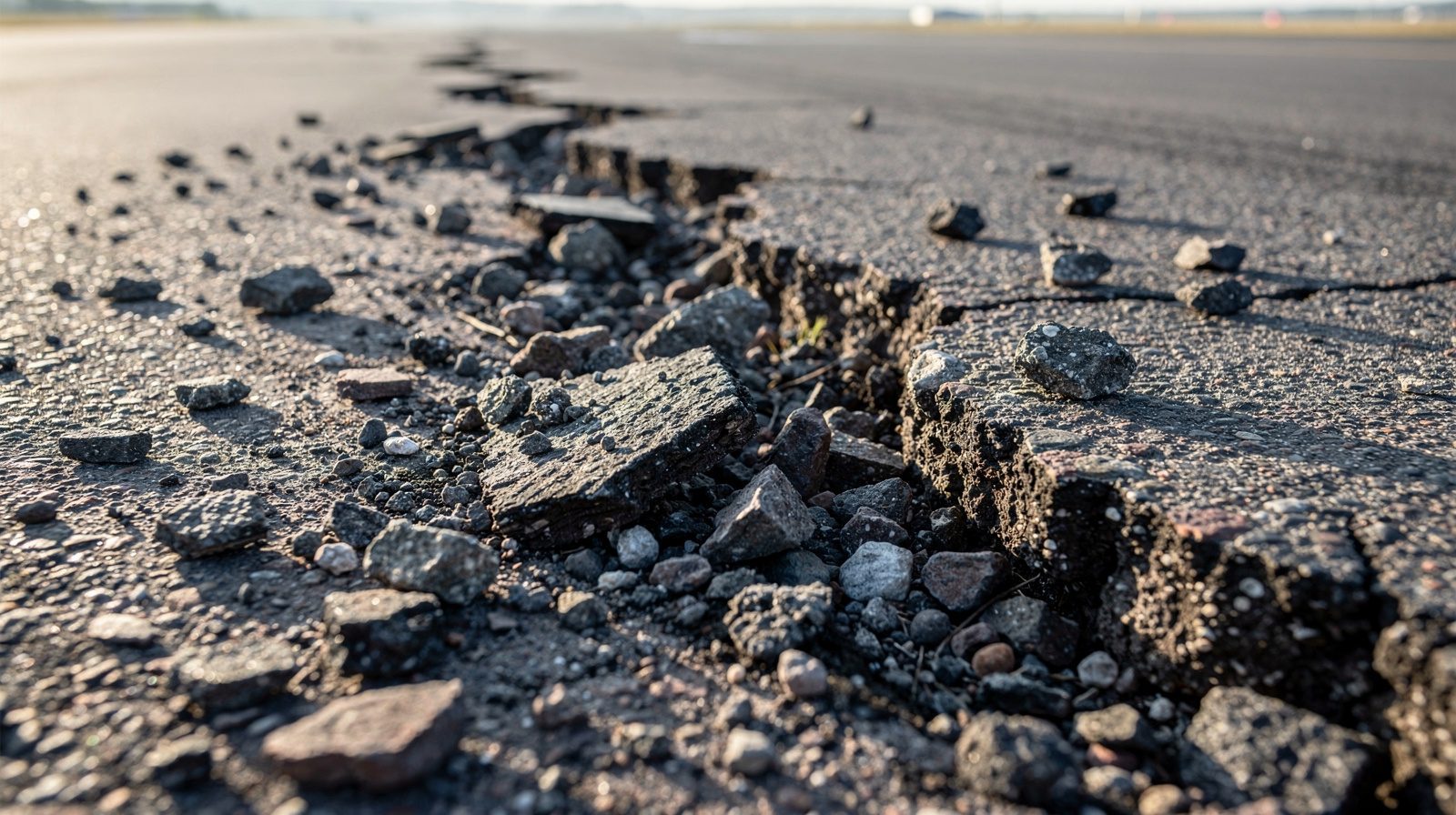
A rut is a surface depression in the wheel path. FAA AC 150/5380-6C (3.2.1) says that ruts often show only after rain, when the wheel paths fill with water. Traffic loads cause it. The material in one or more layers, or in the subgrade, consolidates or moves sideways and does not recover.
The layer that deforms matters. A rut that comes from the subgrade shows a structural problem, and the FAARFIELD design rules guard against it. A rut in a poor asphalt mix shows an unstable mix.
The rutting page covers the mechanisms, the rating and the repairs.
Other distress in a flexible pavement
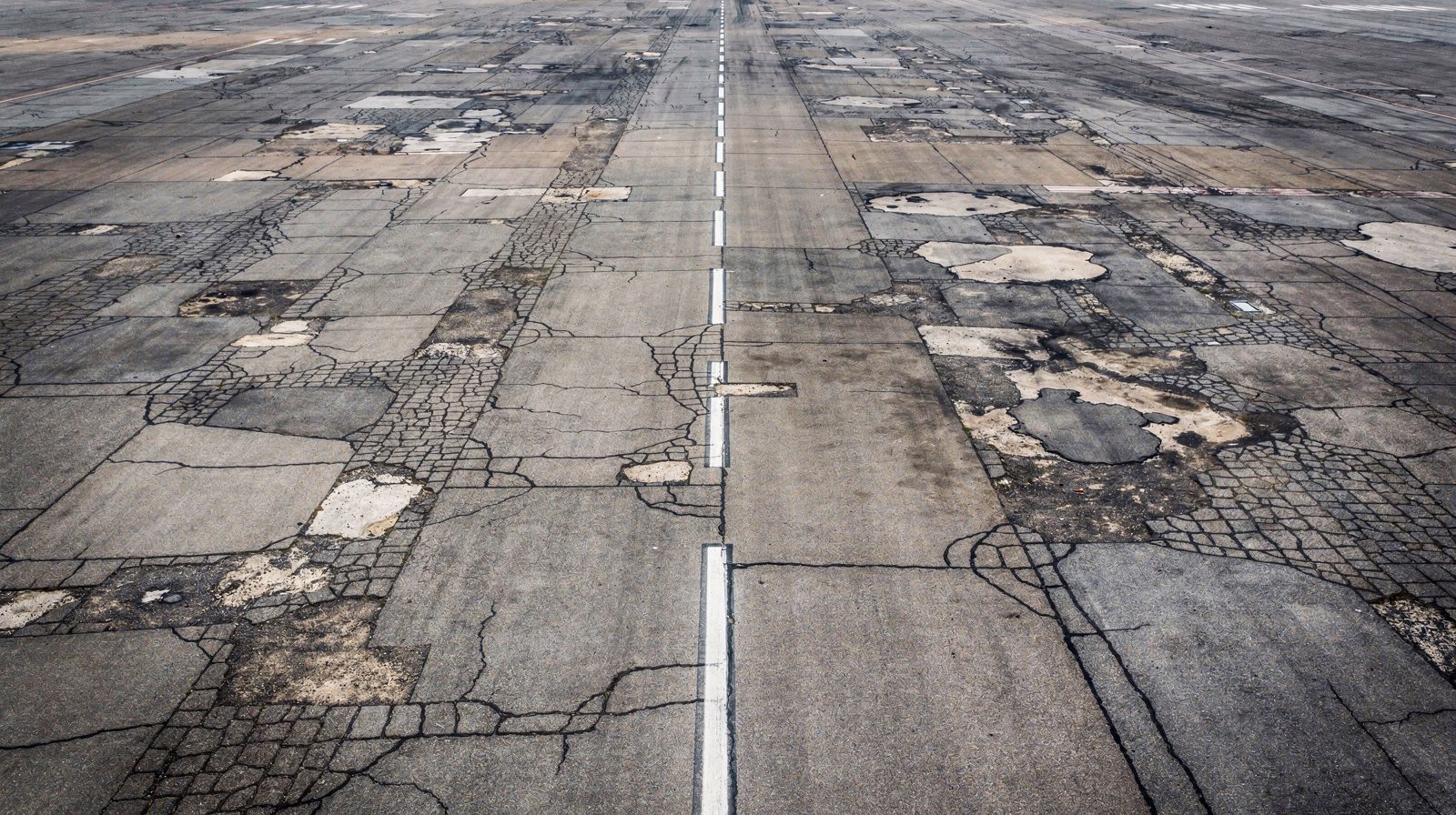
AC 150/5380-6C (3.2.1) sorts the distress of a flexible pavement into four groups.
- Cracking. Longitudinal and transverse cracks, block cracking, reflection cracking, slippage cracks and alligator (fatigue) cracking. Alligator cracking starts at the bottom of the asphalt layer under repeated traffic. The alligator cracking page covers it.
- Disintegration. Raveling, weathering, potholes, asphalt stripping, jet blast erosion and patch failure.
- Distortion. Rutting, corrugation, shoving, depressions and swelling.
- Loss of skid resistance. Polished aggregate, contaminants, bleeding and fuel or oil spillage.
Raveling and potholes make loose material. The AC says that raveling can be a significant source of foreign object debris (FOD). The raveling page covers that distress. This page covers the pavement type that suffers it.
Fuel and oil also matter. The AC says that continuous fuel or oil spillage on a hot mix surface softens the asphalt. The FAA offers P-404 fuel-resistant asphalt for the top of a surface where this is a risk (Table 3-3, note 2 of AC 150/5320-6G).
Flexible compared with rigid
| Item | Flexible pavement | Rigid pavement |
|---|---|---|
| Main load resistance | The layers together, to the subgrade | The surface concrete layer |
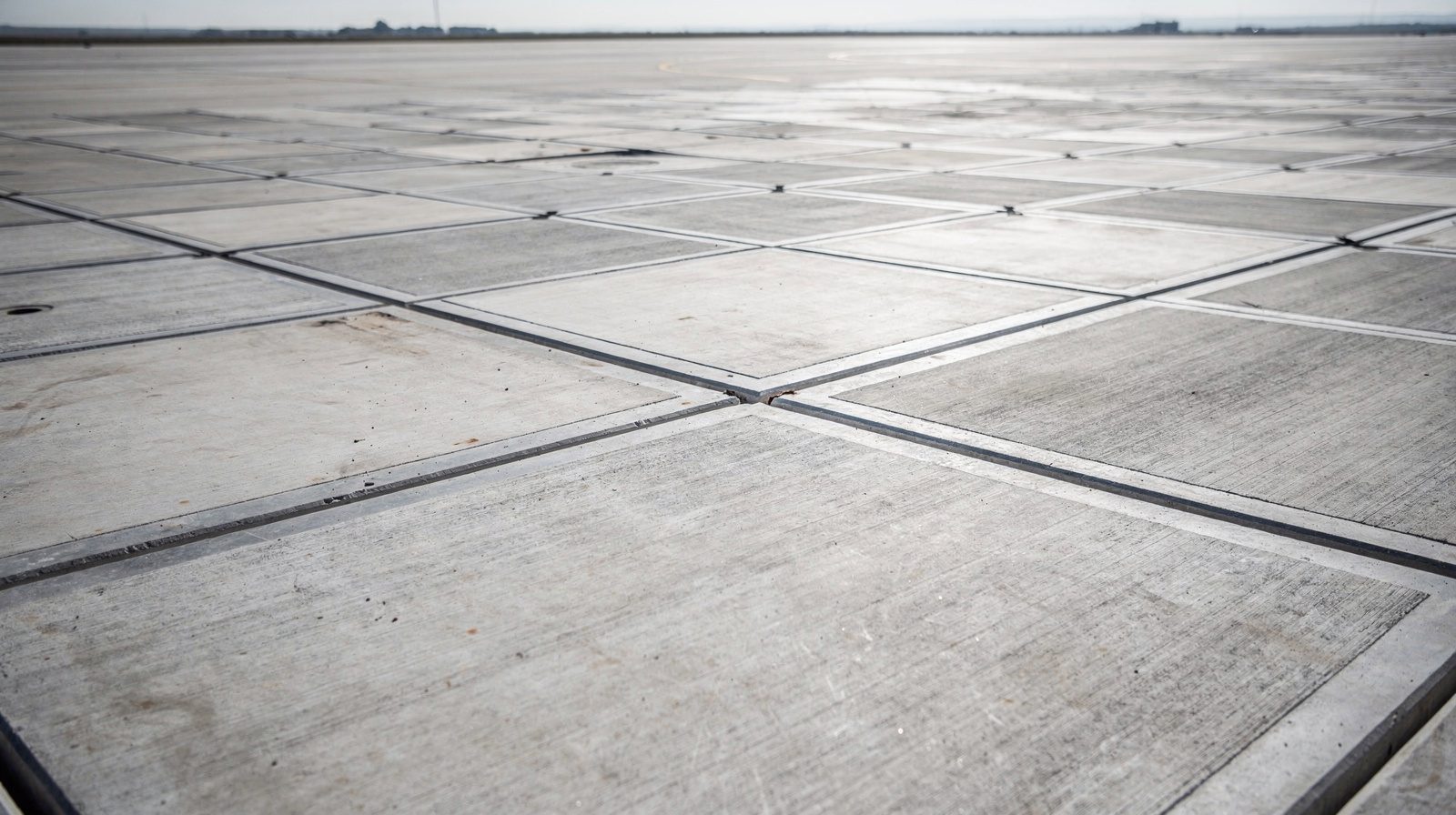
| Typical surface | Asphalt (P-401) | Cement concrete (P-501) |
| Structural failure | The subgrade is no longer protected | Extensive load cracking of the panels |
| Effect of tire pressure | More effect on the asphalt layer | Negligible effect on design |
| Joints | Paving lane joints, which can crack | Isolation, contraction and construction joints |
| Maintenance | Crack sealing, seal coats, small patches, mill and overlay | Crack and joint sealing, panel replacement, spall repair, diamond grinding |
| Strength report code | F | R |
AC 150/5320-6G (1.6.2.1) says that with proper design, materials, construction and maintenance, any pavement type can give the desired service life. The choice depends on cost, funding, operations, construction time, material supply, expected maintenance and future traffic. The rigid pavement page covers the other type.
Life, maintenance and rehabilitation
AC 150/5320-6G (3.10.5.1) says that routine crack sealing, seal coats and small patches are required to get the most life from a flexible pavement. Timely surface treatments extend functional life, and they work better the sooner they go on. A mill and overlay often gives a significant extra functional and structural life (4.3).
Removal and replacement of any structural layer below the surface course is reconstruction, not rehabilitation (4.4). The AC also says that PCI numbers give only a relative view of the surface condition. They are not exact limits for a decision (4.1). The PCI page covers the index.
Strength reporting
A flexible pavement is reported with the code F in the ACR-PCR method (Annex 14, 2.6.6). A composite pavement, for example an asphalt overlay on a concrete pavement, is reported as the type that best shows its structural behaviour. FAARFIELD treats a rigid pavement with a flexible overlay as rigid until the overlay thickness equals the rigid thickness (AC 150/5335-5D, 4.5.2.3). The pavement classification number page explains the older rating.
Lights in a flexible pavement
Inset lights need a base in the pavement. AC 150/5340-30J (10.3.1) requires a sectional light base for a new flexible pavement. The crew sets the bottom section in the base layer. After paving, the top section goes on. The top of the top section sits 35 mm (1 3/8 in) below the finished surface (10.3.10). After paving, the crew bores a 50 mm (2 in) hole through the surface layer to find the centre mark of the cover plate (10.3.11).
What to check on an inspection
An inspection of a flexible pavement looks for these items:
- Ruts, depressions and shoving in the wheel paths, and ponding after rain.
- Cracks, and the pattern they form.
- Raveling, potholes and loose material that can become FOD.
- Fuel or oil softening, and bleeding.
- Patches and their condition.
TarmacView plans the drone survey flight and captures the pavement images for the pavement condition assessment . The detection and rating are offered as early access.
Frequently Asked Questions
- What is a flexible pavement?
- A flexible pavement is a layered pavement in which each structural layer rests on the layer below, and the surface is usually asphalt. The FAA says that the layers rest in turn on the subgrade. Each layer protects the layer that supports it.
- What causes rutting in a flexible pavement?
- Rutting comes from permanent deformation in one or more layers or in the subgrade. Traffic loads consolidate or displace the material. FAA AC 150/5380-6C describes a rut as a surface depression in the wheel path. A poorly built asphalt layer can rut by consolidation under load.
- How does a flexible pavement differ from a rigid pavement?
- A flexible pavement spreads load down through layers. A rigid pavement carries most of the load in its surface concrete layer. The FAA says that structural failure of a flexible pavement is a subgrade that is no longer protected. For a rigid pavement it is extensive load cracking of the concrete panels.
- What are the layers of a flexible pavement?
- The layers are the asphalt wearing surface, a base course, a subbase where one is needed, and the subgrade. The base may be crushed aggregate or a stabilized material such as asphalt or cement-treated aggregate. A pavement for aircraft that all weigh less than 27,200 kg may be full-depth asphalt.
- How thick is a flexible pavement on an airfield?
- The structural design sets the thickness, and the FAA sets minimums by the weight of the heaviest aircraft. The asphalt surface is at least 75 mm (3 in) where all aircraft weigh less than 27,200 kg (60,000 lb). It is at least 100 mm (4 in) above that weight. A stabilized base of at least 125 mm (5 in) is also required from 45,360 kg (100,000 lb).
- How long does a flexible pavement last?
- FAA AC 150/5320-6G says that airport pavements have historically performed well for 20 years. A flexible pavement built with quality materials and kept up with timely crack sealing and surface treatments can last beyond its 20-year structural life. The AC says the first surface treatment is often applied about 5 years after construction.
- Which code shows a flexible pavement in a pavement strength report?
- The code is F. ICAO Annex 14 and FAA AC 150/5335-5D report the pavement type for the ACR-PCR method as R for rigid or F for flexible. A composite pavement is reported as the type that best reflects its structural behaviour, with a note.
References
- faa-ac-150-5320-6g
- AC 150/5320-6G, Airport Pavement Design and Evaluation FAA
- faa-ac-150-5380-6c
- AC 150/5380-6C, Guidelines and Procedures for Maintenance of Airport Pavements FAA
- faa-ac-150-5335-5d
- AC 150/5335-5D, Standardized Method of Reporting Airport Pavement Strength, ACR-PCR FAA
- icao-annex-14-vol1
- Annex 14 to the Convention on International Civil Aviation, Aerodromes, Volume I, Aerodrome Design and Operations, Ninth Edition (July 2022, consolidated with later amendments) ICAO
- faa-ac-150-5340-30j
- AC 150/5340-30J, Design and Installation Details for Airport Visual Aids FAA
This is a reference entry. TarmacView provides drone inspection services and doesn't sell the equipment or materials described in this glossary.