What is a Rigid Pavement?
Rigid Pavement
Definition
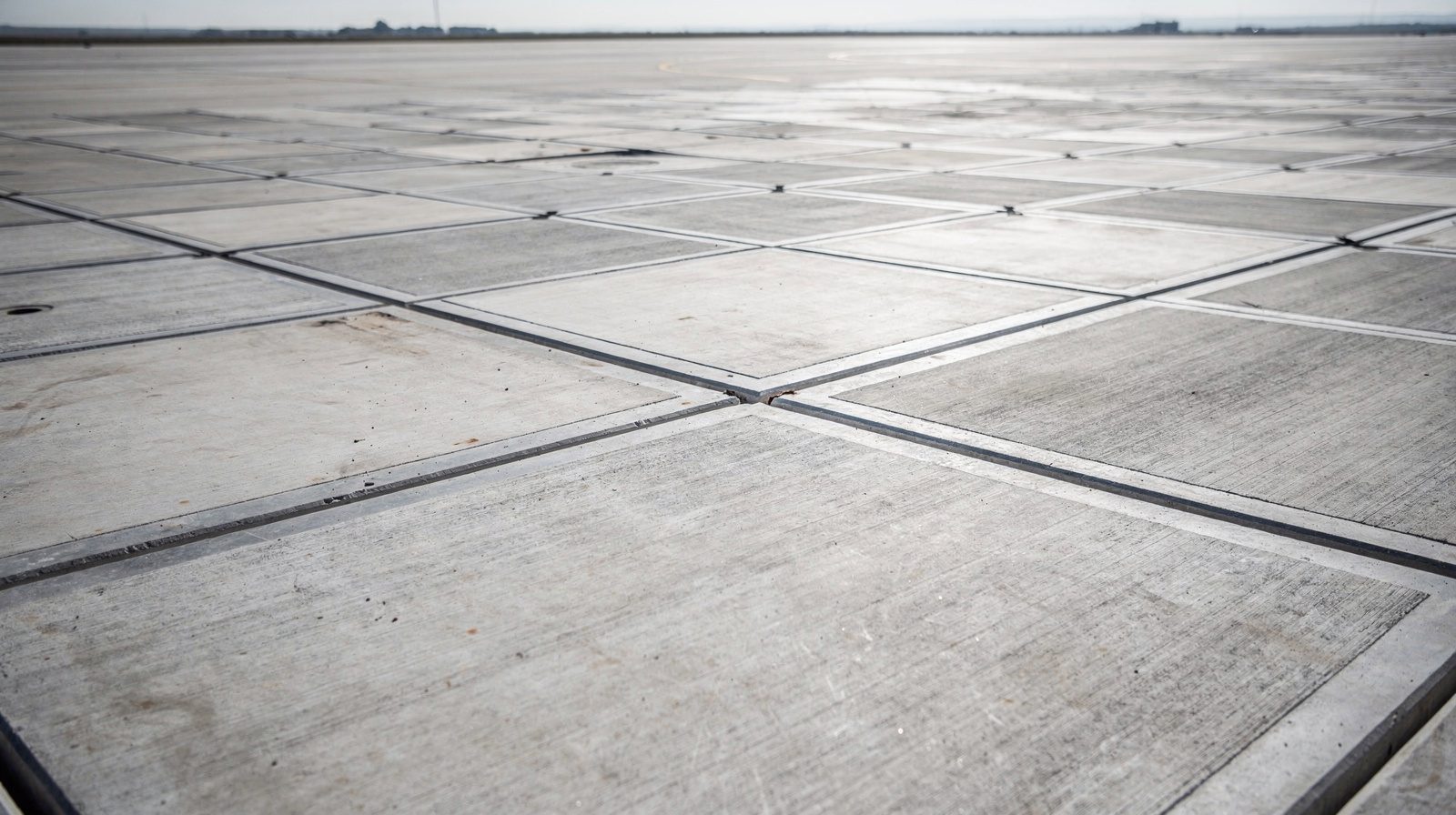
A rigid pavement is a pavement in which a surface layer of cement concrete gives most of the resistance to the load.
FAA AC 150/5320-6G says that the surface course of a rigid pavement is typically cement concrete, Item P-501. The surface layer is a set of concrete panels. The pavement page covers all pavement types. The concrete runway page covers the runway use. This page covers the rigid type.
How a rigid pavement carries load
A rigid pavement uses one very stiff structural layer. FAA AC 150/5335-5D says that the stiffness of this layer gives beam action. This action spreads the load over a large area of the subgrade. The capacity depends on the strength of the concrete. It also depends on uniform support from the layers below.
The layers are the concrete panels, a base course, and a compacted subgrade (AC 150/5320-6G, 3.16.1.1). The base gives uniform and stable support to the panels (3.16.3.1). The FAA requires a stabilized base under pavements for aircraft of more than 45,360 kg (100,000 lb) (3.16.3.2). The base course and subgrade pages cover these layers.
Thickness, strength and frost
- Minimum thickness. The concrete surface is at least 150 mm (6 in) for every aircraft weight class (Table 3-4).
- Design strength. Flexure is the main action in a concrete pavement, so the flexural strength matters most. The FAA recommends a design flexural strength of 4.14 to 5.17 MPa (600 to 750 psi) for most airfield work (3.16.7.3).
- Frost. Panels thinner than 230 mm (9 in) are more open to frost damage. The FAA says that it is best practice to reinforce such panels with at least 0.050 percent steel in both directions. This applies where the subgrade can heave, moisture can freeze and the base has no frost protection (3.16.5.3).
- Failure mode. FAARFIELD checks one mode for a rigid pavement. It is bottom-up cracking of the panel, which it controls by limiting the stress at the bottom of the concrete (3.16.1.2).
Joints
Temperature and moisture changes cause volume change and warping of the panels. The stress can be large. Joints divide the pavement into panels of set size, so they reduce the stress and limit random cracking (3.16.8.1 and 3.16.8.2).
AC 150/5320-6G (3.16.9.1) sorts joints by function:
- Isolation joints. They stand where the pavement meets a structure. They also stand where two pavements may move in different directions, for example a taxiway and a runway. A future extension starts at one.
- Contraction joints. They give controlled cracking when the concrete shrinks from a fall in moisture or temperature. They also reduce stress from curling and warping.
- Construction joints. They join two panels that crews place at different times, for example at the end of a day or between paving lanes. For aircraft of 13,610 kg (30,000 lb) or more, the FAA uses Type E construction joints.
Panel thickness controls the joint spacing, and not the other way round. Smaller panels generally perform better in the long term (3.16.8.4). Table 3-7 gives the recommended maximum spacing in each direction.
| Panel thickness | Maximum joint spacing |
|---|---|
| Up to 150 mm (6 in), no stabilized base | 3.8 m (12.5 ft) |
| 165 to 229 mm (6.5 to 9 in), no stabilized base | 4.6 m (15 ft) |
| Over 229 mm (9 in), no stabilized base | 6.1 m (20 ft) |
| 203 to 254 mm (8 to 10 in), stabilized base | 3.8 m (12.5 ft) |
| 267 to 330 mm (10.5 to 13 in), stabilized base | 4.6 m (15 ft) |
| 343 to 406 mm (13.5 to 16 in), stabilized base | 5.3 m (17.5 ft) |
| Over 406 mm (16 in), stabilized base | 6.1 m (20 ft) |
The transverse spacing stays at 1.25 times the longitudinal spacing or less. A spacing above 6.1 m (20 ft) needs a technical analysis in the engineer’s report. The AC also says to seal all joints (3.16.8.5). Items P-604 and P-605 of AC 150/5370-10 give the sealants. The joint sealant page covers them.
Spalling at joints
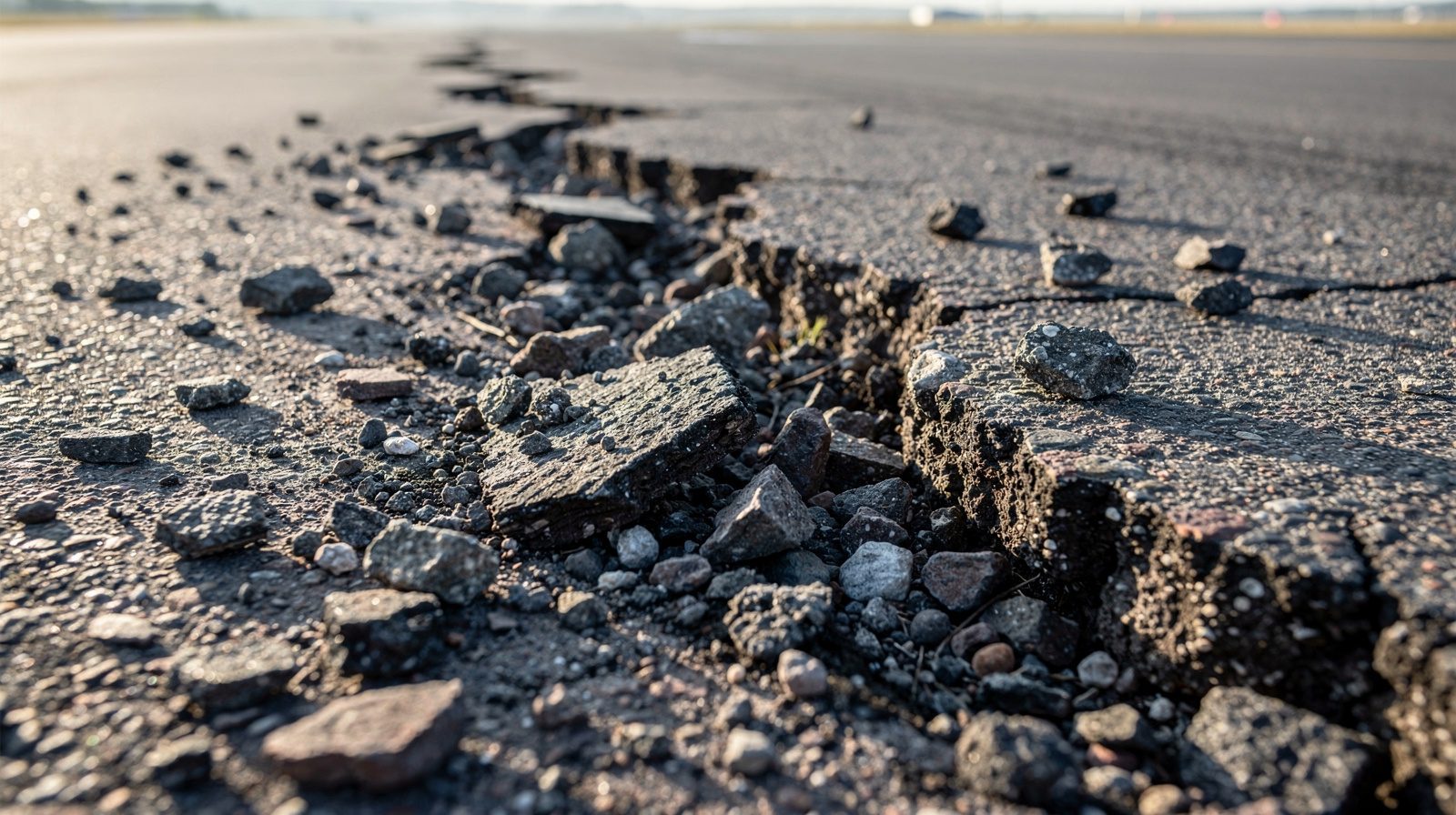
Joint spalling is the breakdown of the slab edge within 0.6 m (2 ft) of the side of a joint. AC 150/5380-6C (3.2.2) says that a joint spall usually does not go through the full slab thickness. It meets the joint at an angle. A corner break differs, because it goes through the full thickness.
The AC gives three causes. The first is excess stress at the joint or crack from incompressible material in the joint. The second is weak concrete at the joint, from overworking, together with traffic loads. The third is misaligned dowels, which hold the slab and prevent movement.
Joint seal damage can lead to spalling. The AC says that damaged seals let soil and rocks collect in the joints. The material stops the slabs from expanding, and it can cause buckling, shattering or spalling. The joint spalling page covers the rating levels and the repair. This page covers why a rigid pavement has joints that can spall.
Other distress in a rigid pavement
AC 150/5380-6C (3.2.2) sorts the distress into five groups.
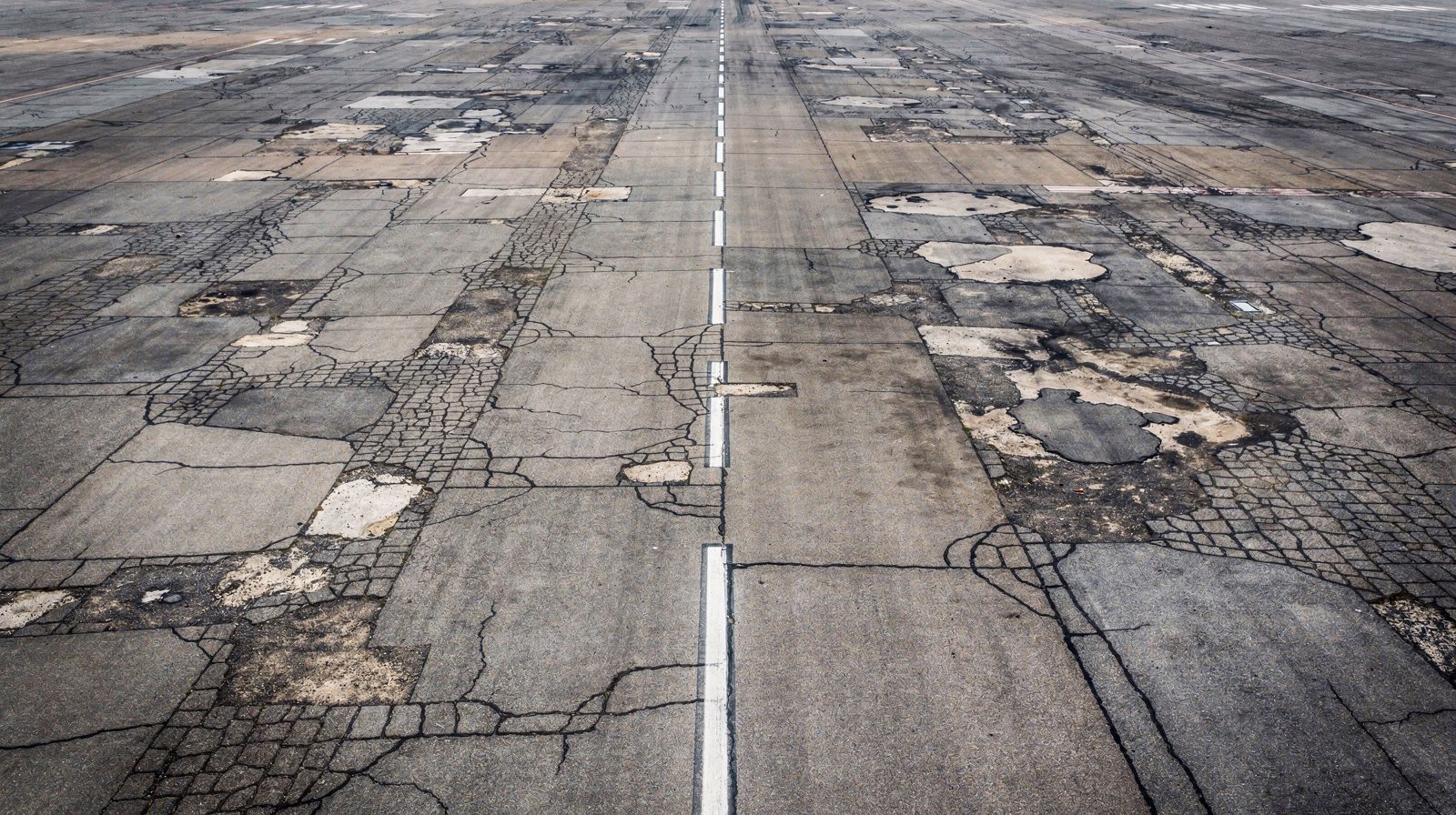
- Cracking. Longitudinal, transverse and diagonal cracks, corner breaks, durability (D) cracking, shrinkage cracks and shattered slabs. A shattered slab has four or more pieces. The D cracking and shattered slab pages cover two of these.
- Joint seal damage. Stripping, extrusion, hardening, loss of bond and missing sealant.
- Disintegration. Scaling, map cracking, alkali-silica reactivity, joint and corner spalling, blowups, popouts and patch failure.
- Distortion. Pumping and faulting. Pumping is the ejection of water and base material through joints or cracks.
- Loss of skid resistance. Polished aggregate and contaminants such as rubber deposits.
Disintegration breaks the pavement into small, loose pieces (3.2.2). Spalls, scaling and popouts can therefore make foreign object debris (FOD), and an inspection looks for it.
Rigid compared with flexible
AC 150/5320-6G (1.6.2.1) says that with proper design, materials, construction and maintenance, any pavement type can give the desired service life.
- Load path. A rigid pavement relies on the stiff panel. A flexible pavement relies on the layers together.
- Tire pressure. Tire pressure has a negligible effect on a rigid pavement design (3.12.6.3). AC 150/5335-5D (4.5.4.1) says that a rigid pavement can usually take code W, the high tire pressure category.
- Failure. Structural failure of a rigid pavement is extensive load cracking of the panels (3.10). For a flexible pavement it is a subgrade that is no longer protected.
- Repair. A rigid pavement can have up to 30 percent of its panels repaired or replaced as rehabilitation. More than 30 percent is reconstruction (4.3 and 4.4).
The flexible pavement page covers the other type, including its rutting.
Overlays and the strength code
An asphalt overlay on a rigid pavement gives a composite pavement. AC 150/5380-6C says that reflection cracking occurs most often in asphalt overlays on concrete, because the cracks and joints of the old slab show through. The asphalt overlay page covers overlays.
The ACR-PCR method reports a rigid pavement with the code R (Annex 14, 2.6.6). An example code is 800/R/B/W/T. R is rigid pavement and B is a medium strength subgrade. W is a high tire pressure and T is a technical evaluation (AC 150/5335-5D, 4.5.6). A rigid pavement with a flexible overlay stays classed as rigid until the overlay thickness equals the rigid thickness (4.5.2.3).
Joints and airfield lights
Joints affect where light bases stand. AC 150/5340-30J says these rules for rigid pavement:
- Runway centerline lights. On a new runway, the light base stands at least 0.6 m (2 ft) from any pavement joint. The distance runs to the edge of the fixture base (3.3.1.1.3).
- Taxiway centerline lights. The nearest edge of the fixture stands about 0.6 m (2 ft) from any rigid pavement joint (4.3.3.1).
- Runway guard lights. If a light conflicts with a rigid pavement joint, the crew moves the holding position marking and the lights. They move away from the runway by the minimum distance (4.4.3.2).
In a new rigid pavement, the mounting flange of an inset light base is at least 19 mm (3/4 in) below the finished surface (10.2). A light that stands higher can protrude and can be a hazard to vehicles such as snowplows. The inset light stands in a concrete anchor with a steel reinforcing cage.
What to check on an inspection
An inspection of a rigid pavement looks for these items:
- Spalls at joints and corners, and the width of the spalled zone.
- Joint seals that are missing, hard or out of the joint.
- Cracks, corner breaks and shattered slabs.
- Faulting at joints, and staining that shows pumping.
- Loose pieces that can become FOD.
TarmacView plans the drone survey flight and captures the pavement photos for the pavement condition assessment , including the joints. Crack detection and the ASTM D5340 rating are in development and offered as early access.
Frequently Asked Questions
- What is a rigid pavement?
- A rigid pavement is a pavement in which a surface layer of cement concrete gives most of the resistance to the load. FAA AC 150/5320-6G says that an airport rigid pavement is concrete on a granular or stabilized base course, which rests on a compacted subgrade.
- What causes spalling of joints in a rigid pavement?
- Joint spalling comes from excess stress at the joint. FAA AC 150/5380-6C names two causes. Incompressible material in the joint is one. Weak concrete at the joint, from overworking, combined with traffic loads is the other. Misaligned dowels also cause it. A spall is a breakdown of the slab edge within 0.6 m (2 ft) of the joint.
- What types of joints does a rigid pavement have?
- There are three types, and the joint function sets the type. Isolation joints separate the pavement from a structure or from a pavement that moves in another direction. Contraction joints give controlled cracking when the concrete shrinks. Construction joints join panels that crews place at different times.
- Why does a rigid pavement have joints?
- Joints divide the pavement into panels of set size. Changes in temperature and moisture cause volume change and warping, and these cause large stress. Joints reduce the effect of that stress and limit random cracking. A joint seal keeps water and incompressible material out.
- How thick is a rigid pavement on an airfield?
- The structural design sets the thickness. The FAA minimum for the concrete surface is 150 mm (6 in) for every aircraft weight class. A stabilized base of at least 125 mm (5 in) is also required under pavements for aircraft of 45,360 kg (100,000 lb) or more. Panels thinner than 230 mm (9 in) are more open to frost damage.
- What is the difference between a rigid and a flexible pavement?
- A rigid pavement carries load in its concrete slab. A flexible pavement spreads load down through layers of select materials. The FAA says that tire pressure has a negligible effect on a rigid pavement design. Its structural failure is extensive load cracking of the panels. A flexible pavement fails when the subgrade is no longer protected.
- How long does a rigid pavement last?
- FAA AC 150/5320-6G says that airport pavements have historically performed well for 20 years. Crack sealing, joint sealant repair, isolated panel replacement and partial depth spall repair are needed to get the most life from a rigid pavement. Replacing more than 30 percent of the panels counts as reconstruction.
References
- faa-ac-150-5320-6g
- AC 150/5320-6G, Airport Pavement Design and Evaluation FAA
- faa-ac-150-5380-6c
- AC 150/5380-6C, Guidelines and Procedures for Maintenance of Airport Pavements FAA
- faa-ac-150-5335-5d
- AC 150/5335-5D, Standardized Method of Reporting Airport Pavement Strength, ACR-PCR FAA
- icao-annex-14-vol1
- Annex 14 to the Convention on International Civil Aviation, Aerodromes, Volume I, Aerodrome Design and Operations, Ninth Edition (July 2022, consolidated with later amendments) ICAO
- faa-ac-150-5340-30j
- AC 150/5340-30J, Design and Installation Details for Airport Visual Aids FAA
This is a reference entry. TarmacView provides drone inspection services and doesn't sell the equipment or materials described in this glossary.