What is the Aeronautical Information Manual (AIM)?
Definition
The Aeronautical Information Manual (AIM) is the FAA’s official guide to basic flight information and ATC procedures in the US National Airspace System.
The FAA wrote it for the aviation community. It holds the fundamentals that a pilot needs to fly in US airspace. It also holds health and medical facts, factors that affect flight safety, a pilot and controller glossary, and information on safety, accident and hazard reporting.
This page covers the FAA manual. The aeronautical information page covers the data that States publish for air navigation, which is a different subject.
What the AIM is not
The AIM is not a regulation. The FAA’s Flight Information Publication Policy says that the publication is not regulatory. It gives examples of operating techniques and procedures. Other federal publications or regulations may make them requirements. It exists to help pilots meet the duties that those other publications set.
Three FAA publications play different roles.
- The Code of Federal Regulations (CFR) holds the regulatory requirements.
- Advisory circulars (AC) hold non-regulatory material. An AC does not bind the public unless a regulation incorporates it.
- The AIM holds basic flight information and ATC procedures. Its text points to the regulation where a rule applies. Paragraph 5-4-5 points to 14 CFR 91.175 for instrument approaches, for example.
An airport engineer reads the AIM for the pilot’s view of the airfield. The design values, such as spacing and intensity of lights, belong to design standards and not to the AIM.
What the chapters cover
The AIM has 12 chapters, numbered 0 to 11, and 5 appendices.
| Chapter | Title |
|---|---|
| 0 | General Information |
| 1 | Air Navigation |
| 2 | Aeronautical Lighting and Other Airport Visual Aids |
| 3 | Airspace |
| 4 | Air Traffic Control |
| 5 | Air Traffic Procedures |
| 6 | Emergency Procedures |
| 7 | Safety of Flight |
| 8 | Medical Facts for Pilots |
| 9 | Aeronautical Charts and Related Publications |
| 10 | Helicopter Operations |
| 11 | Unmanned Aircraft Systems (UAS) |
A paragraph number has three parts. They are the chapter, the section and the paragraph. Paragraph 2-1-4 is chapter 2, section 1, paragraph 4. It covers runway edge light systems.
Airport lighting in the AIM
Chapter 2, section 1 is titled Airport Lighting Aids. It describes each lighting system from the pilot’s side.
| Paragraph | Subject | What it says |
|---|---|---|
| 2-1-1 | Approach light systems | They start at the landing threshold. They reach about 730 to 910 m (2,400 to 3,000 ft) into the approach on precision instrument runways. On non-precision instrument runways they reach about 430 to 460 m (1,400 to 1,500 ft) |
| 2-1-3 | Runway end identifier lights | A pair of synchronised flashing lights on each side of the threshold. They may be omnidirectional or unidirectional |
| 2-1-4 | Runway edge light systems | Classes by intensity. HIRL and MIRL have variable intensity. LIRL normally has one setting |
| 2-1-5 | In-runway lighting | Centreline lights, touchdown zone lights, lead-off and lead-on lights, and land and hold short lights |
| 2-1-7 and 2-1-8 | Control of lights | The tower controls them. At some airports the pilot switches them by radio |
| 2-1-10 | Taxiway lights | Edge lights are blue. Centreline lights are green |
Runway edge lights and night operations
Paragraph 2-1-4 says that runway edge lights outline the edges of the runway in darkness or restricted visibility. It sets out four facts.
- The FAA classes the systems by the intensity that they can produce. The classes are high intensity (HIRL), medium intensity (MIRL) and low intensity (LIRL).
- HIRL and MIRL have variable intensity controls. LIRL normally has one setting.
- The lights are white. On an instrument runway, yellow replaces white on the last 610 m (2,000 ft) or half the runway length, whichever is less. This forms a caution zone for landings.
- The lights at the runway ends show red toward the runway. They show green outward from the end, to mark the threshold for landing aircraft.
The paragraph gives no spacing or intensity values. The runway edge light page covers those values, the fixtures and the inspection, against EASA, ICAO and FAA rules.
In-runway lighting
Paragraph 2-1-5 adds three runway lighting systems for low visibility.
- Centreline lights stand at 15 m (50 ft) intervals. They are white until the last 914 m (3,000 ft). They then alternate white and red for 610 m (2,000 ft). The last 305 m (1,000 ft) shows red only.
- Touchdown zone lights are two rows of white transverse light bars. They start 30 m (100 ft) beyond the threshold. They end 914 m (3,000 ft) beyond it, or at the runway midpoint, whichever is less.
- Land and hold short lights are a row of pulsing white lights across the runway at the hold short point. They are on whenever land and hold short operations are in effect.
Who switches the lights
The control tower controls the approach light systems and the runway lighting. At some places the flight service station controls them where no tower is in operation (2-1-7). Pilots may ask for the lights on or off. The runway edge lights, in-pavement lights and approach lights have intensity controls that the controller sets to meet the request.
At selected airports a pilot keys the aircraft microphone to control the lights by radio (2-1-8). All radio-controlled lighting at one airport uses the same frequency.
How the AIM relates to other publications
- The AIP. The Aeronautical Information Publication is the international version of the AIM. It contains parallel information and specific information on the international airports. See Aeronautical Information Publication .
- The Chart Supplement. The AIM is complemented by separate publications. The Chart Supplement U.S. holds data on airports, communications, navigation aids, instrument landing systems, VOR receiver check points, preferred routes and special notices.
- Instrument approach charts. AIM paragraph 5-4-5 explains the instrument approach procedure charts.
Updates
The FAA publishes the AIM as a basic manual and then as changes. The schedule in the October 2023 edition lists effective dates from 20 April 2023 to 9 July 2026. Each date follows the previous one by 24 weeks. The sequence is a basic manual, then Change 1, Change 2 and Change 3, and then a new basic manual.
The online AIM shows Change 3, effective 9 July 2026. The FAA posts the manual by its effective date on the Air Traffic Plans and Publications website. It also sends email notices to subscribers when a change appears. Each organisation is responsible for viewing, downloading and subscribing.
The AIM and drone work at airports
Chapter 11 covers unmanned aircraft systems. Paragraph 11-1-2 covers a UAS under 55 pounds (about 25 kg) maximum gross takeoff weight. It may generally fly in visual line of sight up to 400 feet (122 m) above ground level in Class G airspace. In controlled airspace the operator needs an authorisation from ATC.
A Part 107 operator can ask for an airspace authorisation through LAANC or DroneZone. This applies to flights in Class B, Class C or Class D airspace. It also applies to the surface area of Class E airspace that is designated for an airport. The UAS facility map gives the maximum altitude that ATC can approve without further coordination.
These rules apply to US airspace only.
What it means on an airfield
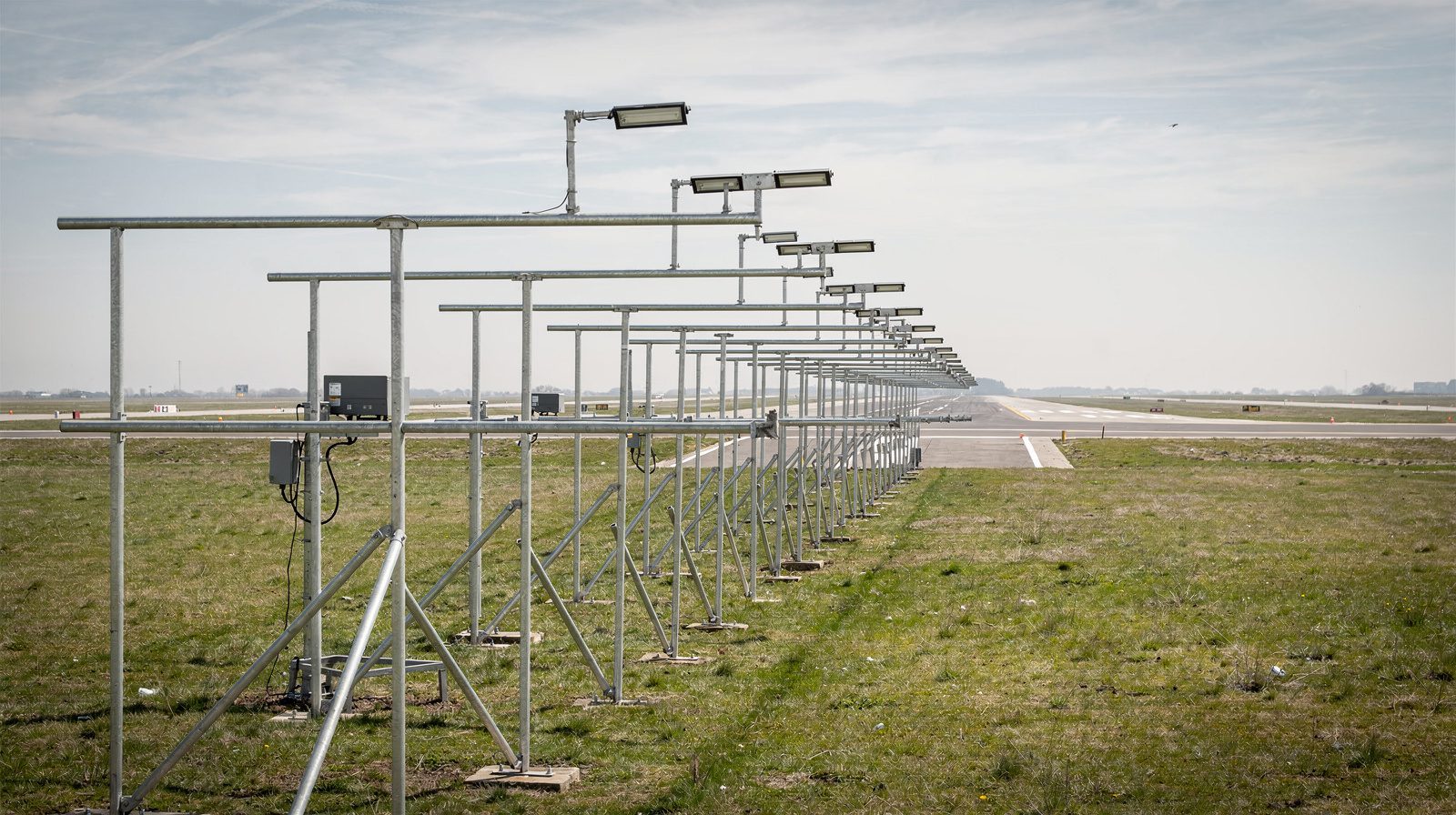
An airfield lighting system serves pilots who read the AIM. A pilot expects the colours, the caution zone, the intensity steps and the radio control that paragraphs 2-1-1 to 2-1-10 describe. An inspection checks that the lights match the design standard. The AIM tells the inspector what the pilot sees at night.
TarmacView’s runway edge lights inspection flies the rows by drone. It measures each unit.
Frequently Asked Questions
- What is the FAA Aeronautical Information Manual?
- The Aeronautical Information Manual (AIM) is the FAA's official guide to basic flight information and ATC procedures in the US National Airspace System. It also covers medical facts, flight safety factors, a pilot and controller glossary, and hazard reporting.
- What does the AIM say about runway edge lights?
- Paragraph 2-1-4 says that runway edge lights outline the runway edges in darkness or restricted visibility. The FAA classes them by intensity as HIRL, MIRL and LIRL. The lights are white. On an instrument runway, yellow replaces white on the last 610 m (2,000 ft) or half the runway length, whichever is less.
- Does the AIM give design values for runway edge lights?
- No. Paragraph 2-1-4 describes the lights from the pilot's side and gives no spacing or intensity values. Those values belong to design standards. Examples are EASA CS-ADR-DSN, ICAO Annex 14 and the FAA advisory circulars.
- Is the AIM a regulation?
- No. The FAA's own policy statement in the AIM says that the publication is not regulatory. It gives examples of operating techniques and procedures. Other federal publications or regulations may make them requirements.
- Who controls the airport lights, according to the AIM?
- The control tower controls the approach lights and the runway lights. Where there is no tower in operation, the flight service station may control them. Pilots may ask for lights on or off, and for a change of intensity. At selected airports a pilot can switch the lights by radio (2-1-7 and 2-1-8).
- How often does the AIM change?
- The schedule in the October 2023 edition shows a new effective date every 24 weeks. It lists a basic manual and then Changes 1, 2 and 3 in turn. The online AIM shows Change 3, effective 9 July 2026.
- What is the difference between the AIM and the AIP?
- The AIM is the US manual of basic flight information and ATC procedures. The Aeronautical Information Publication (AIP) is the international version. It contains parallel information and details on the international airports.
- Does the AIM cover drone operations?
- Yes. Chapter 11 covers unmanned aircraft systems. Paragraph 11-1-2 covers a UAS under 55 pounds (about 25 kg) maximum gross takeoff weight. It may generally fly in visual line of sight up to 400 feet (122 m) above ground level in Class G airspace. Operations in controlled airspace need an authorisation from ATC.
References
- faa-aim-index
- Aeronautical Information Manual, index page FAA
- faa-aim-pdf-2023
- Aeronautical Information Manual, Basic with Change 1, 5 October 2023 FAA
This is a reference entry. TarmacView provides drone inspection services and doesn't sell the equipment or materials described in this glossary.