ASTM D6433: Road and Parking Lot PCI Surveys
What ASTM D6433 covers for road and parking lot PCI surveys, how it differs from airport D5340, who cites it, and which steps imagery can support or cannot.
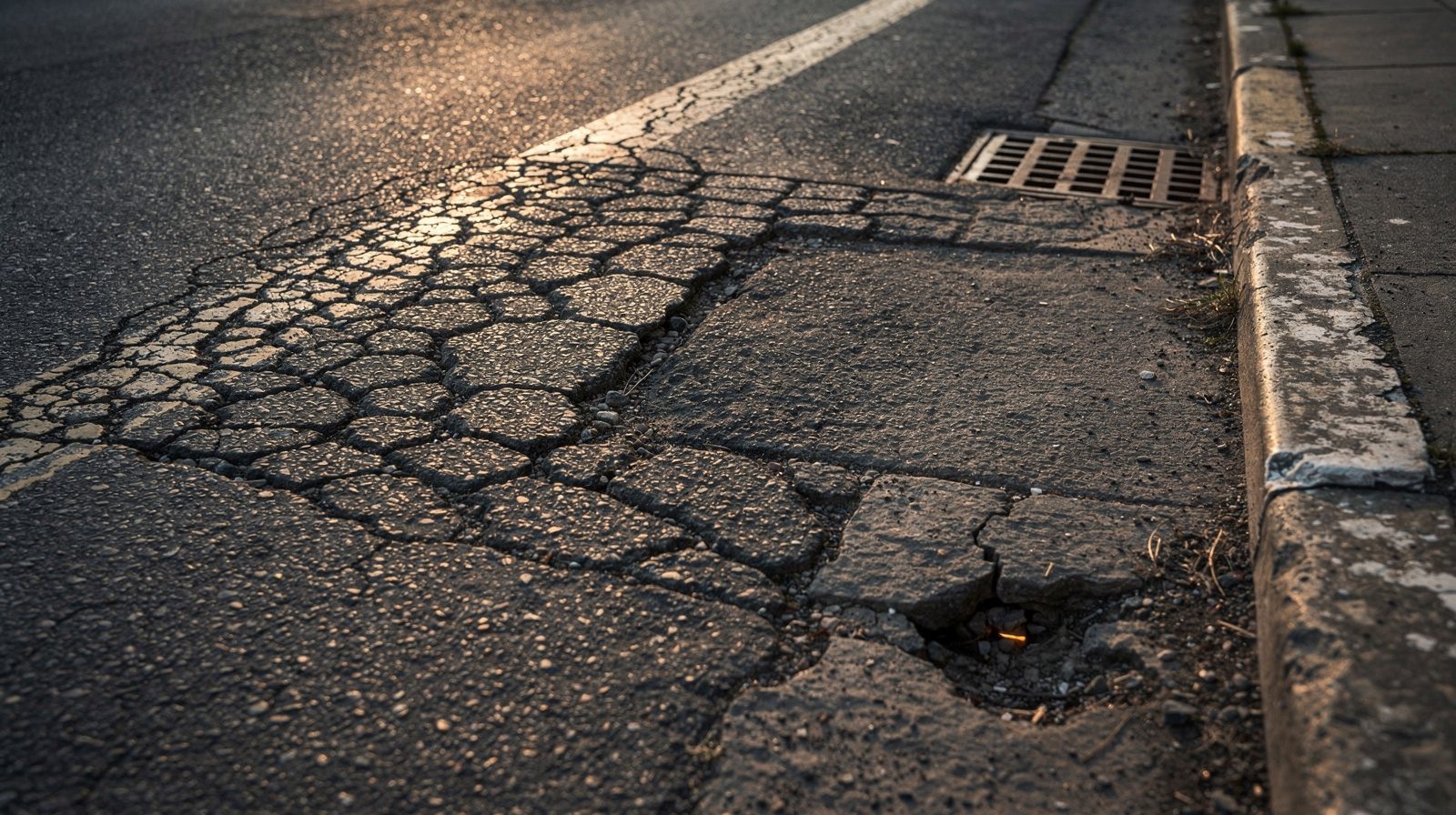
- 01 D6433 rates what an inspector sees on the surface of a road or parking lot. ASTM's summary of the significance clause says the PCI cannot measure structural capacity and gives no direct measurement of skid resistance or roughness.
- 02 D6433 is the road and parking lot practice and D5340 is the airport method. FAA AC 150/5380-7B names each for its own type of pavement, so treat them as two separate surveys.
- 03 Neither the EASA aerodrome rules nor Annex 14 mention a Pavement Condition Index. D6433 binds only where an agency manual, contract or programme names it.
- 04 Several severity rules in the ERDC distress manuals need a straightedge, a knife blade, a depth measurement or a drive at posted speed. Imagery can serve some of them and not others.
- 05 FHWA gives an example of how sensitive the index is. A one percent difference in the area of low-severity fatigue cracking can move the PCI by 12 points.
On this page · 11 sections
A pavement distress survey records the type, severity and quantity of each surface distress. ASTM D6433 is the standard practice that turns those records into a Pavement Condition Index from 0 to 100 for roads and parking lots. A pavement management system then uses that condition data to model deterioration and recommend treatments.
D6433 shares its method with the airport standard, ASTM D5340. The two are easy to mix up, and a report that names the wrong one may not meet the programme that asked for it. This page keeps the scope, the edition, the sources that cite the practice and the parts of a survey that imagery can and cannot serve.
What D6433 covers
The title is Standard Practice for Roads and Parking Lots Pavement Condition Index Surveys. ASTM’s summary of section 1.1 says it covers the determination of road and parking lot pavement condition through visual surveys that use the Pavement Condition Index method. The output is a number from 0 to 100 for each inspected unit, where 0 is a failed pavement and 100 is an excellent one. The term page on ASTM D6433 keeps the short definition. This page keeps the scope, the edition and the procedure.
The summary of the significance clause is plain about what the number is not. The PCI is a rating of surface condition based on observed surface distress. It indicates structural integrity and surface operating condition, but it cannot measure structural capacity and gives no direct measurement of skid resistance or roughness. It supports decisions on maintenance and repair, and repeated surveys show how fast a pavement is deteriorating. ASTM’s summary of section 1.3 adds that the US Army Corps of Engineers developed the PCI and that the Department of Defense and the American Public Works Association later verified and adopted it.
D6433 at a glance
- Issuer
- ASTM International, Committee E17, Subcommittee E17.42, published in Book of Standards Volume 04.03.
- Current edition
- D6433-24, listed as active by ASTM and last updated 15 November 2024. The first ASTM edition dates from 1999 (ERDC PAVER).
- Type
- A standard practice, not a regulation. It applies where an agency manual, contract or programme names it.
- Surfaces
- Roads and parking lots. The ERDC distress manuals that carry the definitions cover asphalt-surfaced and jointed concrete surfaced pavement.
- Output
- A Pavement Condition Index from 0 to 100 per inspected unit, rolled up to the section.
- Inputs
- Distress type, severity and quantity, recorded by an inspector on the surface.
- Out of scope
- Structural capacity, which the PCI cannot measure, and direct measurement of skid resistance and roughness, per ASTM's summary of the significance clause.
- Airport counterpart
- ASTM D5340, for airport pavements. A separate standard, not an interchangeable one.
D6433 and D5340 are not interchangeable
FAA AC 150/5380-7B, Appendix B, paragraph B-1.0, puts the split in two sentences. D5340 covers the determination of airport pavement condition through visual surveys using the PCI method. D6433 covers the determination of road and parking lot pavement condition. Both use the PCI method on a 0 to 100 scale, which is why the two get confused. The catalogue of distresses is not the same. The ERDC manuals for roads number 20 asphalt distresses and 19 jointed concrete distresses. The ERDC manuals for airfields number 17 and 16, and the airfield asphalt set carries distresses that only occur on an airfield, jet blast erosion and oil spillage among them. A runway rated with the road catalogue has not been rated with the airfield one. The D5340 page sets out the airport method.
What the EU and ICAO texts say
Neither framework asks for a PCI. A text search of the March 2026 EASA Easy Access Rules for Aerodromes, which carry Regulation (EU) No 139/2014 and CS-ADR-DSN, finds no occurrence of Pavement Condition Index or PCI. The Annex 14 Volume I, 9th edition, copy hosted by the Swiss FOCA gives the same result. Both texts deal with pavement bearing strength reporting, the ACN-PCN method in the EASA text and ACR-PCR in Annex 14, which is a different question from surface condition. D6433 therefore enters an aerodrome only through the owner’s own pavement management, as it does for a municipal road.
What a distress survey and a pavement management system do
A distress survey is the data collection step. An inspector divides the pavement into sample units and records every distress by type, severity and quantity. FAA AC 150/5380-7B, Appendix B, paragraph B-2.0, says the PCI is based on an objective measurement of those three things. A pavement management system is what uses the result. FHWA describes pavement management as a process that uses data to model pavement behavior and to determine efficient, effective long-term strategies for a pavement network. Its principal function is to develop treatment and project recommendations that give the best pavement condition at the least practical cost over the short and long term.
In the short term such a system shows the inventory, location, condition and remaining useful life of the network. In the long term it forecasts condition under different funding scenarios, so an agency can estimate the funding needed to reach a target condition. AC 150/5380-7B describes the airport version in the same terms (paragraph 2.0). It is a consistent, objective, systematic procedure for setting policy, priorities and schedules, allocating resources and budgeting maintenance and rehabilitation. It adds that most pavement management software uses the PCI method (paragraph B-1.0). The three parts work as a chain. The survey supplies the distress records, D6433 or D5340 turns them into a rating, and the management system uses repeated ratings to plan work. The distress survey glossary page keeps the short definition.
Where the method comes from and who cites it
The PCI began as a military method. The ERDC PAVER page records that the PCI for roads and parking lots became an ASTM standard in 1999. The distress manuals that carry its definitions were prepared at the Corps’ Construction Engineering Research Laboratory, and the road editions in this page’s references date from June 2009. The PCI explainer covers the method in more depth.
Department of Defense. The Tri-Service Pavement Working Group’s pavement management plan manual, in paragraph 2-4.1, says the PCI is a numerical rating on a scale of 0 to 100 determined by a visual pavement survey based on procedures in ASTM D5340, ASTM D6433, TSPWG 3-260-03.02-19 and UFC 3-260-16. It also says the ratings are a qualitative assessment of the surface condition and not to be confused with structural capacity. The same manual and UFM 3-270-08 name PAVER as the application where the results are kept. The UFM is non-mandatory guidance by its own foreword.
Highway agencies. The FHWA guide on quality management of pavement condition data lists D6433 among the ASTM standards developed to support condition data collection. It describes the standard as a method for determining road and parking lot condition through visual surveys using the PCI method developed by the Army Corps of Engineers. The guide also describes manual surveys as walking or travelling at slow speed and noting the surface distress, with rut depth and faulting typically estimated by manual spot measurements. The guide states that it is not itself a standard, specification or regulation.
Airports. FAA AC 150/5380-6C, in paragraph 3.1, points to AC 150/5380-7, ASTM D5340 and ASTM D6433 for additional information on distresses. That is a pointer to reading material and does not assign D6433 to airfield pavement.
How a D6433 survey runs
The survey is hierarchical. The Department of Defense manual UFM 3-270-08 defines a sample unit as a defined portion of a pavement section designated only for the purpose of pavement inspection. A network is split into branches and sections, a section is split into sample units, and an inspector records every distress inside each unit that is inspected. The same manual says the number of units inspected depends on whether a network-level or a project-level inspection is called for. The sizing rules of D6433 itself sit in its paywalled text, which was not opened for this page, so this page gives no unit size. A report should state it.
Inside each inspected unit the inspector records distress by type, severity and quantity. Severity is low, medium or high for most types. The PCI of the unit follows from those records, and the section value is built from the units inspected. The PCI explainer walks through the arithmetic.
The distress catalogue
The ERDC manuals for roads and parking lots give the distress definitions, severity levels and measuring methods that the PCI method uses. They are free to download and cover the same method that D6433 standardises. They are the Corps’ own documents, dated June 2009, and are not the current ASTM text. Read the counts and rules below as the manuals’ content and check any figure that matters against a licensed copy of D6433-24.
Asphalt-surfaced roads and parking lots, 20 types. Alligator or fatigue cracking, bleeding, block cracking, bumps and sags, corrugation, depression, edge cracking, joint reflection cracking, lane or shoulder drop-off, longitudinal and transverse cracking, patching and utility cut patching, polished aggregate, potholes , railroad crossing, rutting , shoving, slippage cracking, swell, raveling and weathering.
Concrete-surfaced roads and parking lots, 19 types. Blowup or buckling, corner break, divided slab, durability cracking, faulting , joint seal damage, lane or shoulder drop-off, linear cracking, large patching and utility cuts, small patching, polished aggregate, popouts, pumping, punchout, railroad crossing, scaling, shrinkage cracks, corner spalling and joint spalling.
The manuals also fix counting rules that change a result. In the asphalt manual, distresses found inside a patched area are not recorded separately, and the effect of the distress on the patch is taken into account in the patch’s severity. If a crack varies in severity along its length, each identifiable portion is recorded on its own, and if the portions cannot be separated the crack is rated at the highest severity present. In the concrete manual, a slab with the same distress at more than one severity is counted once, at the higher severity.
What imagery can serve, and what it cannot
D6433 is already a visual method, so imagery changes the vantage point rather than the category. What it cannot change is the part of the method that happens on the road with a tool in hand, in a moving car or with a rule applied by a person. The ERDC manuals make the split visible.
Which parts of a D6433 survey imagery can support
| Part of the survey | What the manuals ask for | What imagery can do | What stays with the walked or driven survey |
|---|---|---|---|
| Surface-visible cracking and breakage | Locate, classify and measure length, area or slabs affected, with crack severity by width and surrounding breakdown | Locate and measure from above, where the ground sample distance resolves the crack width and the pattern | Confirming the class where a rule depends on what is under the surface or on crack width at the limit of resolution |
| Potholes | Count them, and grade each by average diameter and maximum depth in a table | Find them and measure the diameter | Depth, which is geometry and needs a surface model or a measurement in the hole, not a photograph |
| Rutting | Area of surface affected, with severity from the mean rut depth taken by laying a straightedge across the rut and measuring at points along its length | Show the extent in the wheel paths | The straightedge measurement the severity rule is written around |
| Ride quality | For bumps, shoving, corrugation, swells and railroad crossings, severity from how a vehicle behaves, driven at the posted speed in a sedan representative of local traffic | Locate the distress and show its extent | The drive, because the severity definition is about vibration and discomfort in a vehicle |
| Faulting and joint seal (concrete) | Faulting severity from the difference in elevation across a joint, with the low band starting above 3 mm, and joint seal damage low where sealer has debonded from the joint edge, shown when a knife blade can be inserted between sealer and joint face without resistance | Show missing, extruded or vegetated sealant and obvious steps at joints | Millimetre elevation differences and the knife-blade test |
| Counting rules | Do not record distress inside a patch, record varying crack severity in portions, count a slab once at its highest severity | Apply the same rule the same way everywhere, once it has been encoded and checked | The judgement calls a trained inspector makes when a case does not fit the rule cleanly |
Surface-visible families can be located and measured from above, and a drone or vehicle survey sees the whole surface rather than a sample. Deformation is geometry, so rutting and pothole depth come only from a surface model built by photogrammetry or from a measurement taken on the ground. Some rules are tactile, judged by touch or by the feel of a drive. The asphalt manual defines ride quality severity by how a vehicle behaves, and the concrete manual defines low joint seal damage by a knife blade. No camera performs either step.
How sensitive the index is to measurement error
The FHWA quality management guide gives the best warning for anyone replacing a walked measurement with an estimated one. In its background chapter it notes that just a one percent difference in the area of low-severity fatigue cracking can make a 12 point difference in the 100-point PCI calculation defined in ASTM D6433. It adds that such a difference may lead to a completely different treatment recommendation and a significant cost.
The example is one distress at one severity, and it should not be read as a general rule for every distress. It does show why a detection method needs measured accuracy on the distress types it reports before its quantities feed an index. A result that is close on average can still move a section across a treatment threshold.
Where TarmacView sits
TarmacView’s road pavement assessment is not offered yet and is in active development. The platform already plans the survey flights and captures georeferenced drone and ground imagery of the agreed streets, and keeps it so a disputed call can be re-examined later. Crack detection is close to a first MVP and finds cracks as one class and nothing else. TarmacView reports neither a PCI nor a PCI proxy for roads, no condition rating per section and no distress codes, and it does not claim to be a D6433 survey. Where a programme requires a formal survey to the named standard, a formal survey is needed. The airport equivalent is covered on the D5340 page .
Keeping two surveys comparable
A single PCI is a snapshot, and the value of the method is the trend. A trend holds only when the second survey measures the same thing the same way as the first.
The same sections and sample units. A section PCI is built from its inspected units. Move a boundary or renumber the units and the next value describes different ground.
The same edition. A report should name the edition it was run to, and a change of edition between surveys should be checked against both texts before two values are compared.
Consistent rating. Severity calls rest on the inspector’s reading of the manual. A change of inspector or contractor is worth noting against the trend.
The same method of capture. A rating from a walked survey and a rating from imagery are different measurements. Compare like with like, and when the method changes, run both on the same sections once so the step in the trend is explained and not mistaken for deterioration.
Frequently Asked Questions
- Is ASTM D6433 the same as ASTM D5340?
- No. FAA AC 150/5380-7B, Appendix B, describes D5340 as covering the determination of airport pavement condition and D6433 as covering road and parking lot pavement condition. Both use the Pavement Condition Index method, which runs from 0 to 100, but they are separate standards. A programme that names one should not be handed a report to the other without its agreement.
- Which edition of D6433 is current?
- ASTM lists D6433-24 as the active edition and shows it as last updated on 15 November 2024. The ERDC PAVER page says the PCI for roads and parking lots became an ASTM standard in 1999. A survey report should state the edition it was run to.
- Is a D6433 survey required by law?
- Nothing opened for this page makes it a legal requirement. It is an ASTM practice and it binds where an agency manual, a contract or a programme names it. The Tri-Service Pavement Working Group manual names it among the procedures a Department of Defense PCI is based on. A road owner outside such a programme chooses it, or an equivalent, for its own pavement management.
- Can D6433 be used on a runway?
- FAA AC 150/5380-7B assigns D5340 to airport pavements and D6433 to roads and parking lots, so a runway, taxiway or apron is a D5340 survey. An airport's own access roads and car parks are roads and parking lots in the ordinary sense, and D6433 is the practice its title points to for them. The circular does not discuss that case, so the programme should say which standard it applies to landside pavements.
- Does a PCI tell me how strong the road is?
- No. ASTM's summary of the significance clause says the PCI cannot measure structural capacity and does not directly measure skid resistance or roughness. It describes the surface condition and supports maintenance and repair priorities. Load-carrying capacity is a question for deflection testing and pavement strength evaluation, and friction and roughness have their own measurement methods.
- Can a drone survey count as a D6433 survey?
- An automated rating from imagery is not a D6433 survey, however well it performs. ASTM's scope summary says the PCI reflects the collective judgement of pavement maintenance engineers, and the distress manuals assume an inspector on the surface. Imagery can locate and measure much of the surface distress and direct a walked survey to the right sections. Whether a programme accepts anything else is for the authority that requires the survey to say.
- What is a pavement distress survey, and what does a pavement management system do?
- A distress survey records each surface distress by type, severity and quantity, unit by unit, and a PCI survey turns those records into a rating from 0 to 100. A pavement management system uses that condition data to model pavement behavior and recommend treatments. FHWA gives its principal function as developing treatment and project recommendations that give the best condition at the least practical cost over the short and long term.
- How is the PCI measured at airports?
- By a visual survey to ASTM D5340, not by an instrument. FAA AC 150/5380-7B, Appendix B, says D5340 covers airport pavement condition through visual surveys using the PCI method, and D6433 covers roads and parking lots. The PCI is based on the type, severity and quantity of distress and runs from 0, a failed pavement, to 100, a new one. The D5340 page on this site sets out the airport procedure.
References
- astm-d6433-24
- ASTM D6433-24, Standard Practice for Roads and Parking Lots Pavement Condition Index Surveys ASTM International
- faa-ac-150-5380-7b
- AC 150/5380-7B, Airport Pavement Management Program (PMP) Federal Aviation Administration
- paver-asphalt-roads
- Asphalt Surfaced Roads and Parking Lots PAVER Distress Identification Manual US Army Corps of Engineers, ERDC-CERL
- paver-concrete-roads
- Concrete Surfaced Roads and Parking Lots PAVER Distress Identification Manual US Army Corps of Engineers, ERDC-CERL
- erdc-paver
- PAVER, Tri-Service Transportation US Army ERDC
- fhwa-qm-pavement-condition-data
- Practical Guide for Quality Management of Pavement Condition Data Collection Federal Highway Administration
- tspwg-m-3-270-08-14-03
- TSPWG M 3-270-08.14-03, Pavement Management Plan Tri-Service Pavement Working Group
- ufm-3-270-08
- UFM 3-270-08, O&M Manual: Pavement Management Department of Defense, Unified Facilities Manual
- paver-asphalt-airfields
- Asphalt Surfaced Airfields PAVER Distress Identification Manual US Army Corps of Engineers, ERDC-CERL, hosted by the FAA
- paver-concrete-airfields
- Concrete Surfaced Airfields PAVER Distress Identification Manual US Army Corps of Engineers, ERDC-CERL, hosted by the FAA
- faa-ac-150-5380-6c
- AC 150/5380-6C, Guidelines and Procedures for Maintenance of Airport Pavements Federal Aviation Administration
- easa-ear-aerodromes
- Easy Access Rules for Aerodromes (Regulation (EU) No 139/2014) European Union Aviation Safety Agency
- fhwa-pavement-management
- Pavement Management Federal Highway Administration